



.png)



















.png)





What Is a VPN? How It Works and Why Businesses Should Use a VPN
Sep 15, 2026As businesses today place increasingly greater emphasis on data security and information safety when accessing the Internet, the concept of a VPN is no longer unfamiliar. But what is a VPN, how does it work, and why has it become an indispensable part of a modern enterprise security strategy? This article will help you better understand VPNs, their benefits and limitations, as well as the optimal Cloud VPN solution from Vcloudia.
What Is a VPN?
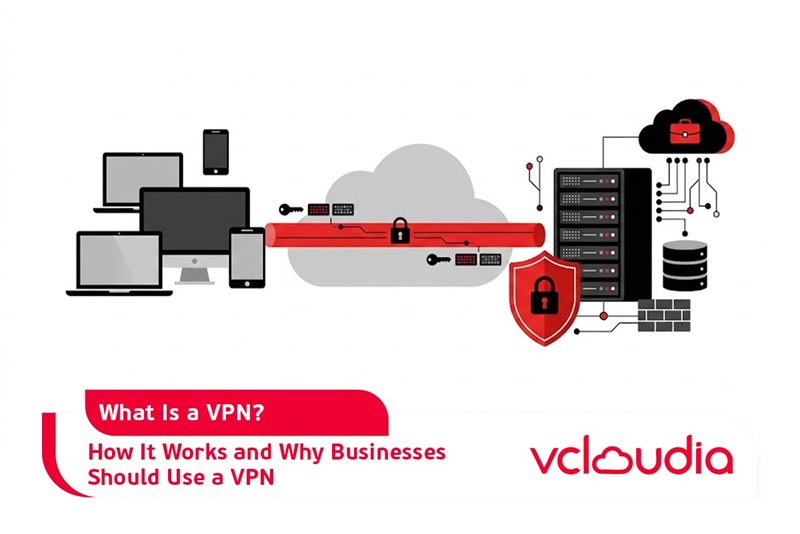
A VPN (Virtual Private Network) is a technology that establishes a secure and private network connection over public Internet infrastructure. Fundamentally, a VPN creates an encrypted tunnel between a user's device and a remote VPN server. All data transmitted through this tunnel is strictly protected, disguising the user's real IP address and encrypting the information, thereby preventing threats such as cyberattacks, eavesdropping, or data theft.
Instead of connecting directly to the destination, your Internet traffic is routed through a VPN server. This means that to third parties such as Internet Service Providers (ISPs), hackers, or surveillance entities, they will only see that you are connecting to the VPN server, without being able to track your online activities or your original IP address. This level of security and privacy is especially critical when accessing the Internet via unsecured public Wi-Fi networks or in remote work environments.
For example: An employee working from home can use a VPN to establish a secure connection to the company's internal network. Thanks to the VPN, they can access sensitive systems such as accounting software or CRM without worrying about the risk of hackers intercepting the transmission or stealing information, ensuring the data flow is protected end-to-end.
How a VPN Works
A VPN operates by creating an encrypted "tunnel" between the user's device (computer, smartphone, tablet, etc.) and a VPN server located in a data center or on a cloud platform. When data leaves the device, it is fully encrypted, rendering hackers, Internet Service Providers (ISPs), or any third parties incapable of reading or tampering with it.
The specific operational process of a VPN includes the following steps:
Establishing a connection between the user device and the VPN server
This encrypted data is then routed through the selected VPN server. VPN servers can be located in any geographic location around the world. When launching a VPN on a device (computer, phone, router, etc.), the user is connected to a VPN server (typically located within the enterprise internal system or at a service provider). Here, a dedicated communication channel-called a VPN tunnel-is established. This channel acts like a "private tunnel," preventing third parties from accessing the contents of the data being transmitted.
Hiding the real IP address: As data passes through the VPN server, your real IP address is replaced with the IP address of the VPN server. This ensures that the websites or services you visit only see the VPN server's IP address, granting anonymity and protecting your physical location.
Encrypting data before transmission
Before data leaves the user device, it is encrypted according to high-level security standards (e.g., AES 256-bit). This ensures that even if hackers or spyware intercept the transmission, they cannot read the content because the data has been completely transformed.
Transmitting data securely to the destination
The VPN server then sends data out to the Internet on behalf of the user. At this point, the user's real IP address is hidden and replaced by the VPN server's IP address-ensuring anonymity and protecting the actual location.
When response data returns from the Internet, this process is reversed: the VPN server receives it, encrypts it, and transmits it through the secure tunnel back to the user's device.
Simple simulation:
- Without a VPN: Device → Internet (IP easily exposed, data susceptible to theft)
- With a VPN: Device → Encrypted tunnel (VPN tunnel) → VPN server → Internet (data fully protected)
This process takes place continuously, creating a secure and private communication channel that protects data from surveillance, eavesdropping, or interception by third parties.
Why Should Businesses Use a VPN?
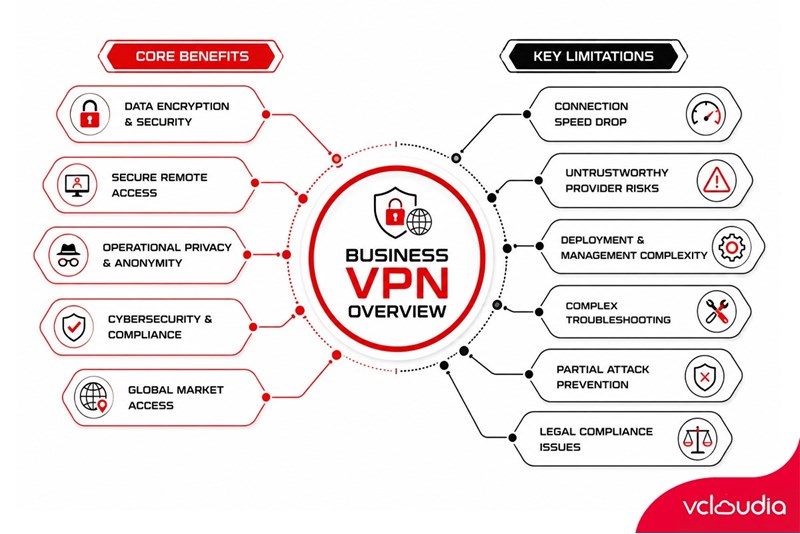
With such a secure operational mechanism, a VPN delivers numerous vital benefits, making it a crucial tool for every enterprise in the digital age:
1. Securing data and communication
When employees access internal systems from outside the enterprise (at home, cafes, hotels, etc.), transmitting data over public Internet poses numerous risks. A VPN encrypts the entire data stream, ensuring remote access remains protected as if within the local network. This prevents hackers or malicious actors from intercepting and eavesdropping on critical enterprise information, safeguarding digital assets from Man-in-the-Middle (MitM) attacks and data leaks. This solution is particularly vital in a hybrid workplace environment, where enterprises cannot control each employee's network infrastructure yet must still ensure data safety.
2. Secure remote access to internal resources
In the context of increasingly popular remote and flexible work models, a VPN enables employees to securely access company internal networks, servers, applications, and data from anywhere with an Internet connection. A well-designed VPN system can enforce role-based access control by location, department, or device. This helps enterprises govern who has permission to access which resources, from where, and within what timeframe-mitigating the risks of insider threats or unauthorized access. Furthermore, VPNs support Multi-Factor Authentication (MFA) integration, reinforcing user identity protection.
3. Ensuring privacy and anonymity for business operations
As online business operations become increasingly diverse, protecting privacy is critical. A VPN helps enterprises mask their real IP address, preventing tracking or behavioral data collection by Internet Service Providers, competitors, or advertising agencies. This is particularly useful when conducting market research, competitive web scraping/browsing, or performing other sensitive operations.
4. Strengthening overall cybersecurity and regulatory compliance
A VPN represents a vital defensive layer in an enterprise's comprehensive cybersecurity strategy. It reinforces firewalls and mitigates risks stemming from public network vulnerabilities. In addition, utilizing a VPN assists businesses in meeting data security and privacy requirements under industry compliance standards (e.g., HIPAA, GDPR, PCI DSS) or legal regulations concerning information protection.
5. Bypassing geographic restrictions and accessing international services
In certain instances, businesses need to access geo-restricted services or content. A VPN allows connections through servers located in other countries, thereby bypassing these barriers and securely expanding access to global markets and information.
With outstanding benefits in security, flexible access, and privacy protection, a VPN has become an indispensable tool, contributing to the stability and safety of business operations.
VPN Limitations Businesses Need to Know
Although VPNs offer substantial benefits regarding security and remote access capabilities, enterprises must also be clearly aware of potential limitations to manage and deploy this solution most effectively.
1. Impact on connection speed
The process of encrypting and routing data through a VPN server can reduce Internet speeds, impacting bandwidth-heavy tasks and overall work productivity.
2. Security risks from untrustworthy providers
Selecting non-transparent or free VPN providers carries the risk of data monitoring or security vulnerabilities, defeating the purpose of protecting enterprise information.
3. Complexity in deployment and management
For large organizations, configuring and maintaining a VPN infrastructure demands extensive technical expertise and substantial IT resources. Configuration errors can lead to outages or security vulnerabilities.
4. Troubleshooting difficulties
When connection issues occur, diagnosing and resolving faults within a VPN system can be complex and time-consuming because it involves multiple network layers and software components.
5. Inability to prevent all cyberattack vectors
A VPN encrypts the transmission line, but cannot prevent:
- Malware attacks originating from endpoint devices (if an employee's machine is already infected with a virus)
- Attacks from legitimate internal accounts with access privileges (insider threats)
- Risks arising from human error or operational data leakage
Therefore, a VPN should only be one component within a comprehensive security ecosystem, alongside defensive layers such as firewalls, IDS/IPS, antivirus, MFA, etc.
6. Legal compliance issues
Using a VPN to circumvent geographic restrictions or regulations in certain jurisdictions can incur legal risks, requiring enterprises to ensure compliance with all applicable laws.
Identifying and managing these limitations is critical. Businesses need to invest in high-quality VPN solutions from reputable providers, while establishing rigorous management procedures to maximize the benefits delivered by VPNs and mitigate risks. For these reasons, an increasing number of enterprises are transitioning to Cloud VPN-a modern, easy-to-deploy, high-performance VPN model that seamlessly integrates unified security.
Comparison Between Traditional VPN and Modern Cloud VPN
When selecting a secure connectivity solution, enterprises today typically face two main approaches: traditional VPN based on physical infrastructure, and Cloud VPN (or VPN-as-a-Service), which is emerging as a modern, more flexible alternative. Both utilize encrypted tunnels between user devices and internal systems. However, major differences lie in deployment methodologies, scalability, and operational flexibility. Understanding the distinction between these two models is essential for enterprises to make the right decision.
Traditional VPN
Traditional VPN typically involves deploying hardware appliances (such as firewalls with integrated VPN gateways, dedicated routers) or VPN software on on-premises physical servers. To establish a VPN connection, IT administrators must manually configure these appliances, creating encrypted tunnels to each branch office or individual remote employee device.
Advantages:
- Full control: The enterprise maintains complete authority over infrastructure and configurations.
- Suitable for isolated environments: Ideal for environments with strict compliance mandates requiring zero third-party dependency.
Disadvantages:
- High initial investment cost: Requires procurement of hardware appliances and software licenses.
- Complex deployment and management: Demands deep IT expertise and lengthy configuration cycles.
- Limited scalability: Difficult to scale quickly during surges in user volume, requiring physical hardware upgrades.
- Single point of failure: A failure in a centralized VPN gateway can disrupt all network connections.
- Performance impact: Dependent on on-premises hardware capacity and local Internet bandwidth.
Modern Cloud VPN
Cloud VPN is a VPN service delivered via cloud platforms, typically offered as VPN-as-a-Service (VPNaaS) or integrated into Security Service Edge (SSE) architectures. Instead of managing hardware in-house, enterprises utilize a VPN infrastructure managed and operated by the cloud service provider. Users connect to the cloud provider's Points of Presence (PoPs) globally.
Advantages:
- Fast and simple deployment: Eliminates the need for hardware procurement, allowing rapid provisioning via a web console.
- Elastic scalability: Easily scales up or down based on operational demand, unconstrained by on-premises hardware limits.
- Reduced upfront and operational costs: Shifts expenditure from CAPEX (capital expenditure) to OPEX (operating expense), reducing workload on IT teams.
- High availability and stability: Leverages distributed cloud infrastructure with built-in redundancy and load balancing.
- Optimized performance: PoPs situated close to end users minimize latency and optimize throughput.
- Seamless integration: Often bundles or easily integrates with other cloud security services (e.g., Zero Trust, CASB, SWG).
Disadvantages:
- Vendor dependency: The enterprise depends on third-party security policies and service quality.
- Reduced control: Lower degree of direct infrastructure control compared to self-managed setups.
- Costs can scale with usage: Subscription pricing models based on traffic throughput or user count.
Conclusion
With the expansion of remote and multi-site working models and the need for operational acceleration, Cloud VPN is increasingly becoming the preferred choice for enterprises requiring security, agility, and cost-efficiency. However, to maximize the advantages of Cloud VPN, selecting a reputable, highly secure infrastructure provider with responsive technical support is paramount.
Looking for a high-performance, secure solution?
Explore the services offered by Vcloudia – a leading provider of Cloud Computing and Data Center solutions. Contact us for expert consultation and find the right model for your needs:
- Hotline: +855 888 55 66 08 (free of charge)
- Fanpage: https://www.facebook.com/vcloudia/
- Website: https://vcloudia.com
Related news
What is a Hybrid Cloud Server? How Do Enterprises Benefit From Using a Hybrid Cloud Server?
The Hybrid Cloud Server model is an effective way to align IT priorities with business needs. Many enterprises can benefit from using a Hybrid Cloud Server instead of other options.
What is Cloud NAS? The Differences Compared to Traditional NAS and Cloud Storage
Are you looking for an efficient and flexible data storage solution for your enterprise? Cloud NAS might be the answer you are searching for. But what is Cloud NAS, and how does it differ from traditional NAS and Cloud Storage?
What is SQL? How to Download and Install SQL Server from A to Z
SQL Server is one of the many relational database management systems commonly used today. Developed by Microsoft, SQL Server offers a comprehensive range of versions tailored to meet all the development needs of you and your business.
What is Cloud Native? Cloud Native - The Modern Approach to Software Development
Cloud native leverages a variety of modern technologies and methodologies, including PaaS, multi-cloud, microservices, agile practices, containers, CI/CD, and more. The term "cloud native" is widely used, particularly by cloud service providers. Furthermore, it even has its own dedicated foundation - the Cloud Native Computing Foundation (CNCF), launched in 2015 by the Linux Foundation.
What Is Firebase Hosting? Concepts and How to Apply It to Your Website
If you are building and designing a website, understanding the concept of "What is Firebase Hosting?" is essential. This is one of the indispensable services for a website. In this article, let's explore with Vcloudia the definition of Firebase Hosting as well as how to apply it to your website!
What is Docker? A Comprehensive A-Z Guide to Installation and Usage
Docker is a topic that is generating considerable interest today. Originally an open-source platform, it is increasingly being widely adopted by businesses and organizations of all sizes.
What is WordPress Hosting? Key Factors for Choosing a Good WordPress Hosting
Almost every type of website, ranging from simple levels such as personal blogs, news sites, business introduction pages, e-commerce, to more complex levels such as hotel booking, car rental, and real estate pages, can be deployed on the WordPress platform. For a website to operate well, an indispensable component is hosting.
What is Cloud PC? Why do businesses need to use Cloud PC?
Today, the need for flexible working and data access anytime, anywhere is becoming increasingly popular. Among these, Cloud PC - cloud desktop emerges as an optimal solution helping businesses improve flexibility, work efficiency, reduce IT infrastructure investment costs, and enhance security.
What is a Container? Technical Characteristics of a Container
The issues arising regarding software dependency on the system environment when handing over products and applications are immense. So, what is the way to mitigate this risk? The answer is virtualization technology.