



.png)


















.png)





What is a Hybrid Cloud Server? How Do Enterprises Benefit From Using a Hybrid Cloud Server?
Sep 15, 2026The Hybrid Cloud Server model is an effective way to align IT priorities with business needs. Many enterprises can benefit from using a Hybrid Cloud Server instead of other options. In this article, let's take some time with Vcloudia to learn more about Hybrid Cloud Servers and the benefits of using them.
What is a Hybrid Cloud Server?
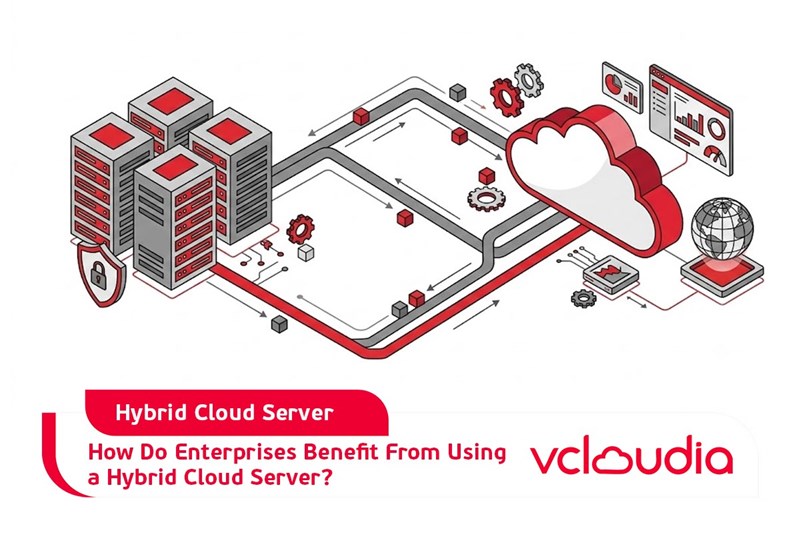
A Hybrid Cloud Server is a hybrid virtual server solution combining a Private Cloud with one or more Public Cloud services, accompanied by proprietary software that allows communication between each distinct service. The Hybrid Cloud Server solution provides enterprises with greater flexibility. It allows for the easy customization and adjustment of workloads between cloud solutions as needs arise and costs fluctuate.
Hybrid Cloud Server services are powerful because they allow enterprises to better control their private data. For example, an organization can store their critical data on a dedicated Private Cloud or their own internal data center. But in addition, they can still simultaneously leverage the advantages of Public Cloud services.
Hybrid Cloud Server Architecture
The unified management of Public and Private Cloud resources is preferred over managing each cloud environment individually because doing so optimizes processes further. When environments are managed separately, it increases the risk of security vulnerabilities if each solution is not fully optimized to operate with the other solutions. The architecture of a Hybrid Cloud Server will help eliminate many security risks by limiting the exposure of private data to the Public Cloud.
Hybrid Cloud Server model
The infrastructure for a Hybrid Cloud Server typically includes public infrastructure as a service (IaaS) platforms, a Private Cloud or data center, and access to a secure network. Many hybrid models leverage local area networks (LAN) as well as wide area networks (WAN).
Enterprises adopting Hybrid Cloud Server solutions often start with an IaaS solution and expand functionalities to a Private Cloud. To deploy a Hybrid Cloud Server solution effectively, the Public and Private Clouds must be compatible with each other so they can communicate. In many cases, the private cloud must be built to be compatible with the public solution.
Benefits of a Hybrid Cloud Server solution
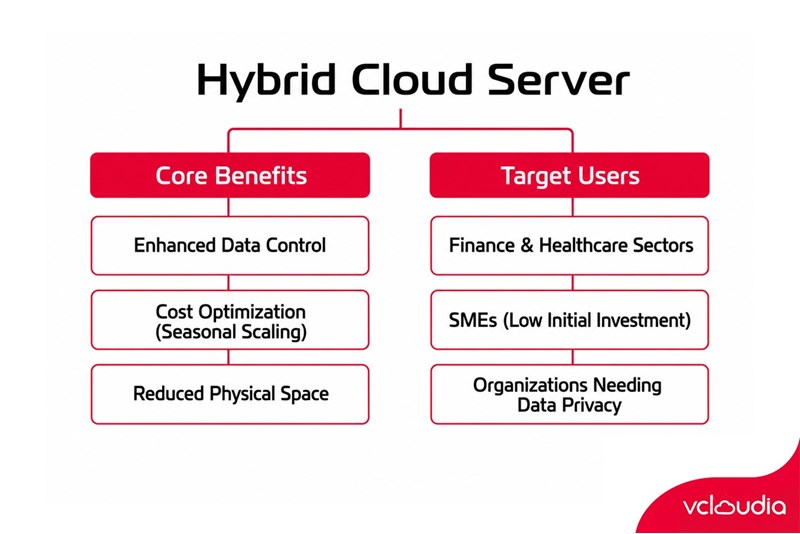
The benefits of a Hybrid Cloud Server solution stem from its ability to help IT leaders enhance control over their data. Essentially, this model provides enterprises with multiple choices so that stakeholders can select an environment best suited for each individual use case.
Most enterprises do not always utilize the exact same amount of resources. In fact, this often only has a seasonal nature. Therefore, instead of continuing to pay for additional resources that are not always used, we can save costs by scaling private resources out to a public cloud only when truly necessary.
The Hybrid Cloud Server model requires much less physical storage space than a Private Cloud model. Enterprises can deploy a private on-premises network to handle internal needs. Then automatically scale out to the private cloud when computing resources exceed the available capacity of the local system. This model can benefit small and medium-sized enterprises when they do not yet have excessive investment costs for a massive dedicated data center.
Who uses Hybrid Cloud Servers?
Enterprises across many industries have turned to Hybrid Cloud Server solutions to reduce their own operating costs. From the financial sector to the healthcare sector, Hybrid Cloud Server environments have proven effective not only in improving computing and storage capabilities but also in optimizing scarce resources regarding physical storage space. Many organizations simply do not have enough room or meet the operating conditions to deploy servers directly at their company.
In some sensitive sectors such as healthcare, data privacy is paramount. The Hybrid Cloud Server model is an ideal solution because it allows medical teams to keep patient data in a secure, private server. At the same time, it leverages the enhanced computing power of the public IaaS model. Simply put, any industry that benefits from public cloud applications can also benefit from the Hybrid Cloud Server model.
Conclusion
Hybrid Cloud Servers are viewed as a lifesaver for many small and medium-sized enterprises today. It helps them both save costs and maximize the resource utilization of the system.
Looking for a high-performance, secure solution?
Explore the services offered by Vcloudia – a leading provider of Cloud Computing and Data Center solutions. Contact us for expert consultation and find the right model for your needs:
- Hotline: +855 888 55 66 08 (free of charge)
- Fanpage: https://www.facebook.com/vcloudia/
- Website: https://vcloudia.com
Related news
What is Cloud NAS? The Differences Compared to Traditional NAS and Cloud Storage
Are you looking for an efficient and flexible data storage solution for your enterprise? Cloud NAS might be the answer you are searching for. But what is Cloud NAS, and how does it differ from traditional NAS and Cloud Storage?
What is SQL? How to Download and Install SQL Server from A to Z
SQL Server is one of the many relational database management systems commonly used today. Developed by Microsoft, SQL Server offers a comprehensive range of versions tailored to meet all the development needs of you and your business.
What Is a VPN? How It Works and Why Businesses Should Use a VPN
As businesses today place increasingly greater emphasis on data security and information safety when accessing the Internet, the concept of a VPN is no longer unfamiliar. But what is a VPN, how does it work, and why has it become an indispensable part of a modern enterprise security strategy?
What is Cloud Native? Cloud Native - The Modern Approach to Software Development
Cloud native leverages a variety of modern technologies and methodologies, including PaaS, multi-cloud, microservices, agile practices, containers, CI/CD, and more. The term "cloud native" is widely used, particularly by cloud service providers. Furthermore, it even has its own dedicated foundation - the Cloud Native Computing Foundation (CNCF), launched in 2015 by the Linux Foundation.
What Is Firebase Hosting? Concepts and How to Apply It to Your Website
If you are building and designing a website, understanding the concept of "What is Firebase Hosting?" is essential. This is one of the indispensable services for a website. In this article, let's explore with Vcloudia the definition of Firebase Hosting as well as how to apply it to your website!
What is Docker? A Comprehensive A-Z Guide to Installation and Usage
Docker is a topic that is generating considerable interest today. Originally an open-source platform, it is increasingly being widely adopted by businesses and organizations of all sizes.
What is WordPress Hosting? Key Factors for Choosing a Good WordPress Hosting
Almost every type of website, ranging from simple levels such as personal blogs, news sites, business introduction pages, e-commerce, to more complex levels such as hotel booking, car rental, and real estate pages, can be deployed on the WordPress platform. For a website to operate well, an indispensable component is hosting.
What is Cloud PC? Why do businesses need to use Cloud PC?
Today, the need for flexible working and data access anytime, anywhere is becoming increasingly popular. Among these, Cloud PC - cloud desktop emerges as an optimal solution helping businesses improve flexibility, work efficiency, reduce IT infrastructure investment costs, and enhance security.
What is a Container? Technical Characteristics of a Container
The issues arising regarding software dependency on the system environment when handing over products and applications are immense. So, what is the way to mitigate this risk? The answer is virtualization technology.