



.png)



















.png)





What Is Firebase Hosting? Concepts and How to Apply It to Your Website
Sep 15, 2026If you are building and designing a website, understanding the concept of "What is Firebase Hosting?" is essential. This is one of the indispensable services for a website. In this article, let's explore with Vcloudia the definition of Firebase Hosting as well as how to apply it to your website!
What Is Firebase Hosting?
Firebase Hosting is a fast, secure, and reliable managed hosting service from Google, sharing characteristics quite similar to cloud-based database storage services. This service is specifically designed to deploy static web applications, dynamic content, or microservices with high performance.
Simply put, Firebase Hosting is a platform applied to the development of websites and applications without the need for servers or backends. So, what are the benefits of Firebase Hosting?
Benefits of Firebase Hosting
Developers can easily interact with databases during the process of setting up a website's structure. It can be said that this service helps you save a considerable amount of time and effort.
When using Firebase Hosting, you no longer need to worry about feature integration as before. Built-in API properties will help you resolve this issue. You only need to focus on designing the user interface on the website to suit your users.
In short, as the name implies, Firebase Hosting is a premium hosting service provided by the "tech giant Google." To date, although Firebase Hosting is not yet truly widespread in Vietnam, it has gradually proven its quality and popularity among users in the international market.
How to Apply Firebase Hosting to a Website
As mentioned above, Firebase Hosting brings numerous benefits to users and developers when integrated into a website. And naturally, to use Firebase Hosting, you must register for it and implement it into your web system.
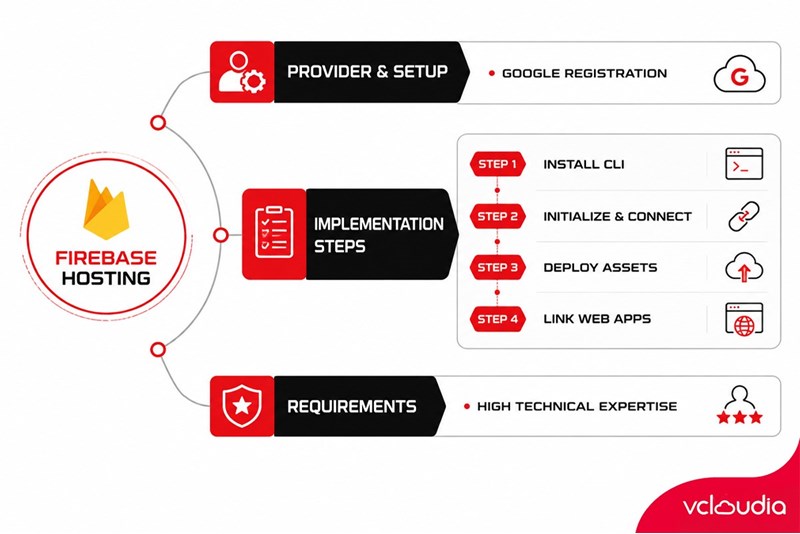
Currently, Firebase Hosting is provided and distributed by Google. If you need to use Firebase Hosting, you can contact Google and proceed with the operations and steps required by Google as the provider. After completing the registration process, you can follow these 4 steps to apply Firebase Hosting to your website:
- Step 1: Install Firebase Hosting CLI (You should choose the latest version)
- Step 2: Initialize your own project, then build the features you need along with the Front-End interface. After that, connect to Firebase Hosting using available commands in the root directory (located within the local project). At this point, make sure to specify the links to your root storage directories, including data information and code!
- Step 3: You have configured everything necessary in Step 2. Now, you simply need to upload the new assets to Google's Cloud Server (using Firebase Deploy).
- Step 4: Almost done! And now for the final step. Link to the Firebase Web apps that possess the basic properties you need, and deploy them directly on your website!
Although Firebase Hosting provides exceptional support for developers, it is a service that requires high expertise. You need a fairly high level of technical proficiency to apply Firebase Hosting to your website.
If you are a beginner exploring this field, you will need a veteran mentor with high expertise to support you. Otherwise, you can opt for simpler services with continuous and prompt support from the service provider. This would be a simpler and much lower-risk approach.
Conclusion
In the article above, we have shared complete information regarding the concept of Firebase Hosting, as well as how to apply it to a website. We hope that through this article, you have gained the most comprehensive overview of Firebase Hosting and how to use it.
Looking for a high-performance, secure solution?
Explore the services offered by Vcloudia – a leading provider of Cloud Computing and Data Center solutions. Contact us for expert consultation and find the right model for your needs:
- Hotline: +855 888 55 66 08 (free of charge)
- Fanpage: https://www.facebook.com/vcloudia/
- Website: https://vcloudia.com
Related news
What is a Hybrid Cloud Server? How Do Enterprises Benefit From Using a Hybrid Cloud Server?
The Hybrid Cloud Server model is an effective way to align IT priorities with business needs. Many enterprises can benefit from using a Hybrid Cloud Server instead of other options.
What is Cloud NAS? The Differences Compared to Traditional NAS and Cloud Storage
Are you looking for an efficient and flexible data storage solution for your enterprise? Cloud NAS might be the answer you are searching for. But what is Cloud NAS, and how does it differ from traditional NAS and Cloud Storage?
What is SQL? How to Download and Install SQL Server from A to Z
SQL Server is one of the many relational database management systems commonly used today. Developed by Microsoft, SQL Server offers a comprehensive range of versions tailored to meet all the development needs of you and your business.
What Is a VPN? How It Works and Why Businesses Should Use a VPN
As businesses today place increasingly greater emphasis on data security and information safety when accessing the Internet, the concept of a VPN is no longer unfamiliar. But what is a VPN, how does it work, and why has it become an indispensable part of a modern enterprise security strategy?
What is Cloud Native? Cloud Native - The Modern Approach to Software Development
Cloud native leverages a variety of modern technologies and methodologies, including PaaS, multi-cloud, microservices, agile practices, containers, CI/CD, and more. The term "cloud native" is widely used, particularly by cloud service providers. Furthermore, it even has its own dedicated foundation - the Cloud Native Computing Foundation (CNCF), launched in 2015 by the Linux Foundation.
What is Docker? A Comprehensive A-Z Guide to Installation and Usage
Docker is a topic that is generating considerable interest today. Originally an open-source platform, it is increasingly being widely adopted by businesses and organizations of all sizes.
What is WordPress Hosting? Key Factors for Choosing a Good WordPress Hosting
Almost every type of website, ranging from simple levels such as personal blogs, news sites, business introduction pages, e-commerce, to more complex levels such as hotel booking, car rental, and real estate pages, can be deployed on the WordPress platform. For a website to operate well, an indispensable component is hosting.
What is Cloud PC? Why do businesses need to use Cloud PC?
Today, the need for flexible working and data access anytime, anywhere is becoming increasingly popular. Among these, Cloud PC - cloud desktop emerges as an optimal solution helping businesses improve flexibility, work efficiency, reduce IT infrastructure investment costs, and enhance security.
What is a Container? Technical Characteristics of a Container
The issues arising regarding software dependency on the system environment when handing over products and applications are immense. So, what is the way to mitigate this risk? The answer is virtualization technology.