



.png)

















.png)





What is Cloud PC? Why do businesses need to use Cloud PC?
Sep 15, 2026Today, the need for flexible working and data access anytime, anywhere is becoming increasingly popular. Among these, Cloud PC - cloud desktop emerges as an optimal solution helping businesses improve flexibility, work efficiency, reduce IT infrastructure investment costs, and enhance security. So what is Cloud PC? Why do businesses need to use Cloud PC and which business models is this solution suitable for? Let's explore the details with Vcloudia in the article below.
What is Cloud PC?
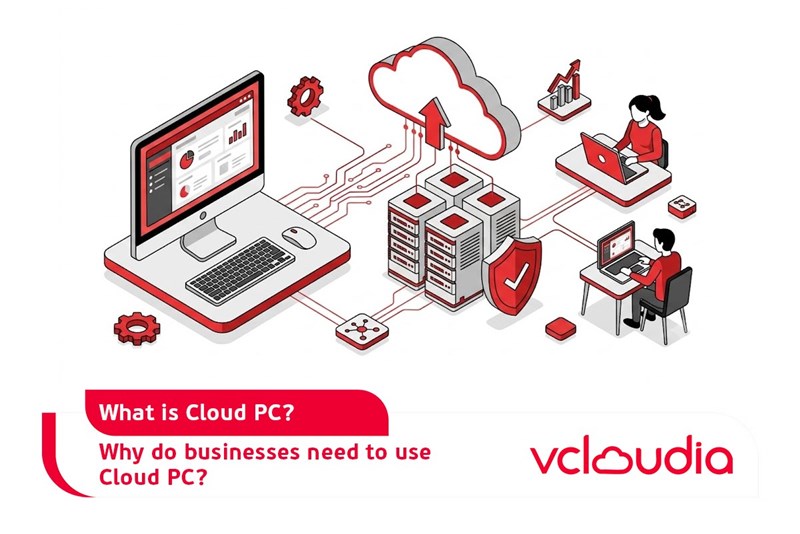
Cloud PC (also known as Cloud Desktop) is a virtualized computer model stored and operated on a cloud platform, instead of being deployed on an internal data center or running on a physical device such as a laptop or workstation. As a result, Cloud PC can be set up in just a few minutes, enhancing security for data and applications without the need to invest in hardware. In particular, Cloud PC allows users to access a remote computing environment via the internet with superior performance compared to traditional physical computers.
Why do businesses need to use Cloud PC?
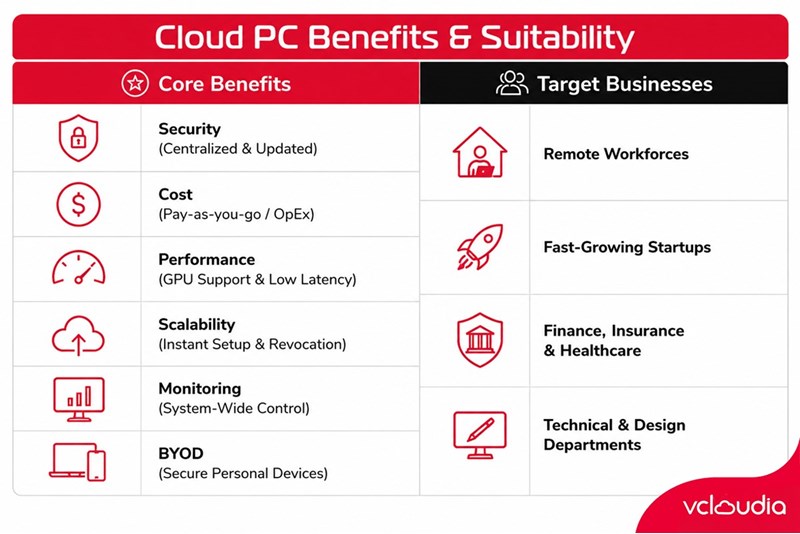
Cloud PC not only helps businesses optimize costs but also brings many important benefits in terms of security, performance, and operational flexibility, specifically:
Enhanced security
Managing and updating systems across hundreds, or even thousands, of physical computers in an organization is a major challenge for the IT team. If a device is not updated in a timely manner, it can become a security vulnerability, creating conditions for cyberattacks. With Cloud PC, all critical data is securely stored on the cloud with an operating system that is always up to date, thereby minimizing the risk of attacks.
Flexible cost model
Cloud PC helps businesses shift from initial investment costs to operational costs, optimizing budgets with flexible payment models such as pay-as-you-go. Here, businesses can choose a fixed monthly price or pay by the hour depending on actual needs. This helps optimize resources and avoid waste like when using physical computers.
High performance
Cloud PC helps solve the latency problem commonly encountered in traditional virtualization solutions like VDI. By leveraging advanced cloud infrastructure, Cloud PC is always updated with the latest technology, never becomes obsolete, and can be upgraded instantly when necessary.
In particular, industries such as architecture, construction, oil and gas, automotive manufacturing, and media often use intensive graphics software to work with 3D models, analyze geological structures, or design products. When working remotely, sharing and synchronizing massive data between offices is a hurdle. In this regard, Cloud PC with powerful GPUs allows processing these tasks right on the cloud, helping design teams work smoothly no matter where they are.
Outstanding flexibility and scalability
Cloud PC brings unprecedented flexibility to businesses. In just a few minutes, businesses can set up or revoke virtual computers anywhere in the world to meet operational needs, scale up or down business operations without facing any barriers. Meanwhile, for some industries that tend to change their computing resource needs according to stages such as retail, education, etc., investing in physical computers to meet peak demand is not optimal.
Comprehensive monitoring and control
Cloud PC provides the ability to observe and analyze operational performance across the entire system - from corporate offices, home offices, hotels to customer locations. As a result, businesses can easily detect connection issues, identify problems affecting a small group of users or an entire cloud region, and proactively handle threats like ransomware attacks as soon as abnormal signs are detected.
Support for the BYOD (Bring Your Own Device) model
Today, the majority of employees use personal devices such as laptops, tablets, and mobile phones for work. The BYOD model helps businesses increase labor productivity but also poses a difficult problem regarding security. With Cloud PC, employees can comfortably use personal devices while still ensuring company data is protected.
With these benefits, Cloud PC is gradually replacing physical computer systems and traditional VDI solutions, helping businesses operate more efficiently, securely, and flexibly in the digital era.
Which businesses is Cloud PC suitable for?
Businesses with remote workforces
With flexible access from any device, Cloud PC helps employees work efficiently without being limited by geographical location. In this setup, business data is also stored on the Cloud instead of personal computers, minimizing the risk of information leakage. As a result, the IT department can easily manage the system remotely, ensuring security and stable performance.
Businesses needing flexible scalability
Startups and fast-growing companies often face difficulties in expanding their IT systems. With Cloud PC, businesses can quickly increase or decrease the number of machines without investing in hardware. At the same time, the flexible payment model of this solution also helps optimize costs, suitable for organizations with constantly fluctuating needs.
Finance, insurance, and healthcare industries
These businesses often require high security standards and strict access control. Here, Cloud PC supports multi-factor authentication (MFA), identity management, and does not store data on personal devices, helping to minimize the risk of information leakage. As a result, compliance with regulations such as PCI-DSS, HIPAA, or GDPR by businesses also becomes easier.
Businesses with technical and design departments
With powerful configurations, Cloud PC can meet the needs of graphics processing, video rendering, or AI/ML programming. Therefore, engineers and designers can access workstations remotely while still ensuring performance like on physical machines, helping to work more flexibly without investing a lot of costs.
Conclusion
Cloud PC is an inevitable trend in the context that businesses need to optimize costs, enhance security, and work more flexibly. With the ability to access anytime, anywhere, reduce hardware costs, and improve data security, Cloud PC brings an optimal solution for businesses of all sizes.
Looking for a high-performance, secure solution?
Explore the services offered by Vcloudia – a leading provider of Cloud Computing and Data Center solutions. Contact us for expert consultation and find the right model for your needs:
- Hotline: +855 888 55 66 08 (free of charge)
- Fanpage: https://www.facebook.com/vcloudia/
- Website: https://vcloudia.com
Related news
What is a Hybrid Cloud Server? How Do Enterprises Benefit From Using a Hybrid Cloud Server?
The Hybrid Cloud Server model is an effective way to align IT priorities with business needs. Many enterprises can benefit from using a Hybrid Cloud Server instead of other options.
What is Cloud NAS? The Differences Compared to Traditional NAS and Cloud Storage
Are you looking for an efficient and flexible data storage solution for your enterprise? Cloud NAS might be the answer you are searching for. But what is Cloud NAS, and how does it differ from traditional NAS and Cloud Storage?
What is SQL? How to Download and Install SQL Server from A to Z
SQL Server is one of the many relational database management systems commonly used today. Developed by Microsoft, SQL Server offers a comprehensive range of versions tailored to meet all the development needs of you and your business.
What Is a VPN? How It Works and Why Businesses Should Use a VPN
As businesses today place increasingly greater emphasis on data security and information safety when accessing the Internet, the concept of a VPN is no longer unfamiliar. But what is a VPN, how does it work, and why has it become an indispensable part of a modern enterprise security strategy?
What is Cloud Native? Cloud Native - The Modern Approach to Software Development
Cloud native leverages a variety of modern technologies and methodologies, including PaaS, multi-cloud, microservices, agile practices, containers, CI/CD, and more. The term "cloud native" is widely used, particularly by cloud service providers. Furthermore, it even has its own dedicated foundation - the Cloud Native Computing Foundation (CNCF), launched in 2015 by the Linux Foundation.
What Is Firebase Hosting? Concepts and How to Apply It to Your Website
If you are building and designing a website, understanding the concept of "What is Firebase Hosting?" is essential. This is one of the indispensable services for a website. In this article, let's explore with Vcloudia the definition of Firebase Hosting as well as how to apply it to your website!
What is Docker? A Comprehensive A-Z Guide to Installation and Usage
Docker is a topic that is generating considerable interest today. Originally an open-source platform, it is increasingly being widely adopted by businesses and organizations of all sizes.
What is WordPress Hosting? Key Factors for Choosing a Good WordPress Hosting
Almost every type of website, ranging from simple levels such as personal blogs, news sites, business introduction pages, e-commerce, to more complex levels such as hotel booking, car rental, and real estate pages, can be deployed on the WordPress platform. For a website to operate well, an indispensable component is hosting.
What is a Container? Technical Characteristics of a Container
The issues arising regarding software dependency on the system environment when handing over products and applications are immense. So, what is the way to mitigate this risk? The answer is virtualization technology.