


















What is Cloud NAS? The Differences Compared to Traditional NAS and Cloud Storage
Sep 15, 2026Are you looking for an efficient and flexible data storage solution for your enterprise? Cloud NAS might be the answer you are searching for. But what is Cloud NAS, and how does it differ from traditional NAS and Cloud Storage? Let's explore this in detail with Vcloudia in this article.
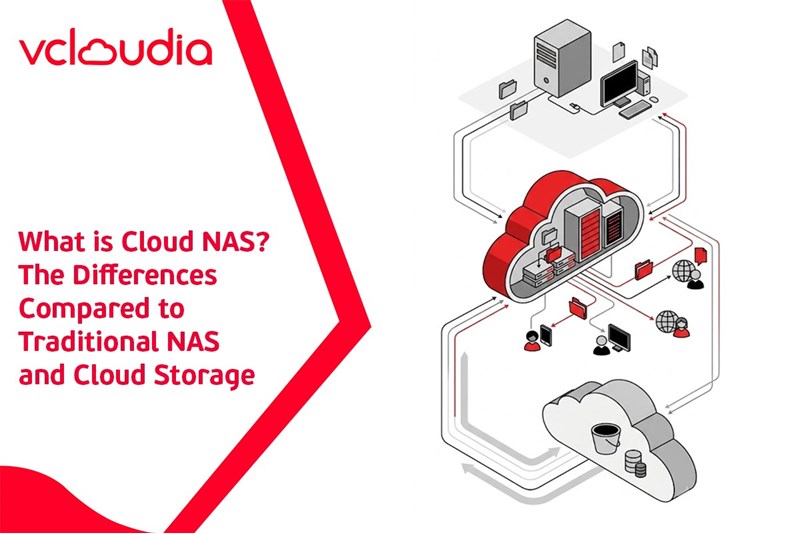
What is Cloud NAS?
Cloud NAS stands for Network Attached Storage on Cloud. This is a data storage service integrated by two technologies: Cloud and NAS (Network Attached Storage).
First, it is necessary to clearly understand what Cloud and NAS are. Cloud, also known as cloud computing, is a computing model that uses computer technologies and develops based on the Internet. Instead of storing data and running applications on personal computers or private servers, you will use these services from remote servers on the Internet.
NAS, also known as network-attached storage, is a device dedicated to storing and sharing files, allowing various devices to simultaneously access, download, and use data anytime, anywhere via the internet or an internal network. NAS provides the ability to store data on a cloud platform with characteristics and features similar to traditional NAS, but accompanied by numerous benefits regarding accessibility, scalability, and data management.
Cloud NAS is a modern data storage solution combining cloud technology and network storage systems (NAS). It offers the ability to store data on a cloud platform with characteristics and features identical to traditional NAS, but comes with many benefits regarding accessibility, scalability, and data management. Consequently, this technology helps enterprises save on infrastructure investment costs.
Cloud NAS features
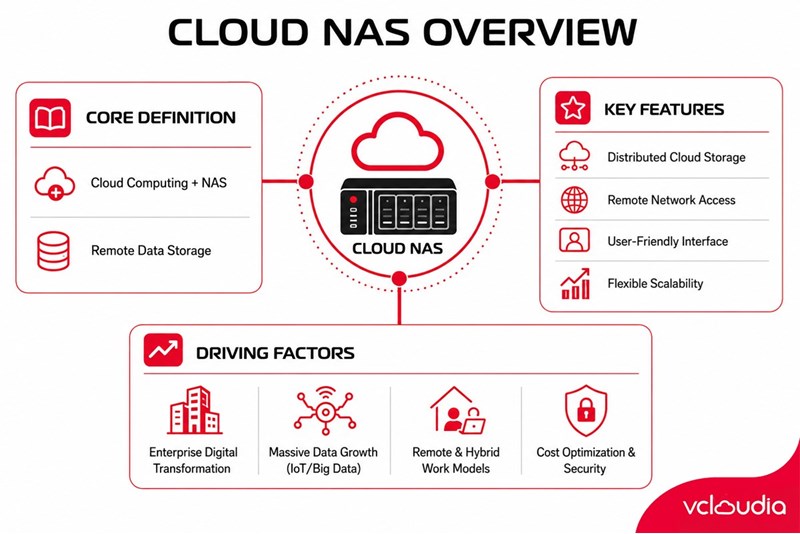
Cloud NAS is a smart combination of traditional network storage technology (NAS) and cloud computing, delivering a more modern and flexible data storage solution.
1. Storage on the cloud
Instead of storing data on a physical device located at the company or home, Cloud NAS leverages the power of massive data centers in the cloud. Data is distributed and backed up across multiple different servers, helping to ensure high security and disaster recovery capabilities.
2. Remote access via network
With Cloud NAS, users can access their data from anywhere as long as they have an Internet connection and a network-connected device such as a computer, mobile phone, or tablet. No longer restricted by geographical location, organizations can work with their data anytime, anywhere.
3. User-friendly management interface
Cloud NAS typically provides an intuitive and easy-to-use management interface, similar to the interfaces of traditional NAS devices. Units, organizations, or enterprises can easily create shared folders, set access permissions, back up data, and manage users.
4. Flexible scalability
The storage capacity of Cloud NAS can be increased or decreased easily and quickly, depending on usage demands. Enterprises also do not need to worry about purchasing additional physical storage devices or upgrading hardware.
The Growing Demand for Cloud Usage Drives the Development of Cloud NAS
The integration of technological trends, especially the data explosion and the widespread adoption of cloud computing, has strongly propelled the development of Cloud NAS. The growing demand for data storage, combined with the limitations of traditional solutions, has created a highly potential market for cloud storage solutions like Cloud NAS.
The scalability and cost savings, along with the flexibility of Cloud NAS, have met the needs of enterprises and individual users in the digital era. Economic, technological, and social factors are increasingly accelerating the transition from traditional storage solutions to advanced cloud solutions.
Factors driving the demand for cloud and Cloud NAS usage
1. Digital transformation in enterprises
Enterprises are increasingly prioritizing the transition from traditional on-premises IT systems to cloud-based solutions to optimize performance and minimize operational costs. In this process, Cloud NAS emerges as a core solution, not only simplifying data storage and management but also facilitating flexibility and rapid adaptation to innovation requirements, helping enterprises catch up with the digital transformation trend effectively and sustainably.
2. Massive data growth
The explosion of data from IoT, social networks, video streaming, and big data analytics applications makes it impossible for traditional storage solutions to keep pace. Cloud NAS provides flexible scalability and unlimited capacity, addressing the rapidly increasing storage demand.
3. Remote and hybrid work trends
The prevalence of remote and hybrid work models post-COVID-19 pandemic has posed an urgent requirement for flexible data storage solutions that allow secure access anytime, anywhere. Cloud NAS becomes a strategic choice, delivering seamless data access for users, regardless of whether they work at the office, at home, or on the move, while simultaneously eliminating the dependence on physical infrastructure and traditional internal networks.
4. Application of AI and Big Data technologies
Enterprises need to store large volumes of unstructured data such as images, videos, and logs for analysis by AI and Big Data. Cloud NAS not only assumes the storage role but also deeply integrates with advanced cloud platforms and tools, unlocking the capability to process data efficiently and intelligently.
5. The rise of SaaS and cloud applications
SaaS (Software as a Service) applications such as Google Workspace and Microsoft 365 are becoming increasingly popular, requiring compatible cloud storage platforms. Cloud NAS is designed to integrate smoothly and scale flexibly with SaaS platforms, optimizing performance and operational capabilities within the digital ecosystem.
6. Cost & convenience
Cloud NAS offers a flexible storage solution, helping enterprises completely eliminate the hardware management burden and optimize operational costs thanks to the ability to automate maintenance processes. Consequently, enterprises can focus resources on core activities, promoting sustainable growth.
In addition, with many leading security features, organizations can rest assured in protecting critical data while meeting increasingly stringent security compliance requirements. Unlimited scalability and automation features help enterprises adapt rapidly to market changes.
The impact of Cloud NAS development
- Unlimited scalability: Cloud NAS allows enterprises and individuals to expand storage capacity without replacing hardware or disrupting services.
- Improved and enhanced work performance: Fast access, anytime and anywhere, helps increase team productivity, especially for organizations with multiple facilities and branches.
- Cost optimization: With a pay-as-you-go model, Cloud NAS helps enterprises save budgets and reduce wasteful spending.
- Driving technological innovation: Cloud NAS providers continuously improve technology to compete, bringing outstanding features such as advanced security, artificial intelligence integration, and data analytics.
- Better data protection: Thanks to high security standards and automated backup capabilities, Cloud NAS protects data from risks such as hardware failures, theft, or cyberattacks.
Comparison of Traditional NAS, Cloud NAS, and Cloud Storage
When choosing a data storage solution, enterprises and individuals often consider traditional NAS, Cloud NAS, and Cloud Storage. Each application has its own advantages and limitations.
Traditional NAS: The advantages are high security, good performance with internal data, and low maintenance costs. Nevertheless, this application is limited in terms of scalability and remote access, and it requires technical knowledge to manage.
Cloud NAS: Combines the advantages of both traditional NAS and Cloud Storage, allowing access anytime, anywhere, flexible scalability, and high security. However, costs can be higher compared to traditional NAS, especially when utilizing large capacities.
Cloud Storage: Provides a flexible and efficient solution for data management, with reasonable costs and high integration capabilities. However, to ensure optimal performance and information safety, users need to thoroughly evaluate network bandwidth and the provider's security policies.
However, to make an appropriate decision, enterprises, organizations, or individuals need to consider their usage demands, business scale, and appropriate budget.
Which Enterprises is Cloud NAS Suitable For?
Cloud NAS is a storage solution combining the convenience of the cloud and the centralized management capabilities of traditional NAS. Thus, Cloud NAS is suitable for enterprises that:
- Demand to scale up storage rapidly: Here, Cloud NAS provides the ability to increase capacity flexibly, meeting the development needs of the enterprise.
- Need to access data from anywhere, anytime: With Cloud NAS, employees can access data from any device with an internet connection, enhancing work efficiency.
- Place heavy emphasis on data security: Cloud NAS typically comes with premium security features such as data encryption, automated backups, and strict access controls.
- Want to minimize initial investment costs: Instead of having to make a large investment in physical storage systems, Cloud NAS allows enterprises to pay on a subscription basis.
On the other hand, some enterprises are not yet suited for Cloud NAS when:
- Extremely high performance requirements: If the enterprise needs to process a massive volume of data at blazing-fast speeds, traditional NAS might be a more suitable choice.
- Limitations in internet connectivity: Internet connection quality directly impacts the performance of Cloud NAS. If the network connection is unstable, Cloud NAS might not meet usage demands.
- Strict regulations regarding on-premises data storage: Some data security regulations require data to be stored at a specific location; Cloud NAS might not fulfill this requirement.
If your enterprise is not yet suitable for Cloud NAS but still heavily needs a simple, easy-to-use, and low-cost solution to store and share data - Cloud Storage is an option worth considering. Cloud Storage provides online storage space, allowing you to access and share data from any internet-connected device.
Related news
What is SD-WAN? Technology and Practical Applications
SD-WAN addresses the increasing enterprise demands driven by IoT, SaaS, and Cloud alongside escalating cybersecurity needs, where applications demand prioritization and optimization while enterprises require reductions in deployment costs, operational labor, and time.
Software Solutions for Creating Online Virtual Machines You Should Know
Are you looking for software to create online virtual machines, both free and paid? Don't worry, this article is for you. Vcloudia will introduce you to several useful solutions to help you set up an online virtual machine as desired.
What is a free domain name? Should you use one?
A free domain name is a service provided by domain registrars that allows users to register and use a domain without incurring any costs. For an individual or a business, a website domain name is an extremely crucial factor. So, how can you register a free domain? Should you use a domain name that incurs no cost?
Comparing DigitalOcean, Linode, and Vultr VPS: Which Is the Right Choice for Your Business?
A Virtual Private Server means your website will have all the necessary power to handle your growing traffic. Likewise, if you are a developer, this added flexibility might be all you need to take your application ahead of the competition. However, to be the best, you need to work with the best.
What is ASP.NET? How to Analyze the Core Operational Architecture of the ASP.NET Platform
What is ASP.NET? It is an open-source platform chosen by software developers worldwide. The program offers superior utilities along with a distinctive approach to language utilization.
How to choose a server configuration for a business?
Choosing the right cloud configuration for your enterprise is a pivotal factor that helps optimize budgets, enhance operational performance, and ensure the system remains resilient against any changes. If the configuration is oversized, you waste valuable resources; if it is undersized, the system easily overloads, disrupting services.
Demystifying Cloud Security - The Cloud Security Trend Trusted by Enterprises
Cloud security, also known as cloud computing security, protects cloud-based systems, data, and infrastructure. Cloud security services provide cloud security solutions configured to protect data, support regulatory compliance, safeguard customer privacy, and set authentication rules for individual users and devices.
6 Benefits of Creating Virtual Machines That Users Cannot Ignore
Are you interested in creating virtual machines and want to learn more about their role? Creating a virtual machine is highly suitable for individuals or businesses involved in programming or information technology in general due to its usefulness. Creating a virtual machine helps enhance security, facilitates testing, and limits the spread of viruses.
What is a Web Portal? A comprehensive guide to essential knowledge about Web Portals
In practice, a Web Portal is a specially designed website that serves as a single point of access for updating information. However, many users are still vague about what a Web Portal is. So, what exactly is a Web Portal?
What is VXLAN? Everything about VXLAN that users should not ignore
Today, the emergence of VXLAN technology has brought many benefits to users compared to traditional VLAN technology. So what exactly is VXLAN? What makes this technology worth users' attention?