



.png)


















.png)





What is Docker? A Comprehensive A-Z Guide to Installation and Usage
Sep 15, 2026Docker is a topic that is generating considerable interest today. Originally an open-source platform, it is increasingly being widely adopted by businesses and organizations of all sizes. If you are also interested in this topic, let's explore the information in the following article to help you better understand the Docker platform as well as what Docker is used for.
What is Docker?
Docker is an open-source platform that helps package, deploy, and operate applications easily and efficiently. Docker utilizes container technology to isolate applications and their environments, making application deployment flexible and consistent across any environment. So, what are the benefits of using Docker? In general, Docker practically delivers many outstanding benefits, such as:
- Simplify application development and deployment: Docker allows you to package applications and their environments into a single container, making application deployment fast and easy.
- Enhance operational efficiency: Docker enables you to utilize system resources more efficiently by isolating applications from one another.
- Minimize operating costs: Docker helps reduce operating expenses by simplifying application management.
- Accelerate application development: Docker boosts your application development speed by allowing you to rapidly test and deploy applications.
How Docker Works
Docker uses images to package applications and their environments. An image is a read-only file that contains all the necessary components to run an application. When you create a container from an image, Docker establishes an isolated environment for the application to execute.
After understanding what Docker is and how it works, many users wonder what the core components of Docker are. The primary components of Docker generally include:
- Image: A read-only file containing all the components needed to run an application.
- Container: An isolated environment created from an image.
- Docker Engine: The software running on the server to create, manage, and run containers.
- Docker Registry: A repository for storing public Docker images.
What is Docker Used For?
The popular applications of Docker include:
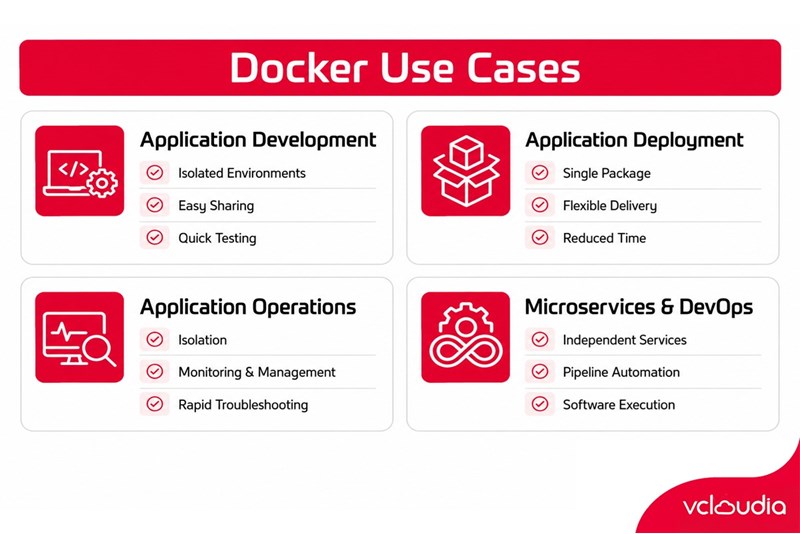
1. Application Development
Docker strongly supports users in:
- Creating isolated development environments for each application.
- Making it easy to share development environments with other team members.
- Enabling quick and easy application testing.
2. Application Deployment
Docker helps package an application and its environment into a single container. Additionally, this open-source software enables you to deploy applications flexibly and consistently across any environment. At the same time, it minimizes application deployment time.
3. Application Operations
During application operations, Docker assists in:
- Isolating applications from one another.
- Helping you monitor and manage applications effortlessly.
- Facilitating rapid application troubleshooting.
4. Microservices
Docker is an ideal platform for deploying microservices applications, helping you create independent and scalable microservices. Additionally, Docker can be used for various purposes, such as:
- Automating the DevOps pipeline.
- Installing and running software.
- Creating testing environments.
- Sharing data.
Conclusion
The above is a comprehensive overview to help answer what Docker is and what it is used for - Docker is a crucial tool for accelerating application development, enhancing operational efficiency, and minimizing operating costs.
For businesses looking to accelerate the deployment of Kubernetes infrastructure, Open Kubernetes Service (OKS) offers a dedicated environment that can be rapidly provisioned on Vcloudia’s public cloud platform. The service supports centralized management, flexible resource scaling, and a reduced operational workload for technical teams.
Learn more at: https://vcloudia.com/en/kubernetes-service
Related news
What is a Hybrid Cloud Server? How Do Enterprises Benefit From Using a Hybrid Cloud Server?
The Hybrid Cloud Server model is an effective way to align IT priorities with business needs. Many enterprises can benefit from using a Hybrid Cloud Server instead of other options.
What is Cloud NAS? The Differences Compared to Traditional NAS and Cloud Storage
Are you looking for an efficient and flexible data storage solution for your enterprise? Cloud NAS might be the answer you are searching for. But what is Cloud NAS, and how does it differ from traditional NAS and Cloud Storage?
What is SQL? How to Download and Install SQL Server from A to Z
SQL Server is one of the many relational database management systems commonly used today. Developed by Microsoft, SQL Server offers a comprehensive range of versions tailored to meet all the development needs of you and your business.
What Is a VPN? How It Works and Why Businesses Should Use a VPN
As businesses today place increasingly greater emphasis on data security and information safety when accessing the Internet, the concept of a VPN is no longer unfamiliar. But what is a VPN, how does it work, and why has it become an indispensable part of a modern enterprise security strategy?
What is Cloud Native? Cloud Native - The Modern Approach to Software Development
Cloud native leverages a variety of modern technologies and methodologies, including PaaS, multi-cloud, microservices, agile practices, containers, CI/CD, and more. The term "cloud native" is widely used, particularly by cloud service providers. Furthermore, it even has its own dedicated foundation - the Cloud Native Computing Foundation (CNCF), launched in 2015 by the Linux Foundation.
What Is Firebase Hosting? Concepts and How to Apply It to Your Website
If you are building and designing a website, understanding the concept of "What is Firebase Hosting?" is essential. This is one of the indispensable services for a website. In this article, let's explore with Vcloudia the definition of Firebase Hosting as well as how to apply it to your website!
What is WordPress Hosting? Key Factors for Choosing a Good WordPress Hosting
Almost every type of website, ranging from simple levels such as personal blogs, news sites, business introduction pages, e-commerce, to more complex levels such as hotel booking, car rental, and real estate pages, can be deployed on the WordPress platform. For a website to operate well, an indispensable component is hosting.
What is Cloud PC? Why do businesses need to use Cloud PC?
Today, the need for flexible working and data access anytime, anywhere is becoming increasingly popular. Among these, Cloud PC - cloud desktop emerges as an optimal solution helping businesses improve flexibility, work efficiency, reduce IT infrastructure investment costs, and enhance security.
What is a Container? Technical Characteristics of a Container
The issues arising regarding software dependency on the system environment when handing over products and applications are immense. So, what is the way to mitigate this risk? The answer is virtualization technology.