



.png)















.png)





What is Cloud NAS? The Differences Compared to Traditional NAS and Cloud Storage
Sep 15, 2026Are you looking for an efficient and flexible data storage solution for your enterprise? Cloud NAS might be the answer you are searching for. But what is Cloud NAS, and how does it differ from traditional NAS and Cloud Storage? Let's explore this in detail with Vcloudia in this article.
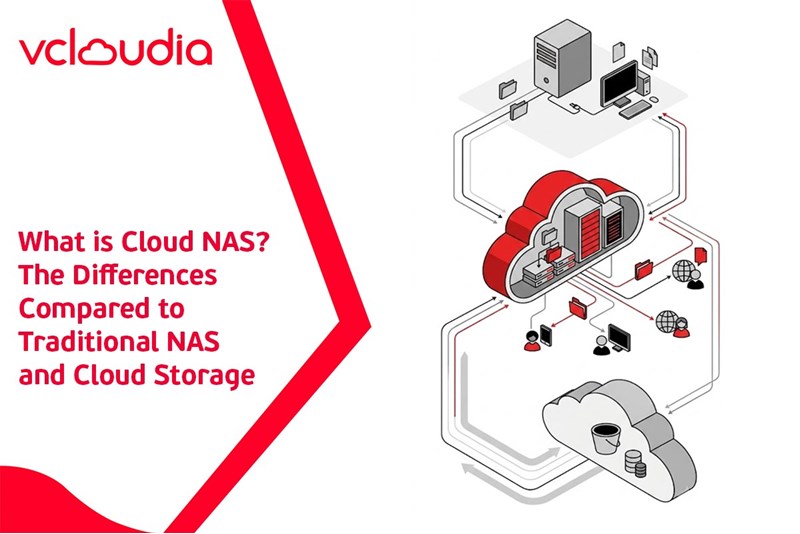
What is Cloud NAS?
Cloud NAS stands for Network Attached Storage on Cloud. This is a data storage service integrated by two technologies: Cloud and NAS (Network Attached Storage).
First, it is necessary to clearly understand what Cloud and NAS are. Cloud, also known as cloud computing, is a computing model that uses computer technologies and develops based on the Internet. Instead of storing data and running applications on personal computers or private servers, you will use these services from remote servers on the Internet.
NAS, also known as network-attached storage, is a device dedicated to storing and sharing files, allowing various devices to simultaneously access, download, and use data anytime, anywhere via the internet or an internal network. NAS provides the ability to store data on a cloud platform with characteristics and features similar to traditional NAS, but accompanied by numerous benefits regarding accessibility, scalability, and data management.
Cloud NAS is a modern data storage solution combining cloud technology and network storage systems (NAS). It offers the ability to store data on a cloud platform with characteristics and features identical to traditional NAS, but comes with many benefits regarding accessibility, scalability, and data management. Consequently, this technology helps enterprises save on infrastructure investment costs.
Cloud NAS features
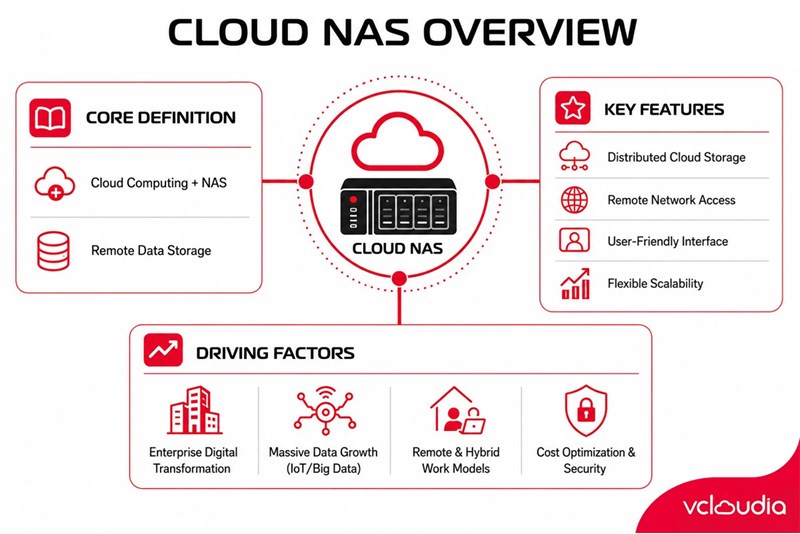
Cloud NAS is a smart combination of traditional network storage technology (NAS) and cloud computing, delivering a more modern and flexible data storage solution.
1. Storage on the cloud
Instead of storing data on a physical device located at the company or home, Cloud NAS leverages the power of massive data centers in the cloud. Data is distributed and backed up across multiple different servers, helping to ensure high security and disaster recovery capabilities.
2. Remote access via network
With Cloud NAS, users can access their data from anywhere as long as they have an Internet connection and a network-connected device such as a computer, mobile phone, or tablet. No longer restricted by geographical location, organizations can work with their data anytime, anywhere.
3. User-friendly management interface
Cloud NAS typically provides an intuitive and easy-to-use management interface, similar to the interfaces of traditional NAS devices. Units, organizations, or enterprises can easily create shared folders, set access permissions, back up data, and manage users.
4. Flexible scalability
The storage capacity of Cloud NAS can be increased or decreased easily and quickly, depending on usage demands. Enterprises also do not need to worry about purchasing additional physical storage devices or upgrading hardware.
The Growing Demand for Cloud Usage Drives the Development of Cloud NAS
The integration of technological trends, especially the data explosion and the widespread adoption of cloud computing, has strongly propelled the development of Cloud NAS. The growing demand for data storage, combined with the limitations of traditional solutions, has created a highly potential market for cloud storage solutions like Cloud NAS.
The scalability and cost savings, along with the flexibility of Cloud NAS, have met the needs of enterprises and individual users in the digital era. Economic, technological, and social factors are increasingly accelerating the transition from traditional storage solutions to advanced cloud solutions.
Factors driving the demand for cloud and Cloud NAS usage
1. Digital transformation in enterprises
Enterprises are increasingly prioritizing the transition from traditional on-premises IT systems to cloud-based solutions to optimize performance and minimize operational costs. In this process, Cloud NAS emerges as a core solution, not only simplifying data storage and management but also facilitating flexibility and rapid adaptation to innovation requirements, helping enterprises catch up with the digital transformation trend effectively and sustainably.
2. Massive data growth
The explosion of data from IoT, social networks, video streaming, and big data analytics applications makes it impossible for traditional storage solutions to keep pace. Cloud NAS provides flexible scalability and unlimited capacity, addressing the rapidly increasing storage demand.
3. Remote and hybrid work trends
The prevalence of remote and hybrid work models post-COVID-19 pandemic has posed an urgent requirement for flexible data storage solutions that allow secure access anytime, anywhere. Cloud NAS becomes a strategic choice, delivering seamless data access for users, regardless of whether they work at the office, at home, or on the move, while simultaneously eliminating the dependence on physical infrastructure and traditional internal networks.
4. Application of AI and Big Data technologies
Enterprises need to store large volumes of unstructured data such as images, videos, and logs for analysis by AI and Big Data. Cloud NAS not only assumes the storage role but also deeply integrates with advanced cloud platforms and tools, unlocking the capability to process data efficiently and intelligently.
5. The rise of SaaS and cloud applications
SaaS (Software as a Service) applications such as Google Workspace and Microsoft 365 are becoming increasingly popular, requiring compatible cloud storage platforms. Cloud NAS is designed to integrate smoothly and scale flexibly with SaaS platforms, optimizing performance and operational capabilities within the digital ecosystem.
6. Cost & convenience
Cloud NAS offers a flexible storage solution, helping enterprises completely eliminate the hardware management burden and optimize operational costs thanks to the ability to automate maintenance processes. Consequently, enterprises can focus resources on core activities, promoting sustainable growth.
In addition, with many leading security features, organizations can rest assured in protecting critical data while meeting increasingly stringent security compliance requirements. Unlimited scalability and automation features help enterprises adapt rapidly to market changes.
The impact of Cloud NAS development
- Unlimited scalability: Cloud NAS allows enterprises and individuals to expand storage capacity without replacing hardware or disrupting services.
- Improved and enhanced work performance: Fast access, anytime and anywhere, helps increase team productivity, especially for organizations with multiple facilities and branches.
- Cost optimization: With a pay-as-you-go model, Cloud NAS helps enterprises save budgets and reduce wasteful spending.
- Driving technological innovation: Cloud NAS providers continuously improve technology to compete, bringing outstanding features such as advanced security, artificial intelligence integration, and data analytics.
- Better data protection: Thanks to high security standards and automated backup capabilities, Cloud NAS protects data from risks such as hardware failures, theft, or cyberattacks.
Comparison of Traditional NAS, Cloud NAS, and Cloud Storage
When choosing a data storage solution, enterprises and individuals often consider traditional NAS, Cloud NAS, and Cloud Storage. Each application has its own advantages and limitations.
Traditional NAS: The advantages are high security, good performance with internal data, and low maintenance costs. Nevertheless, this application is limited in terms of scalability and remote access, and it requires technical knowledge to manage.
Cloud NAS: Combines the advantages of both traditional NAS and Cloud Storage, allowing access anytime, anywhere, flexible scalability, and high security. However, costs can be higher compared to traditional NAS, especially when utilizing large capacities.
Cloud Storage: Provides a flexible and efficient solution for data management, with reasonable costs and high integration capabilities. However, to ensure optimal performance and information safety, users need to thoroughly evaluate network bandwidth and the provider's security policies.
However, to make an appropriate decision, enterprises, organizations, or individuals need to consider their usage demands, business scale, and appropriate budget.
Which Enterprises is Cloud NAS Suitable For?
Cloud NAS is a storage solution combining the convenience of the cloud and the centralized management capabilities of traditional NAS. Thus, Cloud NAS is suitable for enterprises that:
- Demand to scale up storage rapidly: Here, Cloud NAS provides the ability to increase capacity flexibly, meeting the development needs of the enterprise.
- Need to access data from anywhere, anytime: With Cloud NAS, employees can access data from any device with an internet connection, enhancing work efficiency.
- Place heavy emphasis on data security: Cloud NAS typically comes with premium security features such as data encryption, automated backups, and strict access controls.
- Want to minimize initial investment costs: Instead of having to make a large investment in physical storage systems, Cloud NAS allows enterprises to pay on a subscription basis.
On the other hand, some enterprises are not yet suited for Cloud NAS when:
- Extremely high performance requirements: If the enterprise needs to process a massive volume of data at blazing-fast speeds, traditional NAS might be a more suitable choice.
- Limitations in internet connectivity: Internet connection quality directly impacts the performance of Cloud NAS. If the network connection is unstable, Cloud NAS might not meet usage demands.
- Strict regulations regarding on-premises data storage: Some data security regulations require data to be stored at a specific location; Cloud NAS might not fulfill this requirement.
If your enterprise is not yet suitable for Cloud NAS but still heavily needs a simple, easy-to-use, and low-cost solution to store and share data - Cloud Storage is an option worth considering. Cloud Storage provides online storage space, allowing you to access and share data from any internet-connected device.
Related news
What is a Hybrid Cloud Server? How Do Enterprises Benefit From Using a Hybrid Cloud Server?
The Hybrid Cloud Server model is an effective way to align IT priorities with business needs. Many enterprises can benefit from using a Hybrid Cloud Server instead of other options.
What is SQL? How to Download and Install SQL Server from A to Z
SQL Server is one of the many relational database management systems commonly used today. Developed by Microsoft, SQL Server offers a comprehensive range of versions tailored to meet all the development needs of you and your business.
What Is a VPN? How It Works and Why Businesses Should Use a VPN
As businesses today place increasingly greater emphasis on data security and information safety when accessing the Internet, the concept of a VPN is no longer unfamiliar. But what is a VPN, how does it work, and why has it become an indispensable part of a modern enterprise security strategy?
What is Cloud Native? Cloud Native - The Modern Approach to Software Development
Cloud native leverages a variety of modern technologies and methodologies, including PaaS, multi-cloud, microservices, agile practices, containers, CI/CD, and more. The term "cloud native" is widely used, particularly by cloud service providers. Furthermore, it even has its own dedicated foundation - the Cloud Native Computing Foundation (CNCF), launched in 2015 by the Linux Foundation.
What Is Firebase Hosting? Concepts and How to Apply It to Your Website
If you are building and designing a website, understanding the concept of "What is Firebase Hosting?" is essential. This is one of the indispensable services for a website. In this article, let's explore with Vcloudia the definition of Firebase Hosting as well as how to apply it to your website!
What is Docker? A Comprehensive A-Z Guide to Installation and Usage
Docker is a topic that is generating considerable interest today. Originally an open-source platform, it is increasingly being widely adopted by businesses and organizations of all sizes.
What is WordPress Hosting? Key Factors for Choosing a Good WordPress Hosting
Almost every type of website, ranging from simple levels such as personal blogs, news sites, business introduction pages, e-commerce, to more complex levels such as hotel booking, car rental, and real estate pages, can be deployed on the WordPress platform. For a website to operate well, an indispensable component is hosting.
What is Cloud PC? Why do businesses need to use Cloud PC?
Today, the need for flexible working and data access anytime, anywhere is becoming increasingly popular. Among these, Cloud PC - cloud desktop emerges as an optimal solution helping businesses improve flexibility, work efficiency, reduce IT infrastructure investment costs, and enhance security.
What is a Container? Technical Characteristics of a Container
The issues arising regarding software dependency on the system environment when handing over products and applications are immense. So, what is the way to mitigate this risk? The answer is virtualization technology.