



What Is PaaS? Key Insights into Platform as a Service
Nov 21, 2025In today’s rapidly evolving digital era, both businesses and developers are seeking optimal solutions to build software quickly, efficiently, and cost-effectively. One of the most prominent solutions is PaaS – Platform as a Service. Let’s explore it in detail with Vcloudia in the following article.
What is PaaS?
PaaS (Platform as a Service) is a cloud computing service model that allows developers to build, deploy, and manage applications without worrying about managing underlying hardware or software infrastructure.
Think of PaaS as a digital playground where developers can freely create without the hassle of setting up operating systems, servers, or middleware. All of these components are provided and managed by the cloud service provider. As a result, software development becomes faster, simpler, and more efficient—ideal for businesses looking to save time and human resources.
PaaS services are typically billed on a subscription or pay-as-you-go basis, helping organizations minimize upfront hardware and software investments. What sets PaaS apart is its flexibility, scalability on demand, and seamless integration with various software development tools.
How Does PaaS Work?
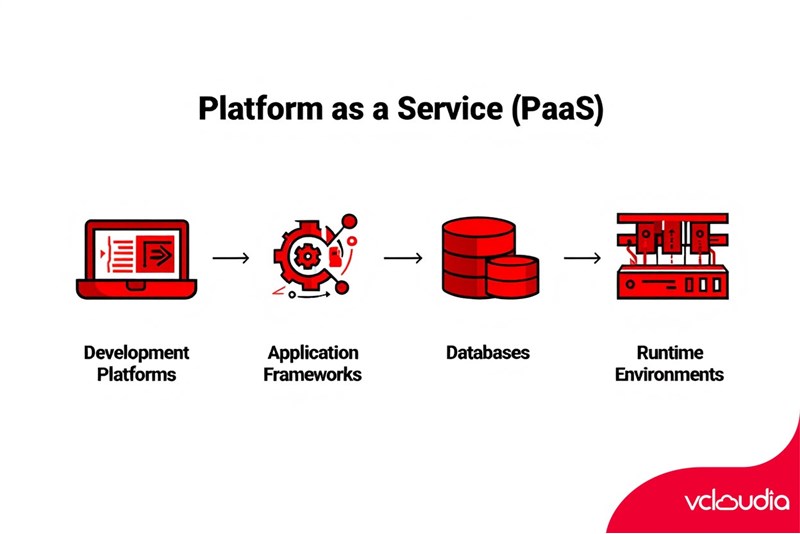
PaaS operates by providing an integrated platform that includes tools, frameworks, and services needed for building, testing, deploying, and maintaining applications. Through an easy-to-use management interface, developers or development teams can access and manage these resources conveniently.
The PaaS provider offers a complete development environment and tools such as compilers, database management systems, storage services, networking, and essential middleware. Developers use these tools to write code, test, and deploy applications directly on the platform.
PaaS automatically handles operational tasks such as load balancing, scaling, data backups, and system updates—reducing manual administrative workload. When your application needs to scale, PaaS allows you to expand resources flexibly according to actual demand, ensuring optimal performance and smooth scalability.
Moreover, PaaS providers offer built-in analytics and performance monitoring tools so businesses can easily track and optimize application performance. This makes development and operations more streamlined and continuous, aligning perfectly with DevOps and CI/CD practices.
Key Advantages of PaaS
Using PaaS offers several clear benefits for both businesses and software developers:
- Accelerated development time: With a pre-integrated environment and minimal setup, developers can start building applications immediately.
- Cost efficiency: No need for costly investments in hardware, software, or complex system administration. Scaling up or down based on actual needs helps optimize operational costs.
- Flexible scalability: In a rapidly changing market, PaaS enables easy system scaling without disrupting business operations.
- Enhanced team collaboration: PaaS provides project management tools, automated testing, continuous deployment, and other utilities that foster innovation and collaboration in modern software development.
Common Limitations of PaaS
Despite its benefits, PaaS also comes with certain challenges:
- Vendor lock-in: Heavy reliance on a specific cloud provider’s infrastructure can be risky if the provider experiences downtime or becomes unsuitable for the business.
- Security concerns: Hosting applications and data on the cloud increases the risk of cyberattacks or data breaches. Choosing a reliable provider and implementing strong security measures is essential.
- Limited customization: Certain technical restrictions—such as limited system control or configuration flexibility—can be a drawback for projects requiring specific setups or large-scale data processing.
- Long-term costs: Without proper resource optimization, PaaS costs can grow significantly over time, especially as your system scales. Hence, careful evaluation is necessary before adopting PaaS for enterprise operations.
Types of PaaS in Use Today
There are many PaaS platforms available on the market, designed to meet diverse business and development needs. PaaS can be categorized by deployment model or core functionality.
1. Based on Deployment Model
- Public Cloud PaaS: The most common model, provided by major vendors like AWS, Google Cloud, or Microsoft Azure via the internet.
- Private Cloud PaaS: Designed for organizations requiring high data security, regulatory compliance, or complete infrastructure control.
- Hybrid Cloud PaaS: A combination of both public and private models, balancing flexibility with security.
- Community Cloud PaaS: Shared infrastructure among several organizations—often non-profits or small groups—to reduce costs.
Each model offers distinct advantages suited to specific business goals and budgets.
2. Based on Functionality
PaaS can also be classified by its key features:
- Web development platforms: e.g., Heroku, Google App Engine—ideal for building web apps and APIs.
- Data-centric platforms: such as IBM Cloud or Azure Data Platform—optimized for big data and analytics applications.
- Specialized PaaS for AI, ML, IoT, or DevOps: e.g., AWS Elastic Beanstalk, Microsoft Azure Machine Learning—empowering innovation and automation.
Choosing the right PaaS depends on your business objectives, existing infrastructure, and financial resources.
When Should You Use PaaS?
PaaS adoption depends on strategic and operational factors:
- When businesses want to reduce time-to-market by streamlining traditional development processes.
- When organizations need to scale quickly to meet market demands or growth.
- When startups or SMEs seek cost optimization through subscription-based or usage-based billing.
- When teams practice DevOps or CI/CD, PaaS provides the ideal environment for continuous integration, deployment, and innovation.
The Future of PaaS
In the coming years, PaaS is expected to evolve toward greater flexibility, intelligence, and integration. Future platforms will increasingly leverage AI, machine learning, automation, and big data to optimize performance and reliability.
Providers will focus on self-optimizing and self-healing PaaS solutions, capable of predictive maintenance and performance tuning. Multi-cloud PaaS adoption will grow, allowing enterprises to avoid vendor lock-in while taking advantage of each provider’s strengths.
In addition, serverless computing will become an integral part of PaaS, eliminating infrastructure management altogether and enabling developers to focus purely on building applications. This will further enhance Agile and DevOps workflows, shortening development cycles and maximizing productivity.
Security, privacy, and global compliance standards will remain at the core of PaaS development, building greater trust among enterprise customers.
Conclusion
In summary, PaaS has become an indispensable part of modern enterprise technology strategy. With its convenience, flexibility, and cost-saving potential, PaaS opens new opportunities for businesses to innovate and compete globally.
While challenges such as vendor dependency, security risks, and long-term costs remain, ongoing advancements in cloud technology are making PaaS more diverse, powerful, and resilient.
Choosing the right PaaS that aligns with your business goals and capabilities is the key to unlocking the full potential of cloud computing—helping your organization thrive in the digital era.
Explore the services offered by Vcloudia – a leading provider of cloud computing and data center solutions. Contact us for expert consultation and find the right model for your needs:
- Hotline: +855 888 55 66 08 (free of charge)
- Fanpage: https://www.facebook.com/vcloudia/
- Website: https://vcloudia.com
Related news
Applications of Cloud Computing in the Healthcare Industry
The application of cloud computing in healthcare is ushering in a new era of improved service quality, optimized hospital operations, and comprehensive digital transformation across the medical sector. This is no longer a distant trend; it has become an essential component of the technological revolution in healthcare.
Can Cloud Servers Fully Replace Physical Servers? A Practical Analysis for Businesses
In today’s era of digital transformation, businesses are constantly seeking ways to optimize their technology infrastructure to improve operational efficiency. One of the most frequently asked questions is: “Can Cloud Servers completely replace physical servers?”
Cloud Server vs VPC: Which Solution Should Startups Choose to Optimize Cost and Performance?
Should a startup choose Cloud Server or VPC? This is a common question many founders and technology managers face when building infrastructure for their new businesses. The right choice not only helps optimize costs but also ensures stable performance and flexible scalability when needed.
What is Hybrid Cloud? How It Works, Pros and Cons, and When to Use It
In today’s digital era, optimizing scalability, data control, and operational performance is essential for businesses to maintain their competitive edge. One of the most effective technological solutions is the Hybrid Cloud model. So, what is Hybrid Cloud?
What is DaaS (Desktop as a Service)?
With its ability to deliver flexible work experiences, high-level security, and centralized management, DaaS is increasingly becoming an inevitable trend in the technology strategies of modern enterprises.
What is BaaS (Backend as a Service)?
BaaS is increasingly popular among startups, small and medium-sized businesses, and product teams that need to launch MVPs quickly. So what is BaaS, how does it work, what are its advantages and limitations, and when should you use it? Let's explore this further with Vcloudia in the following article.
Virtual Private Cloud vs. Dedicated Private Cloud: Key Differences
In today’s digital era, choosing the right cloud computing platform plays a crucial role in determining a business’s operational efficiency. VPC vs. DPC are two commonly discussed concepts as organizations seek to optimize performance, security, and cost. Let’s explore these two service models in detail with Vcloudia.
Comparison Between Virtual Private Cloud and Virtual Private Server
In today’s technology-driven world, choosing the right hosting service for your business or personal needs is essential to ensure efficient operations and cost optimization. Among the most popular options are Virtual Private Cloud (VPC) and Virtual Private Server (VPS). Let’s explore the key differences between these two services with Vcloudia.
Should a Business Choose Shared Hosting or a Cloud Server?
When building and growing a business, choosing the right hosting service is crucial to ensure a website runs reliably, quickly, and securely. The two most common options today are Shared Hosting and Cloud Servers. Which one is the better fit for your business?
What Is Cloud Cost Management and Why Is It Important for Businesses?
As cloud computing services become increasingly popular and play a crucial role in business operations, controlling and optimizing cloud usage costs has become a decisive factor in maintaining profitability and operational efficiency. Vcloudia will help you better understand what cloud cost management is, why it matters, and how to implement it effectively within your organization.