



.png)



















.png)





Should a Business Choose Shared Hosting or a Cloud Server?
Dec 29, 2025When building and growing a business, choosing the right hosting service is crucial to ensure a website runs reliably, quickly, and securely. The two most common options today are Shared Hosting and Cloud Servers. Which one is the better fit for your business?
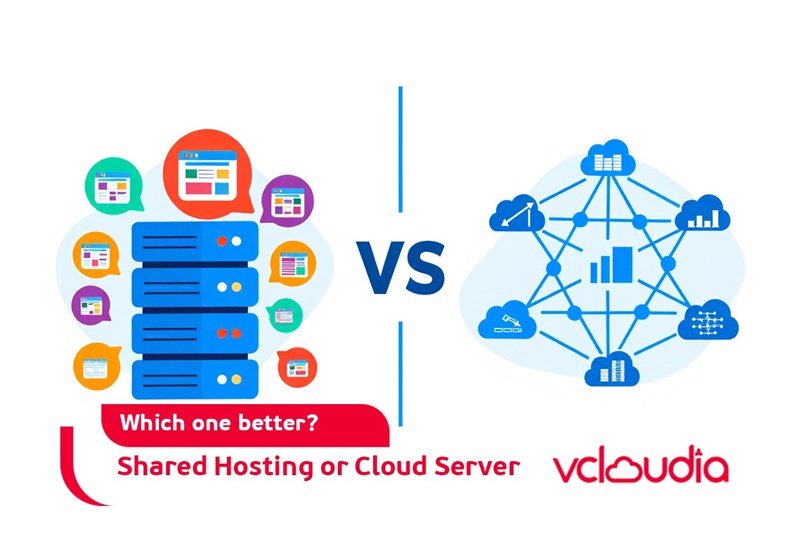
Basic concepts
This section explains the two popular hosting models in detail to clarify their differences and characteristics. Understanding these concepts will help businesses select the service that best matches their needs.
1. What is Shared Hosting?
Shared Hosting is a storage service where multiple websites operate on the same physical server. Server resources—such as bandwidth, disk space, CPU, and RAM—are shared among all customers using the service. The main advantages of Shared Hosting are low cost, easy management, and suitability for small to medium projects or businesses that are just getting started.
In practice, Shared Hosting is the most cost-effective solution because expenses are distributed among many users. Providers typically offer user-friendly control panels that let users set up and run a website without deep technical skills. However, a major limitation of Shared Hosting is limited scalability; performance can degrade or bottlenecks can occur when many websites are active at the same time.
2. What is a Cloud Server?
A Cloud Server is a data hosting service built on a system of physical servers connected via the Internet, creating a virtualized environment that is highly scalable and customizable. Resources like CPU, RAM, bandwidth, and storage can be flexibly adjusted according to a business’s actual needs.
Unlike Shared Hosting, Cloud Servers provide much greater scalability and performance. Businesses can scale resources up or down in stages, ensuring a website stays stable even during peak periods or heavy traffic. Cloud Servers also typically offer stronger security and are suitable for large projects, sensitive data, or businesses that need to scale quickly without major infrastructure changes.
Pros and cons of using Shared Hosting
Shared Hosting is a popular choice for small businesses or individuals who are starting an online presence. Like any service, it has its own set of advantages and disadvantages that should be carefully considered.
1. Advantages
The biggest advantage of Shared Hosting is its extremely low cost, making it suitable for small businesses, startups, or individuals with limited budgets who are just building a website. This reduces initial investment and gives many new businesses the opportunity to experiment and grow.
In addition, Shared Hosting is easy to use. Providers usually include intuitive control panels that allow users without advanced technical skills to manage a site, update content, and install software easily. This saves time and manpower for early operational activities.
2. Disadvantages
Despite its benefits, Shared Hosting has notable limitations such as constrained scalability and susceptibility to issues caused by other websites on the same server. When many sites receive traffic simultaneously, or if one site consumes excessive resources, your site may slow down, experience bottlenecks, or even suffer downtime. This is a significant drawback for businesses that aim to grow quickly, scale up, or maintain high performance.
From a security standpoint, Shared Hosting carries higher risk because sites on the same server can be affected by attacks or malware targeting other customers. Businesses using Shared Hosting may need to implement additional security measures to protect their data and website operations.
Pros and cons of using a Cloud Server
Compared with Shared Hosting, Cloud Servers offer many clear benefits but also come with higher costs and more complex management requirements. Businesses should weigh these strengths and limitations against their development goals.
1. Advantages
One of the greatest benefits of Cloud Servers is flexible scalability, which enables businesses to adjust resources according to real demand. This is ideal for companies with rapid growth, those handling large traffic volumes, or projects that require a high degree of customization.
Cloud Servers also provide stronger security, automatic backups, and greater resilience to network attacks or hardware failures. Performance is generally stable and is not affected by other sites, as can happen with Shared Hosting. Therefore, Cloud Servers are an optimal solution for large projects, e-commerce sites, businesses that handle sensitive data, or systems that require high uptime.
2. Disadvantages
Although effective, Cloud Servers require a higher initial investment than Shared Hosting and demand technical expertise to operate and optimize performance. This can be a barrier for small enterprises or individuals lacking system administration skills.
Additionally, customizing and managing a Cloud Server takes time and effort. To fully leverage its advantages, businesses may need to invest in personnel, management software, or partner with reputable service providers. Viewed holistically, these limitations are usually overcome as a business grows and requires higher performance, security, and scalability.
When should a business use Shared Hosting or a Cloud Server?
Deciding whether to use Shared Hosting or a Cloud Server depends heavily on the company’s size, objectives, and growth plans. For startups with limited budgets or sites that do not yet receive significant traffic, Shared Hosting is the most suitable option to start with. It saves costs, is easy to operate, and meets the basic needs of a new website.
Conversely, for established businesses running projects that demand high performance, flexible scalability, or stringent data security, a Cloud Server is the optimal choice. This service suits large e-commerce platforms, enterprise management systems, or rapidly growing projects. Choosing a Cloud Server helps eliminate overloads, poor performance, and data-loss risks.
The right choice will depend on aligning needs, budget, and management capability to maximize efficiency and minimize costs.
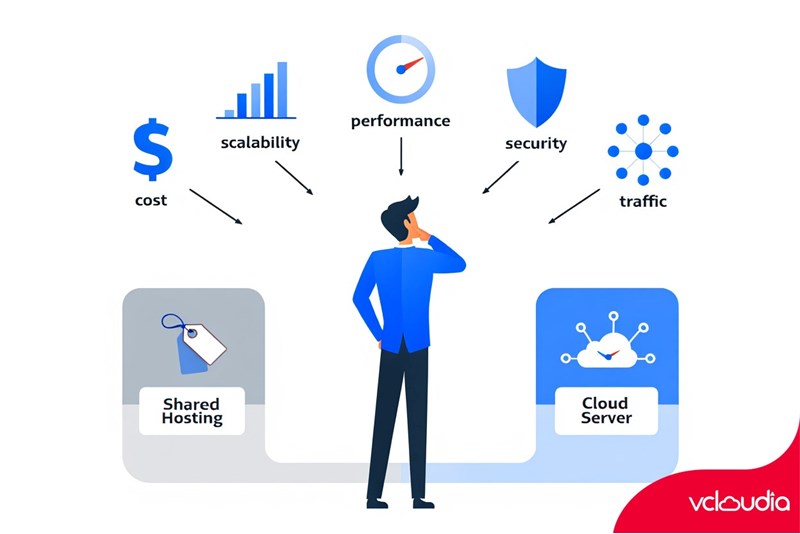
Conclusion
In an increasingly competitive online market, picking the right hosting service affects not only day-to-day operations but also scalability, data security, and long-term growth. Both Shared Hosting and Cloud Servers have their own advantages and limitations and are appropriate for different stages and needs.
If your business is just starting and has a tight budget, Shared Hosting provides a stable, low-cost foundation. If your business is larger, needs rapid scaling, higher performance, and stronger security, a Cloud Server is the better, more flexible option.
Choosing the right hosting solution helps businesses save costs, optimize performance, and build a solid foundation for sustainable growth. Carefully consider your goals and capabilities to make the most informed decision.
Explore the services offered by Vcloudia – a leading provider of cloud computing and data center solutions. Contact us for expert consultation and find the right model for your needs:
- Hotline: +855 888 55 66 08 (free of charge)
- Fanpage: https://www.facebook.com/vcloudia/
- Website: https://vcloudia.com
Featured news
Related news
What is a Snapshot? The Difference Between Snapshot and Backup
Snapshot is a familiar concept in data management and protection. In the context of the information technology boom, where data is a major asset for businesses, understanding Snapshots as well as their application is a key factor for enterprises to maximize technological efficiency.
What is a Firewall? The Role and Importance of Firewalls for Users
In the context of ever-increasing cyberattacks, system security has become a top priority for many enterprises. Alongside deploying antivirus software and controlling connection ports, firewalls are also considered a key solution to effectively enhance cybersecurity.
What is DDoS? Signs, Mitigation Strategies, and Effective Prevention
DDoS is a highly dangerous cyberattack that leaves severe consequences for enterprises. Therefore, gaining a clear understanding of DDoS attacks, as well as how to detect and prevent them, is a topic of significant interest to many.
What is a Trojan? How to Detect, Avoid, and Prevent It
A Trojan is a type of malicious code or software that can cause severe consequences to computer operations. So, what is a Trojan? How can you prevent a Trojan from infiltrating your computer? In the following article, Vcloudia will provide detailed information on these issues.
What is Cloud Backup? Classification, benefits, and limitations
Cloud Backup is a solution that plays an important role in backing up and recovering data when an incident occurs. So what exactly is Cloud Backup? Let's find out the details with Vcloudia in the following article.
What is Cloud Storage? Features and Benefits of Using It
Cloud Storage is the perfect storage solution alternative to bulky, space-consuming physical hard drives. So, what is Cloud Storage? Let's explore the details with Vcloudia through the following article.
What is an API? Characteristics and applications in website design
API, short for Application Programming Interface, is a concept no longer unfamiliar in the information technology field. So what exactly is an API and why is it so important? Let's find out with Vcloudia.
What is Node.js? Instructions on how to install Node.js on cPanel
Currently, it is easy to see that Node.js is being used by quite a lot of people. This is because Node.js can support users in running on multiple platforms and multiple devices.
What is Vultr VPS? Should you use Vultr VPS?
Vultr VPS is one of the best cloud storage solutions in the world. In this article, you will learn the concept: "What is Vultr VPS?", as well as understand its advantages and disadvantages.
Zoom Cloud Meeting: What is it? Basic Things You Should Know About Zoom Cloud Meeting
In 2020, Zoom Cloud Meeting became one of the leading video conferencing software applications. It allows you to virtually interact with colleagues when in-person meetings aren't possible, and it has also been very successful for social events.