



.png)


















.png)





Comparison Between Virtual Private Cloud and Virtual Private Server
Dec 15, 2025In today’s technology-driven world, choosing the right hosting service for your business or personal needs is essential to ensure efficient operations and cost optimization. Among the most popular options are Virtual Private Cloud (VPC) and Virtual Private Server (VPS). Let’s explore the key differences between these two services with Vcloudia.

Basic Concepts
Before diving into a detailed comparison of VPC and VPS, it’s important to understand their fundamental concepts. Knowing how each technology works will help users make better decisions based on objectives, budget, and system management capabilities.
1. What is VPC?
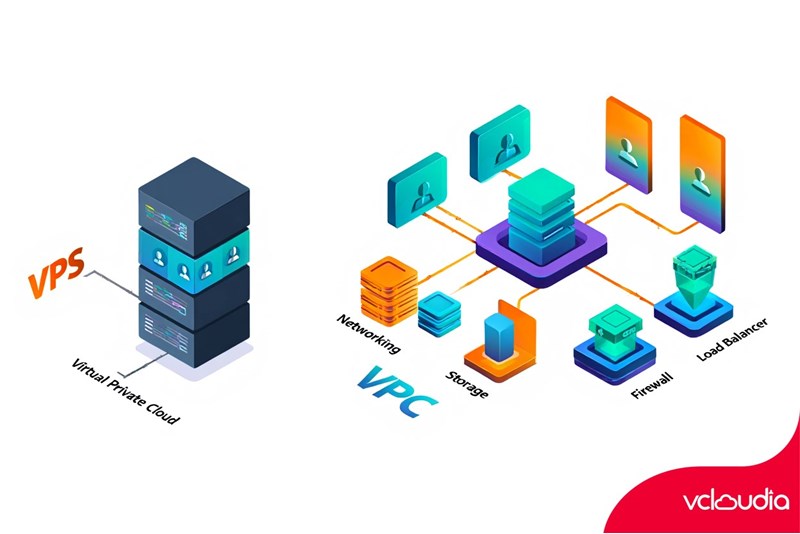
VPC, or Virtual Private Cloud, is a private cloud environment within the infrastructure of cloud service providers such as Amazon Web Services (AWS), Google Cloud, or Microsoft Azure. VPC allows businesses or individuals to create an isolated virtual network with customizable structure, IP address ranges, and security configurations.
A VPC offers comprehensive control over networking, enabling clear segmentation and isolation of data and services. It is an ideal solution for organizations needing to build complex systems that require high flexibility and long-term scalability.
2. What is VPS?
VPS, or Virtual Private Server, is a virtual server that operates as a partitioned segment of a larger physical server. Through virtualization technology, a single physical machine can be divided into multiple VPS instances, each functioning as an independent server with its own operating system and customizable environment, while still sharing the underlying hardware.
VPS is suitable for small businesses, developers, or individuals who need a dedicated server environment for websites, applications, or services—without requiring the full control and complexity of cloud-based infrastructures.
Architecture and How They Work
Understanding how each solution operates is crucial to assessing which one best fits your needs. Although both VPC and VPS leverage virtualization, they differ significantly in structure, scalability, and management.
1. How a VPC Works
A VPC functions as a fully isolated virtual network within a cloud provider’s infrastructure. Users can customize IP addressing, create private networks, configure routing (VPN, Direct Connect), and manage access through security groups.
One of VPC’s standout features is the ability to create separate subnets, set routing rules, enforce detailed access control, and achieve high-level security. Resources such as VMs, databases, or central services can be segmented into isolated networks, enabling the design of scalable, flexible, and highly secure distributed systems.
2. How a VPS Works
A VPS operates through virtualization by dividing a physical server into smaller independent units, each running its own operating system. Users can install software, run applications, or host services such as web servers and databases.
A VPS ensures dedicated resource allocation so one virtual server’s performance isn’t significantly affected by others on the same physical machine. Users have the freedom to configure the environment—from OS selection to software installation—making it ideal for simpler workloads or direct system management needs.
Advantages and Limitations of VPC
VPC is undeniably one of the most flexible and powerful cloud solutions, but it also comes with certain constraints.
1. Advantages
VPC offers high-level control over the entire network, allowing users to build isolated, secure environments suitable for systems requiring strict security, such as banking, financial services, or data-sensitive applications. Its flexible scalability allows businesses to easily adjust resources as their projects grow.
A major benefit of VPC is the ability to customize the network structure and manage it through cloud administration interfaces. This helps optimize performance and operational costs. Additionally, seamless integration with other cloud services enhances scalability and system development.
2. Limitations
VPC generally comes with higher initial and ongoing costs compared to simpler solutions like VPS, especially for small businesses or beginners. It requires strong knowledge of networking and system management, meaning skilled technical staff are needed.
The complexity of VPC environments also means setup, optimization, and maintenance may take more time and demand frequent updates to maintain maximum security—especially in an era of increasingly sophisticated cyber threats.
Advantages and Limitations of VPS
VPS is a flexible and cost-effective solution compared to VPC, making it suitable for small businesses or individuals with limited budgets who still need dedicated server environments.
1. Advantages
VPS is ideal for small and medium businesses, development or testing projects, thanks to its fast setup and cost-efficiency. Users can easily control and customize the system, from software installation to network configuration, supporting various use cases.
You can also scale VPS resources up or down as needed. Additionally, VPS provides flexible backup and recovery options while maintaining independence from more complex cloud ecosystems.
2. Limitations
However, VPS does not offer the same level of control and security as VPC, since it depends on the provider’s configuration and user management. When workloads require broader scalability, complex networking, or deeper integration with cloud services, VPS becomes limited.
VPS also lacks full infrastructure control, which may be restrictive for organizations requiring advanced network segmentation or high-level security management.
When to Choose VPC or VPS?
Choosing the right solution doesn’t depend solely on budget—it also requires evaluating system architecture goals, control requirements, and scalability expectations.
1. When to Use VPS?
VPS is ideal for individuals, small businesses, or startups whose needs do not require a complex network architecture or high scalability. Small websites, blogs, e-commerce shops, or applications without strict security or segmentation needs are well-suited for VPS.
It is also perfect for developers who want testing environments or isolated development servers without high investment costs or dependency on cloud providers.
2. When to Use VPC?
Organizations with high security, scalability, and infrastructure control requirements should opt for VPC. It is especially suitable for complex, multi-layered systems involving interconnected services, APIs, or sensitive data.
VPC is also the best choice for building multi-region systems or when integration with other cloud services is needed. It provides granular network control, helping optimize resource usage, reduce security risks, and enhance user experience.
Conclusion
When comparing VPC vs VPS, it’s clear that both technologies offer unique benefits suited to different use cases and business scales. VPS is ideal for small projects, personal use, and new businesses due to its simplicity, lower cost, and ease of control. Meanwhile, VPC provides greater flexibility, scalability, control, and security—making it the preferred solution for complex systems requiring strict protection and advanced integration.
Choosing between VPC and VPS isn’t always straightforward. You should carefully evaluate your objectives, budget, technical capabilities, and system management needs. Clearly defining your requirements will help you select the most suitable solution—optimizing operational efficiency and supporting long-term business growth.
Looking for a high-performance, secure solution?
Explore the services offered by Vcloudia – a leading provider of cloud computing and data center solutions. Contact us for expert consultation and find the right model for your needs:
- Hotline: +855 888 55 66 08 (free of charge)
- Fanpage: https://www.facebook.com/vcloudia/
- Website: https://vcloudia.com
Featured news
Related news
What is a Snapshot? The Difference Between Snapshot and Backup
Snapshot is a familiar concept in data management and protection. In the context of the information technology boom, where data is a major asset for businesses, understanding Snapshots as well as their application is a key factor for enterprises to maximize technological efficiency.
What is a Firewall? The Role and Importance of Firewalls for Users
In the context of ever-increasing cyberattacks, system security has become a top priority for many enterprises. Alongside deploying antivirus software and controlling connection ports, firewalls are also considered a key solution to effectively enhance cybersecurity.
What is DDoS? Signs, Mitigation Strategies, and Effective Prevention
DDoS is a highly dangerous cyberattack that leaves severe consequences for enterprises. Therefore, gaining a clear understanding of DDoS attacks, as well as how to detect and prevent them, is a topic of significant interest to many.
What is a Trojan? How to Detect, Avoid, and Prevent It
A Trojan is a type of malicious code or software that can cause severe consequences to computer operations. So, what is a Trojan? How can you prevent a Trojan from infiltrating your computer? In the following article, Vcloudia will provide detailed information on these issues.
What is Cloud Backup? Classification, benefits, and limitations
Cloud Backup is a solution that plays an important role in backing up and recovering data when an incident occurs. So what exactly is Cloud Backup? Let's find out the details with Vcloudia in the following article.
What is Cloud Storage? Features and Benefits of Using It
Cloud Storage is the perfect storage solution alternative to bulky, space-consuming physical hard drives. So, what is Cloud Storage? Let's explore the details with Vcloudia through the following article.
What is an API? Characteristics and applications in website design
API, short for Application Programming Interface, is a concept no longer unfamiliar in the information technology field. So what exactly is an API and why is it so important? Let's find out with Vcloudia.
What is Node.js? Instructions on how to install Node.js on cPanel
Currently, it is easy to see that Node.js is being used by quite a lot of people. This is because Node.js can support users in running on multiple platforms and multiple devices.
What is Vultr VPS? Should you use Vultr VPS?
Vultr VPS is one of the best cloud storage solutions in the world. In this article, you will learn the concept: "What is Vultr VPS?", as well as understand its advantages and disadvantages.
Zoom Cloud Meeting: What is it? Basic Things You Should Know About Zoom Cloud Meeting
In 2020, Zoom Cloud Meeting became one of the leading video conferencing software applications. It allows you to virtually interact with colleagues when in-person meetings aren't possible, and it has also been very successful for social events.