



.png)


















.png)





Cloud Server vs VPC: Which Solution Should Startups Choose to Optimize Cost and Performance?
Jan 29, 2026Should a startup choose Cloud Server or VPC? This is a common question many founders and technology managers face when building infrastructure for their new businesses. The right choice not only helps optimize costs but also ensures stable performance and flexible scalability when needed. Vcloudia provides a comprehensive overview of Cloud Server and Virtual Private Cloud (VPC) to help you make the most informed decision for your business.
Overview of Cloud Server
A Cloud Server, also known as a virtual cloud server, is a hosting service based on virtualization technology that allows users to access servers via the internet without owning physical hardware. Cloud Servers are typically offered on a pay-as-you-go basis (hourly or monthly), enabling businesses to easily scale resources up or down according to actual needs.
The greatest advantage of Cloud Server lies in its flexibility in deployment, management, and consumption-based pricing, making it especially suitable for startups with limited initial investment.
In addition, Cloud Servers often come with extended services such as automated backups, load balancing, enhanced security features, and easy-to-use management tools. Providers such as Amazon EC2, Google Cloud Compute, Microsoft Azure, as well as local services like Viettel Cloud and VnPost Cloud, make it easy for businesses to access these solutions for stable and secure system operations. From newly established startups to large enterprises, organizations can leverage Cloud Servers to reduce upfront investment while maintaining the ability to scale flexibly as demand grows.
Overview of Virtual Private Cloud (VPC)
VPC, or Virtual Private Cloud, provides a private networking environment within the cloud, allowing businesses to create isolated virtual networks that can be customized to their specific needs. Unlike standard Cloud Server usage, VPC offers complete network isolation, giving organizations maximum control over security and resource segmentation.
This model is particularly suitable for startups looking to build more complex systems, such as proprietary services or advanced integrations that require tighter infrastructure control.
Using VPC enables businesses to clearly define system components within the network, establish access rules, and allocate resources in a structured manner. Moreover, VPC supports secure connections between data zones, sensitive datasets, and specialized services that require high levels of protection, reducing the risk of cyberattacks and data breaches. VPC is especially well-suited for building complex platforms or services that demand flexible scalability while maintaining strong security.
Cloud Server vs VPC: Which Is More Suitable for Startups?
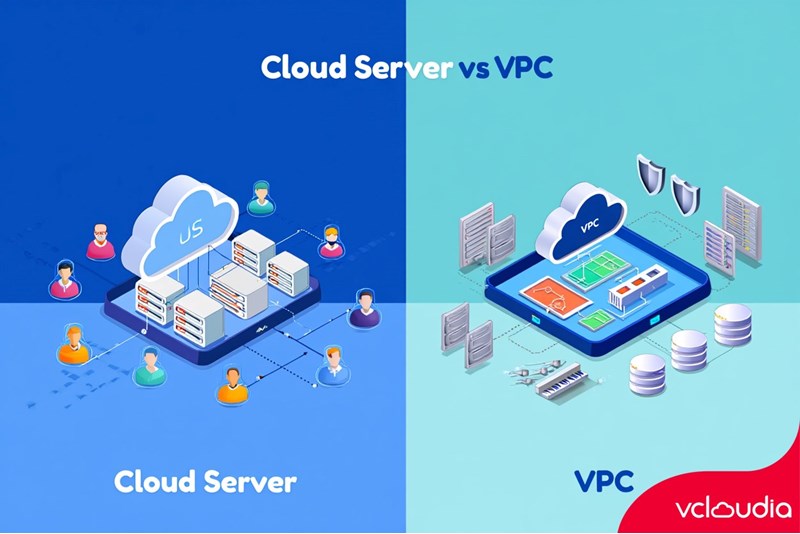
When comparing Cloud Server and VPC, the most noticeable difference lies in scope of use and level of control. Cloud Server offers simplicity and ease of operation, making it ideal for startups with relatively simple requirements and no urgent need for strict network control.
VPC, on the other hand, focuses on maximum control over security and complex network architecture, making it more suitable for businesses with larger systems or services that demand high levels of security.
The decision also depends on the startup’s financial capacity and technical expertise. If a startup is just getting started, with limited resources and no immediate need for advanced networking features, Cloud Server is often the most practical option, with the flexibility to scale later. Conversely, if the startup already has a strong technical team and focuses on developing specialized systems, VPC provides better resource management, reduced security risks, and more comprehensive control.
When Should Startups Choose Cloud Server?
Startups should choose Cloud Server when they are in the early stages of building their systems, especially when operating at a small scale and without clearly defined requirements for advanced security or complex network segmentation. Cloud Server allows easy setup and operation of services, enabling rapid experimentation, development, and testing of new business models within minutes, without requiring deep technical knowledge of networking or system configuration.
This allows startups to focus on product development rather than worrying about infrastructure management.
Moreover, scalability is a key advantage. Cloud Server offers flexible service plans, allowing startups to quickly upgrade or downsize resources to optimize operating costs. In a constantly changing market, having an adaptable infrastructure is a crucial factor in maintaining performance and achieving sustainable growth.
When Should Startups Choose VPC?
VPC is suitable for startups that already have a solid technical foundation or need to build dedicated systems with high levels of control over networking and security. It is ideal for businesses planning to implement larger projects, integrate multiple services, or clearly separate data zones to comply with legal regulations or international standards.
VPC is also a strong option for startups that anticipate significant growth and want to build complex infrastructure to support diverse services.
Additionally, for startups operating in industries such as manufacturing, finance, healthcare, or other sectors with strict security requirements, VPC provides the necessary control to manage the entire operating environment and minimize the risk of data leakage or cyberattacks. However, designing and maintaining a VPC requires strong technical expertise and a capable operations team, making it less suitable for early-stage startups with limited resources.
Suggested Roadmap for Startups
For newly established startups, it is best to begin with Cloud Server to easily test ideas and minimize financial risk. As the business achieves initial success and systems begin to grow, transitioning toward dedicated VPC environments can provide better security control and more structured infrastructure scalability.
During this transition, businesses should prioritize training and understanding network management and security principles to ensure effective VPC operations.
From the early stages to more mature development, companies can integrate advanced cloud services, upgrade network architecture, or even build hybrid solutions (combining Cloud Server and VPC). This approach allows startups to leverage the strengths of both platforms—optimizing costs, improving performance, and ensuring data security. Most importantly, businesses should develop a clear scaling strategy based on actual needs and financial capacity.
Conclusion
Choosing between Cloud Server and VPC is not merely a technical decision—it is closely tied to a startup’s development strategy, resources, and long-term goals. Cloud Server is ideal for getting started quickly, keeping costs low, and offering maximum flexibility, especially for businesses with limited infrastructure management experience. VPC, meanwhile, is better suited for startups with strong technical capabilities that require maximum control over security and networking to support more complex systems.
Depending on their development stage, financial capacity, and long-term objectives, startups should choose the solution that best optimizes both cost and performance. A flexible combination of both approaches, when appropriate, can be an effective strategy for sustainable growth in today’s increasingly competitive environment. Careful planning and strategic decision-making will ensure that technology infrastructure remains a solid foundation for long-term business success.
Looking for a high-performance, secure solution?Explore the services offered by Vcloudia – a leading provider of cloud computing and data center solutions. Contact us for expert consultation and find the right model for your needs:
- Hotline: +855 888 55 66 08 (free of charge)
- Fanpage: https://www.facebook.com/vcloudia/
- Website: https://vcloudia.com
Featured news
Related news
What is a Snapshot? The Difference Between Snapshot and Backup
Snapshot is a familiar concept in data management and protection. In the context of the information technology boom, where data is a major asset for businesses, understanding Snapshots as well as their application is a key factor for enterprises to maximize technological efficiency.
What is a Firewall? The Role and Importance of Firewalls for Users
In the context of ever-increasing cyberattacks, system security has become a top priority for many enterprises. Alongside deploying antivirus software and controlling connection ports, firewalls are also considered a key solution to effectively enhance cybersecurity.
What is DDoS? Signs, Mitigation Strategies, and Effective Prevention
DDoS is a highly dangerous cyberattack that leaves severe consequences for enterprises. Therefore, gaining a clear understanding of DDoS attacks, as well as how to detect and prevent them, is a topic of significant interest to many.
What is a Trojan? How to Detect, Avoid, and Prevent It
A Trojan is a type of malicious code or software that can cause severe consequences to computer operations. So, what is a Trojan? How can you prevent a Trojan from infiltrating your computer? In the following article, Vcloudia will provide detailed information on these issues.
What is Cloud Backup? Classification, benefits, and limitations
Cloud Backup is a solution that plays an important role in backing up and recovering data when an incident occurs. So what exactly is Cloud Backup? Let's find out the details with Vcloudia in the following article.
What is Cloud Storage? Features and Benefits of Using It
Cloud Storage is the perfect storage solution alternative to bulky, space-consuming physical hard drives. So, what is Cloud Storage? Let's explore the details with Vcloudia through the following article.
What is an API? Characteristics and applications in website design
API, short for Application Programming Interface, is a concept no longer unfamiliar in the information technology field. So what exactly is an API and why is it so important? Let's find out with Vcloudia.
What is Node.js? Instructions on how to install Node.js on cPanel
Currently, it is easy to see that Node.js is being used by quite a lot of people. This is because Node.js can support users in running on multiple platforms and multiple devices.
What is Vultr VPS? Should you use Vultr VPS?
Vultr VPS is one of the best cloud storage solutions in the world. In this article, you will learn the concept: "What is Vultr VPS?", as well as understand its advantages and disadvantages.
Zoom Cloud Meeting: What is it? Basic Things You Should Know About Zoom Cloud Meeting
In 2020, Zoom Cloud Meeting became one of the leading video conferencing software applications. It allows you to virtually interact with colleagues when in-person meetings aren't possible, and it has also been very successful for social events.