



.png)
















.png)





What is Hybrid Cloud? How It Works, Pros and Cons, and When to Use It
Jan 29, 2026In today’s digital era, optimizing scalability, data control, and operational performance is essential for businesses to maintain their competitive edge. One of the most effective technological solutions is the Hybrid Cloud model. So, what is Hybrid Cloud? How does it work? And why are so many organizations choosing this approach? Let’s explore the answers with Vcloudia below.
What is Hybrid Cloud?
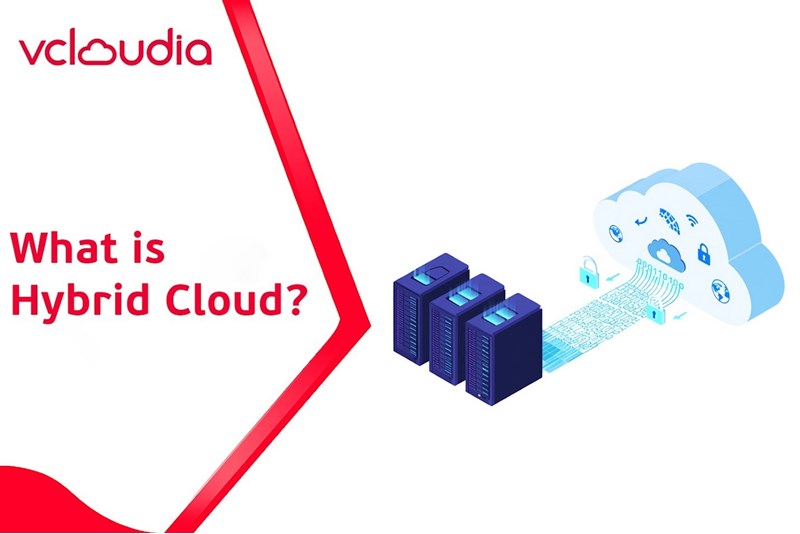
Hybrid Cloud is a cloud computing model that combines public cloud and private cloud services to optimize resource utilization. With this approach, organizations can leverage the strengths of both environments to meet performance, security, and cost requirements more flexibly.
Rather than forcing businesses to choose between public or private cloud, Hybrid Cloud provides maximum flexibility by allowing data and workloads to move between environments based on real-world needs. This not only improves operational efficiency but also enables organizations to scale more easily and adapt quickly to constantly changing market conditions.
How Does Hybrid Cloud Work?
The Hybrid Cloud model operates by building an integrated platform that allows private and public cloud components to work seamlessly together. To achieve this, organizations deploy appropriate technologies and management solutions to ensure connectivity, security, and flexible scalability between environments.
Typically, the process begins with identifying which workloads are best suited for private cloud or public cloud deployment. Services are then managed and distributed through centralized platforms using tools such as APIs, virtual private networks (VPNs), and hybrid cloud management platforms. A critical factor is the ability to move data and processing tasks smoothly between environments, maximizing efficiency without disrupting operations.
Types of Hybrid Cloud
Hybrid Cloud models are often categorized based on their level of integration and architectural structure. Understanding these types helps organizations choose the most suitable solution.
Common types include:
- Layered Hybrid Cloud: This model integrates public and private cloud services through intermediate layers such as API gateways or centralized management platforms. Organizations can choose to separate or integrate components depending on business requirements.
- Data-Integrated Hybrid Cloud: In this model, data is synchronized or transferred between cloud environments to support complex processing and analytics. It helps improve data control while enhancing access speed and analytical performance.
- Operational Hybrid Cloud: This approach combines self-managed infrastructure with services from cloud providers, offering flexible scalability and operational adaptability. It is well-suited for organizations with specific operational or security requirements.
Businesses should carefully evaluate integration capability, cost, and long-term goals before choosing a model, as each type has distinct advantages and limitations.
Benefits of Hybrid Cloud for Businesses
Hybrid Cloud is more than just a technology trend—it delivers tangible business value in an increasingly competitive environment.
1. Flexible Resource Scalability
Hybrid Cloud allows organizations to scale resources quickly. When additional computing power or storage is required, they can expand using the public cloud without investing in new physical infrastructure. When demand decreases, resources can be scaled down to optimize costs.
This flexibility is ideal for seasonal workloads, short-term projects, and software testing environments, helping businesses optimize investment efficiency.
2. Better Data Control
For industries such as finance, healthcare, and government, data security is critical. Hybrid Cloud allows sensitive data to remain in the private cloud (where full control is maintained) while leveraging the public cloud for non-sensitive workloads.
This approach balances security and flexibility, reduces cybersecurity risks, and helps organizations comply with increasingly strict regulations.
3. Improved System Resilience and Load Handling
With the rise of big data and complex applications, infrastructure resilience is crucial. Hybrid Cloud enables load balancing between public and private environments, ensuring stable operations.
During peak periods, organizations can temporarily use public cloud resources to handle increased demand while maintaining critical workloads in the private cloud—reducing the risk of downtime in industries that require high reliability.
4. Optimized Workload Placement
Not all workloads are suitable for the same environment. Hybrid Cloud allows organizations to place workloads based on specific needs such as security, latency, and scalability.
Sensitive applications can remain in the private cloud, while data analytics, testing, or less critical services can run on the public cloud—maximizing efficiency and cost optimization.
5. Strong Support for DevOps and CI/CD
Hybrid Cloud greatly supports DevOps and CI/CD (Continuous Integration / Continuous Deployment) practices. Developers can test, deploy, and update applications faster without being constrained by infrastructure limitations.
This accelerates time-to-market, enhances agility, and is especially beneficial for SaaS products and high-tech development environments.
Limitations of Hybrid Cloud
Despite its advantages, Hybrid Cloud also presents challenges that organizations must consider.
1. Complex Architecture and Deployment
Hybrid Cloud systems require sophisticated architecture and highly skilled professionals. Integration across environments demands deep expertise in networking, security, and infrastructure management.
This can increase implementation time and costs, as well as ongoing maintenance complexity.
2. Higher Operational and Management Costs
Managing multiple environments requires advanced monitoring, management tools, and security solutions. These factors can significantly increase operational expenses, especially during early implementation stages.
Proper budgeting and cost governance are essential to avoid unexpected financial burdens.
3. Requires Highly Skilled IT Teams
Hybrid Cloud is not ideal for organizations lacking experienced cloud, security, and infrastructure professionals. Without expert management, businesses may face security risks, inefficiencies, and higher long-term costs.
Many organizations therefore invest in long-term talent development or partner with trusted technology providers.
4. Security Risks
Data synchronization across multiple environments can create vulnerabilities if not properly controlled. Encryption, strong authentication, and strict access control are essential.
Multi-platform integration can also introduce new attack surfaces, making strong security policies and continuous updates critical.
5. Difficulties in Unified Monitoring
Even with modern cloud management tools, achieving complete visibility across environments remains challenging. Organizations must invest in automation, monitoring systems, and alert mechanisms to detect issues early and minimize business impact.
Hybrid Cloud vs. Public Cloud vs. Private Cloud
The right choice depends on business goals, budget, and security requirements.
Which Businesses Are Best Suited for Hybrid Cloud?
Hybrid Cloud is ideal for large enterprises, multinational companies, and organizations handling sensitive data. Startups and SMEs often begin with public cloud and later transition to Hybrid Cloud as their needs grow.
Industries such as finance, healthcare, legal services, and high-tech benefit significantly from Hybrid Cloud due to strict data protection requirements. Organizations with simpler operations may prefer purely public or private cloud models.
Popular Hybrid Cloud Platforms Today
Several major providers offer powerful Hybrid Cloud solutions:
- VMware Cloud – Strong integration between virtualization infrastructure and cloud environments.
- Microsoft Azure Stack – Enables private cloud deployment aligned with the Azure ecosystem.
- Google Anthos – A multi-cloud management platform for workloads across different clouds.
- Amazon Outposts – Extends AWS infrastructure into on-premises environments.
- IBM Cloud Pak – Integrates AI, analytics, and security for comprehensive hybrid solutions.
Choosing the right platform helps organizations reduce risk, optimize operations, and improve competitiveness.
Conclusion
Hybrid Cloud has become an optimal solution for businesses seeking to balance data control, scalability, and investment costs. Although challenges such as complexity, higher management costs, and security risks remain, the benefits are undeniable.
A clear understanding of how Hybrid Cloud works, its types, advantages, limitations, and available platforms enables organizations to make informed decisions and fully leverage its potential.
In summary, Hybrid Cloud harmonizes security, scalability, and data governance, allowing businesses to adapt flexibly to market changes. It is an inevitable trend in the future of cloud computing, and organizations should plan early to seize the opportunities it offers.
Explore the services offered by Vcloudia – a leading provider of cloud computing and data center solutions. Contact us for expert consultation and find the right model for your needs:
- Hotline: +855 888 55 66 08 (free of charge)
- Fanpage: https://www.facebook.com/vcloudia/
- Website: https://vcloudia.com
Featured news
Related news
What is a Snapshot? The Difference Between Snapshot and Backup
Snapshot is a familiar concept in data management and protection. In the context of the information technology boom, where data is a major asset for businesses, understanding Snapshots as well as their application is a key factor for enterprises to maximize technological efficiency.
What is a Firewall? The Role and Importance of Firewalls for Users
In the context of ever-increasing cyberattacks, system security has become a top priority for many enterprises. Alongside deploying antivirus software and controlling connection ports, firewalls are also considered a key solution to effectively enhance cybersecurity.
What is DDoS? Signs, Mitigation Strategies, and Effective Prevention
DDoS is a highly dangerous cyberattack that leaves severe consequences for enterprises. Therefore, gaining a clear understanding of DDoS attacks, as well as how to detect and prevent them, is a topic of significant interest to many.
What is a Trojan? How to Detect, Avoid, and Prevent It
A Trojan is a type of malicious code or software that can cause severe consequences to computer operations. So, what is a Trojan? How can you prevent a Trojan from infiltrating your computer? In the following article, Vcloudia will provide detailed information on these issues.
What is Cloud Backup? Classification, benefits, and limitations
Cloud Backup is a solution that plays an important role in backing up and recovering data when an incident occurs. So what exactly is Cloud Backup? Let's find out the details with Vcloudia in the following article.
What is Cloud Storage? Features and Benefits of Using It
Cloud Storage is the perfect storage solution alternative to bulky, space-consuming physical hard drives. So, what is Cloud Storage? Let's explore the details with Vcloudia through the following article.
What is an API? Characteristics and applications in website design
API, short for Application Programming Interface, is a concept no longer unfamiliar in the information technology field. So what exactly is an API and why is it so important? Let's find out with Vcloudia.
What is Node.js? Instructions on how to install Node.js on cPanel
Currently, it is easy to see that Node.js is being used by quite a lot of people. This is because Node.js can support users in running on multiple platforms and multiple devices.
What is Vultr VPS? Should you use Vultr VPS?
Vultr VPS is one of the best cloud storage solutions in the world. In this article, you will learn the concept: "What is Vultr VPS?", as well as understand its advantages and disadvantages.
Zoom Cloud Meeting: What is it? Basic Things You Should Know About Zoom Cloud Meeting
In 2020, Zoom Cloud Meeting became one of the leading video conferencing software applications. It allows you to virtually interact with colleagues when in-person meetings aren't possible, and it has also been very successful for social events.