



What is BaaS (Backend as a Service)?
Jan 29, 2026BaaS is increasingly popular among startups, small and medium-sized businesses, and product teams that need to launch MVPs quickly. So what is BaaS, how does it work, what are its advantages and limitations, and when should you use it? Let's explore this further with Vcloudia in the following article.
What is BaaS?
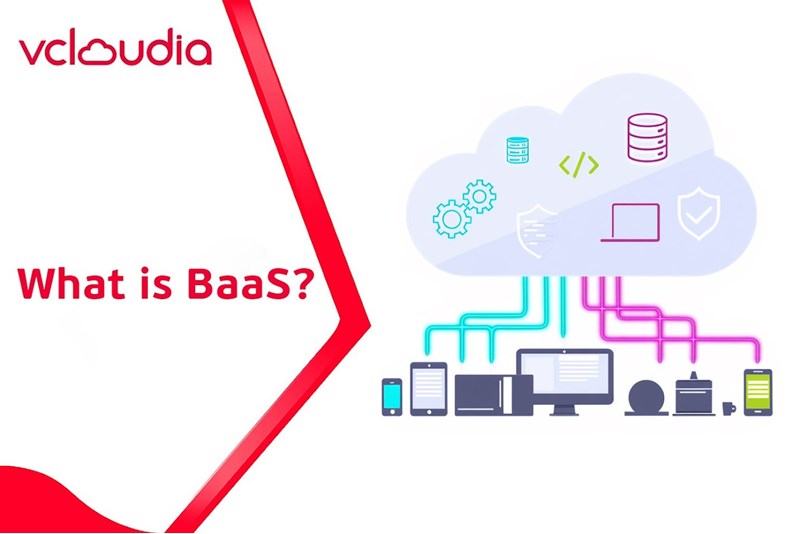
BaaS (Backend as a Service) is a cloud service model that provides ready-made backend functionalities for applications through APIs and SDKs. Instead of building the backend from the ground up, developers can directly use backend services offered by a BaaS platform.
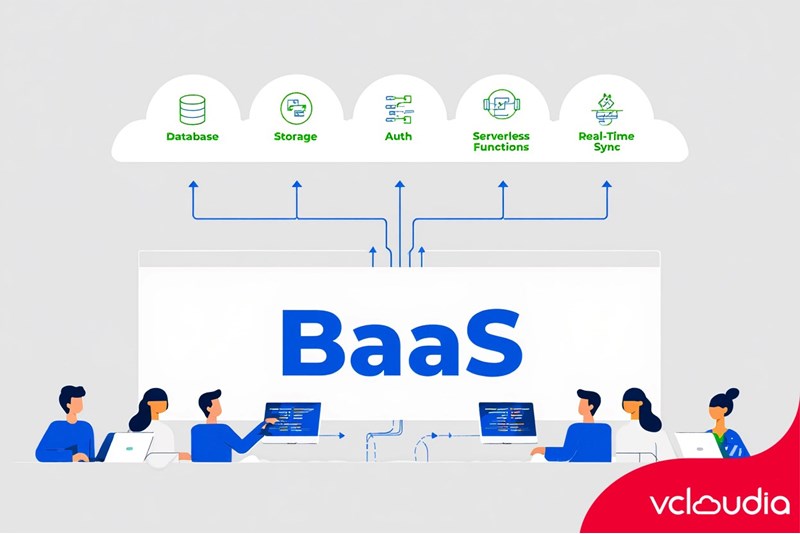
In simple terms, BaaS acts as a pre-built backend, typically including:
- Authentication and user management
- Database services
- File storage
- APIs
- Server-side logic (serverless functions)
- Hosting
- Monitoring and analytics
As a result, development teams can focus more on frontend development, user experience, and business logic, rather than infrastructure engineering.
How does BaaS work?
At its core, BaaS functions as a middleware layer between the application and the backend infrastructure.
A typical workflow looks like this:
- Users interact with the application (web or mobile).
- The application sends requests to APIs provided by the BaaS platform.
- The BaaS platform processes backend operations such as authentication, database queries, and data storage.
- The results are returned to the application and displayed to users.
All infrastructure components—including:
- Servers
- Databases
- Security mechanisms
- Networking
- Backups
- Monitoring
…are managed by the BaaS provider. Businesses only need to configure and consume the services.
This approach aligns perfectly with modern development needs: fast, flexible, and cost-efficient.
Core components of Backend as a Service
A comprehensive BaaS platform typically includes the following components:
1. Authentication & User Management
This is an essential feature for almost any application.
- BaaS platforms usually provide:
- Email/password sign-up and login
- Social login (Google, Facebook, Apple, etc.)
- Role-based access control
- Multi-factor authentication (MFA)
- Password reset and session management
This eliminates the need to build complex authentication systems from scratch.
2. Database
Most BaaS platforms include built-in databases, such as:
- NoSQL databases (e.g., Firebase Firestore)
- SQL databases (e.g., Supabase with PostgreSQL)
These databases are optimized for:
- Easy frontend integration
- Automatic scaling
- Real-time data synchronization
- Reduced operational overhead
3. File Storage
Applications often need to store:
- Profile images
- Documents
- Videos
- Attachments
BaaS platforms provide storage services with features such as:
- Access control management
- Secure file URLs
- Automatic scalability
- CDN integration for faster delivery
4. API
APIs serve as the bridge between frontend and backend.
BaaS platforms typically support:
- REST APIs
- GraphQL APIs
- Multi-language SDKs (JavaScript, Python, Flutter, Swift, etc.)
This makes backend integration consistent, maintainable, and developer-friendly.
5. Cloud / Serverless Functions
Serverless functions allow you to:
- Write server-side business logic
- Execute code based on events (event-driven)
- Run backend logic without managing servers
Common use cases include:
- Sending emails after user registration
- Processing payments
- Data validation
- Integrating third-party APIs
This provides flexibility without the complexity of traditional backend infrastructure.
6. Hosting & CDN
Many BaaS platforms also offer:
- Frontend hosting
- Content Delivery Networks (CDN)
- Automatic HTTPS
- One-click or simple deployment
This significantly shortens the deployment lifecycle.
7. Monitoring & Analytics
A reliable system requires strong observability.
BaaS platforms often include:
- Performance monitoring
- Request and error logging
- Crash reporting
- User behavior analytics
- Visual dashboards
These tools allow teams to monitor application health in real time.
Benefits of BaaS for businesses
1. Faster implementation time
With many backend components already built, teams can avoid weeks or months of infrastructure setup. In many cases, development can begin within hours.
This is especially valuable for:
- Startups
- MVP projects
- Small development teams
2. Lower operational costs
BaaS significantly reduces:
- DevOps staffing costs
- Server management costs
- Infrastructure maintenance
- Downtime risks caused by operational errors
Businesses pay based on usage rather than making large upfront investments.
3. Faster time to market
In competitive markets, time-to-market is critical.
BaaS enables:
- Rapid prototyping
- Early market validation
- Faster product launches than competitors
Many successful startups used BaaS to launch MVPs within weeks.
4. Easy scalability
As user numbers grow, infrastructure must scale accordingly.
Most BaaS platforms offer:
- Automatic resource scaling
- Reduced infrastructure bottlenecks
- Growth support without major architectural changes
5. Improved user experience
System stability, fast response times, and low downtime directly impact user satisfaction.
Thanks to optimized cloud infrastructure, CDN integration, and performance-focused architecture, BaaS can significantly enhance user experience.
Limitations of BaaS
Despite its advantages, BaaS is not suitable for every scenario.
1. Strong dependency on the provider
Using BaaS means depending on:
- The platform’s architecture
- Pricing policies
- Technical limitations
- Long-term stability of the provider
Migrating to another platform later can be difficult (vendor lock-in).
2. Limited backend customization
Compared to fully custom-built backends, BaaS:
- Offers less architectural control
- Makes deep optimizations harder
- Is less suitable for highly specialized systems
3. Rising costs at scale
BaaS is often very affordable at the beginning.
However, as usage and resource consumption increase, costs can grow quickly if the system is not well optimized.
4. Security risks still exist
Although major BaaS providers implement strong security measures:
- Misconfiguration can still lead to data exposure
- Multi-tenant environments inherently carry some risk
BaaS does not eliminate the organization’s responsibility for security.
Comparing BaaS with IaaS and PaaS
When should businesses use BaaS?
BaaS is particularly suitable when:
- Building an MVP to validate an idea
- A startup needs to launch quickly
- The team lacks backend engineers
- Developing small to medium web/mobile applications
- Speed is prioritized over complex architecture
When should businesses NOT use BaaS?
BaaS is not ideal when:
- The system architecture is highly complex
- The application requires extremely strict security control (e.g., core banking systems)
- The organization already has a strong DevOps team
- The product requires deep performance optimization
- Backend processing is extremely heavy and specialized
Popular BaaS platforms today
Some widely used BaaS platforms include:
- Firebase (Google): Very popular for mobile applications
- Supabase: Open-source, built on PostgreSQL
- Appwrite: Focused on self-hosted BaaS
- AWS Amplify: Deep integration with the AWS ecosystem
- Backendless: A low-code BaaS platform
Each platform has its own strengths, depending on your technical needs and team capabilities.
Conclusion
BaaS (Backend as a Service) is a modern infrastructure model that helps businesses and development teams reduce development time, optimize operational costs, and focus on delivering core product value.
In contexts such as:
- Startups building MVPs
- Businesses undergoing digital transformation
- Teams optimizing engineering resources
- BaaS is a highly practical and strategic choice.
However, for large-scale systems, complex architectures, or security-critical environments, organizations should carefully evaluate before adopting BaaS, or consider combining it with PaaS and IaaS models for optimal results.
Explore the services offered by Vcloudia – a leading provider of cloud computing and data center solutions. Contact us for expert consultation and find the right model for your needs:
- Hotline: +855 888 55 66 08 (free of charge)
- Fanpage: https://www.facebook.com/vcloudia/
- Website: https://vcloudia.com
Related news
Applications of Cloud Computing in the Healthcare Industry
The application of cloud computing in healthcare is ushering in a new era of improved service quality, optimized hospital operations, and comprehensive digital transformation across the medical sector. This is no longer a distant trend; it has become an essential component of the technological revolution in healthcare.
Can Cloud Servers Fully Replace Physical Servers? A Practical Analysis for Businesses
In today’s era of digital transformation, businesses are constantly seeking ways to optimize their technology infrastructure to improve operational efficiency. One of the most frequently asked questions is: “Can Cloud Servers completely replace physical servers?”
Cloud Server vs VPC: Which Solution Should Startups Choose to Optimize Cost and Performance?
Should a startup choose Cloud Server or VPC? This is a common question many founders and technology managers face when building infrastructure for their new businesses. The right choice not only helps optimize costs but also ensures stable performance and flexible scalability when needed.
What is Hybrid Cloud? How It Works, Pros and Cons, and When to Use It
In today’s digital era, optimizing scalability, data control, and operational performance is essential for businesses to maintain their competitive edge. One of the most effective technological solutions is the Hybrid Cloud model. So, what is Hybrid Cloud?
What is DaaS (Desktop as a Service)?
With its ability to deliver flexible work experiences, high-level security, and centralized management, DaaS is increasingly becoming an inevitable trend in the technology strategies of modern enterprises.
Virtual Private Cloud vs. Dedicated Private Cloud: Key Differences
In today’s digital era, choosing the right cloud computing platform plays a crucial role in determining a business’s operational efficiency. VPC vs. DPC are two commonly discussed concepts as organizations seek to optimize performance, security, and cost. Let’s explore these two service models in detail with Vcloudia.
Comparison Between Virtual Private Cloud and Virtual Private Server
In today’s technology-driven world, choosing the right hosting service for your business or personal needs is essential to ensure efficient operations and cost optimization. Among the most popular options are Virtual Private Cloud (VPC) and Virtual Private Server (VPS). Let’s explore the key differences between these two services with Vcloudia.
Should a Business Choose Shared Hosting or a Cloud Server?
When building and growing a business, choosing the right hosting service is crucial to ensure a website runs reliably, quickly, and securely. The two most common options today are Shared Hosting and Cloud Servers. Which one is the better fit for your business?
What Is Cloud Cost Management and Why Is It Important for Businesses?
As cloud computing services become increasingly popular and play a crucial role in business operations, controlling and optimizing cloud usage costs has become a decisive factor in maintaining profitability and operational efficiency. Vcloudia will help you better understand what cloud cost management is, why it matters, and how to implement it effectively within your organization.