



















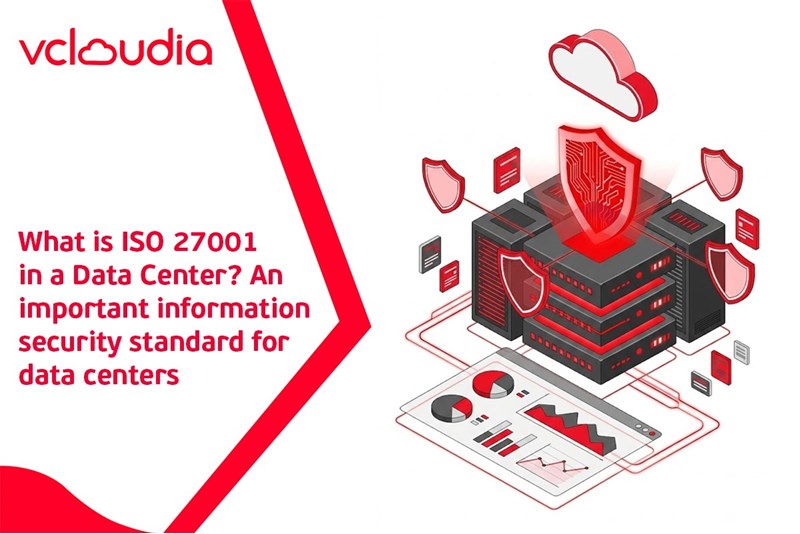
What is ISO 27001 in a Data Center? An important information security standard for data centers
Jun 30, 2026In the context where data has become a core asset of enterprises, information security is no longer an option but a mandatory requirement. For organizations providing storage services and operating IT infrastructure, especially Data Centers, complying with international security standards is a decisive factor in customer trust.
Among these, ISO 27001 is considered the leading important standard for information security management. So what is ISO 27001 in a Data Center? Why does this certification play a strategic role in building a secure data center system? The following article by Vcloudia will analyze this in detail.
What is ISO 27001 in a Data Center?
ISO 27001 is an international standard for the Information Security Management System (ISMS), issued by the International Organization for Standardization (ISO) and the International Electrotechnical Commission (IEC). This standard provides a comprehensive management framework to protect the confidentiality, integrity, and availability of information.
When applied to a Data Center environment, ISO 27001 is not simply about protecting servers or network systems. It encompasses the entire process of risk management, access control, physical security, logical security, operational monitoring, and incident handling related to customer data stored in the data center.
In other words, ISO 27001 in a Data Center is a standard framework that helps data centers build, operate, and maintain an information security system in a structured, controlled, and continuously improved manner. This is a key element to prove security capabilities to enterprise customers, especially in the finance, banking, e-commerce, technology, and digital services sectors.
How is ISO 27001 applied in a Data Center?
ISO 27001 has a broad and comprehensive scope of application in a data center environment. First of all is physical security, which includes access control, surveillance camera systems, technical area partitioning, server rack protection, and level-based access control. Restricting unauthorized access to the Data Hall area is an important requirement to reduce the risk of physical interference with equipment.
Additionally, there is the security of network systems and IT infrastructure. This includes firewall control, network segmentation, device configuration management, transmission data encryption, and security patch management. ISO 27001 requires Data Centers to have clear change control processes, avoiding risks arising from misconfiguration or uncontrolled deployment.
Access management is also a critical component. Personnel are only granted permissions according to the "least privilege" principle, only accessing the resources necessary for their work. Tracking, logging, and periodic auditing help ensure that all access activities are transparent and traceable when needed.
Furthermore, ISO 27001 also covers information asset management, security incident management, business continuity planning, and periodic risk assessments. All of these factors create a comprehensive security ecosystem within a Data Center.
Benefits of ISO 27001 for a Data Center
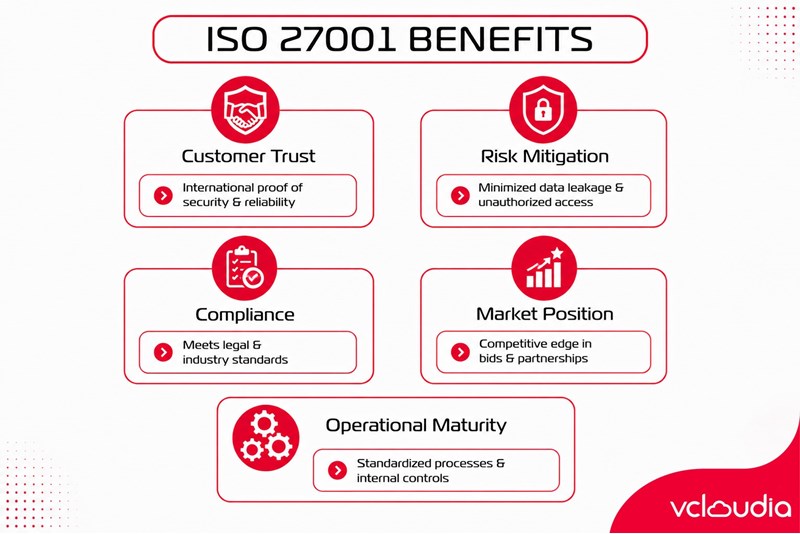
Enhancing reliability and prestige with customers
ISO 27001 certification is proof that a Data Center meets international security standards. This gives enterprise customers peace of mind when placing servers, deploying systems, or storing important data at that data center. In a competitive environment, security prestige is a key factor in attracting and retaining customers.
Minimizing the risk of data leakage
Through strict risk management and control processes, ISO 27001 helps minimize the possibility of data leakage, unauthorized access, or information loss. Periodic assessments and continuous improvements ensure the security system is always updated against new threats.
Meeting legal and compliance requirements
Many industries require compliance with strict data protection regulations. ISO 27001 helps Data Centers meet legal requirements and international standards, reducing the risk of being penalized or losing contracts due to security breaches.
Increasing competitive advantage
During the bidding process or signing contracts with large enterprises, ISO 27001 certification is often a prerequisite. A certified Data Center will have a clear advantage over uncertified competitors.
Standardizing operational processes and internal controls
ISO 27001 helps build clear processes, assign specific responsibilities, and establish strict internal controls. This not only enhances security but also improves the overall operational efficiency of the data center.
The process of achieving ISO 27001 certification for a Data Center
To achieve ISO 27001 certification, a Data Center needs to go through multiple systematic steps. First is assessing the current state of the system and determining the ISMS scope. Then, a risk assessment is conducted, and policies and procedures that align with the standard are developed.
The next phase is deploying control measures, including training personnel, establishing monitoring mechanisms, and completing documentation. Once the system operates stably, the Data Center conducts an internal audit to ensure it meets the standard's requirements.
Finally, an independent certification body will conduct an official audit. If the requirements are met, the Data Center will be granted the ISO 27001 certification. However, certification is not the endpoint but needs to be maintained through periodic audits and continuous improvements.
Challenges when implementing ISO 27001 in a Data Center
Implementing ISO 27001 requires investment in time, costs, and resources. Changing operational processes may face resistance from personnel. In addition, maintaining long-term compliance requires commitment from the leadership board and a security culture throughout the organization. Assessment, consulting, and auditing costs are also factors to consider. However, in the long term, the benefits of reduced risks and enhanced prestige usually far outweigh the initial costs.
When should enterprises choose an ISO 27001 certified Data Center?
Enterprises in the fields of finance, banking, fintech, e-commerce, SaaS, technology, or organizations storing large amounts of customer data should prioritize choosing an ISO 27001 certified Data Center. This is a way to ensure data is protected according to international standards and to minimize legal risks. Even small and medium-sized enterprises undergoing digital transformation should also consider this factor when selecting an infrastructure service provider, especially if data is a strategic asset.
Conclusion
ISO 27001 in a Data Center is not just a formal certification but a foundation for comprehensive security management. This standard helps data centers build systematic risk control systems, enhance reliability, and meet increasingly stringent requirements for information security.
In the context where data has become a core asset and cyber security threats are becoming more sophisticated, choosing an ISO 27001 certified Data Center is a strategic move to protect the enterprise and maintain sustainable growth.
Looking for a high-performance, secure solution?
Explore the services offered by Vcloudia – a leading provider of Cloud Computing and Data Center solutions. Contact us for expert consultation and find the right model for your needs:
- Hotline: +855 888 55 66 08 (free of charge)
- Fanpage: https://www.facebook.com/vcloudia/
- Website: https://vcloudia.com
Featured news
Related news
What Is Computer Vision? Applications of Computer Vision in Business
In an era where image and video data are increasingly dominant, the ability of machines to "see" and "understand" is no longer science fiction. This is precisely where Computer Vision enters the game. Far from being confined to high-tech fields, Computer Vision is progressively penetrating every corner of business - from manufacturing and retail to logistics and customer service.
What Is Pentest? Why Is Penetration Testing Necessary?
With the rapid advancement of technology and the internet, businesses are facing numerous information security risks. Alongside this, protecting data also requires more effective preventive and management measures to ensure the security of critical information, preventing risks of loss and unauthorized access.
What is Overflow? How to Identify and Fix Overflow Errors
Overflow in general, and Buffer Overflow in particular, are very common errors in the fields of computer security and programming. Not only do they cause applications to lose data and stop running, but they also harbor numerous other security risks that make it easy for hackers to launch attacks.
What is Redirect 302? Redirection Techniques and How to Fix Issues
Redirect 302 (Moved Temporarily) is a temporary redirection status code used when accessing a website without negatively impacting SEO. In this article, Vcloudia will help you gain a better understanding of Redirect 302, how to handle errors, and how to distinguish it from Redirect 301 (Moved Permanently) to implement it effectively for your website.
What is a 301 Redirect Error? How to Fix 301, 302, and 303 Errors
In the fields of website management and search engine optimization, understanding redirect status codes such as 301, 302, and 303 is extremely important. They play a decisive role in redirecting website URLs, directly impacting user experience and search performance.
What Is a 404 Not Found Error? Causes and Detailed, Fast Solutions
The 404 Not Found error is one of the most common HTTP status codes that Internet users encounter, appearing when the server cannot find the requested page or resource.
What is the 503 Service Unavailable Error? Causes & How to Fix It
503 Service Unavailable is an error encountered very frequently when using computers. Accordingly, this is a very common condition on websites because the server is unable to receive responses. So specifically, what is the 503 Service Unavailable error, what are its causes, and how can it be fixed?
What Is 500 Internal Server Error? Causes and How to Fix It
A 500 Internal Server Error occurs when a server encounters an issue while processing a request but cannot return a specific cause. This error can appear when visiting a website, using an application, calling an API, or operating a web system.
What is Fake IP? Latest Safe Ways to Fake IP in 2026
Faking your IP is a solution that helps change or conceal your real IP address when accessing the Internet in order to enhance privacy, strengthen security, and bypass regional restrictions.
What Is the Dark Web? Warnings When Accessing the Dark Web
the Dark Web What the Dark Web is sparks considerable curiosity, especially among users who are interested in and passionate about exploring the internet. Considered a small, dark corner of the internet and a hiding place for negative activities, the anonymous space of the dark web harbors many mysteries that not everyone fully understands.