



.png)


















.png)





What is a Trojan? How to Detect, Avoid, and Prevent It
Sep 21, 2026A Trojan is a type of malicious code or software that can cause severe consequences to computer operations. So, what is a Trojan? How can you prevent a Trojan from infiltrating your computer? In the following article, Vcloudia will provide detailed information on these issues.
What is a Trojan?
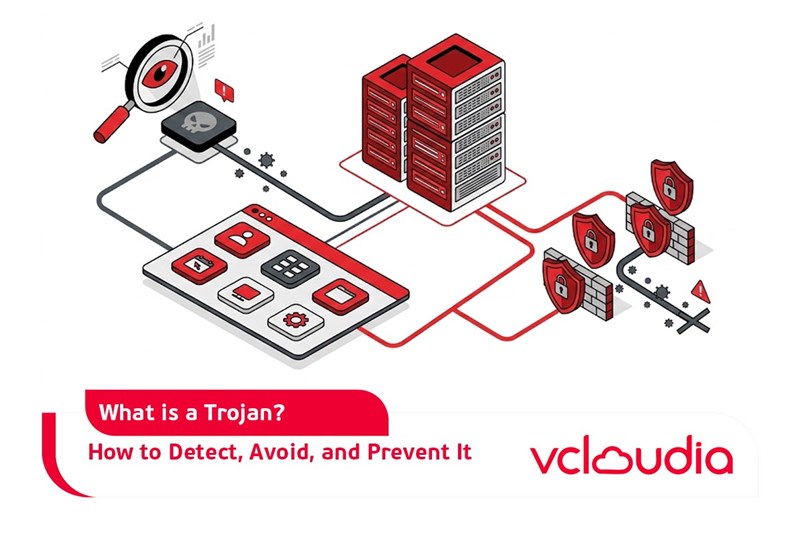
A Trojan is malicious software disguised as a useful program or application. When a user downloads and installs this Trojan, it infiltrates the system and executes destructive actions, stealing vital information and data on the computer.
The operating mechanism of this type of virus is also unusual; a Trojan does not self-replicate by infecting other files or computers. They exist silently within the user's computer to collect information or establish security vulnerabilities to take over the user's device. This type of malicious software can cause massive damage to user devices and threaten personal data stored on them. Unlike other types of viruses that, upon direct attack, are easily detected and eliminated by pre-installed antivirus software, this virus attacks the user's data system through software using extensions such as .exe, .com, .scr, .bat, etc.
Trojans themselves are also divided into various types of viruses, possessing characteristics such as Backdoor, Rootkit, Banker, Game Thief, Fake AV, etc. Therefore, the first step is to clearly distinguish which type of virus it is in order to handle it accurately.
How to detect a computer infected with a Trojan virus
Below are some common signs to identify a computer infected with a Trojan:
- Frequent system errors without a clear reason.
- Documents printing automatically or automatically changing font styles.
- Extremely slow device startup & opening of other programs.
- For Windows operating system users, the Start button does not appear.
- Chat windows automatically opening and closing without user interaction.
- The device automatically turning on and off multiple times.
- Files continuously being hidden.
- The sudden appearance of new applications.
The above are just the basic symptoms when a computer is infected with a virus. With the advancement of technology, malicious codes like Trojans are becoming increasingly sophisticated; they can infiltrate and operate within the system without leaving easily noticeable traces.
To protect systems comprehensively, especially for enterprises, cloud security solutions currently serve as one of the most robust prevention.
Common types of Trojans
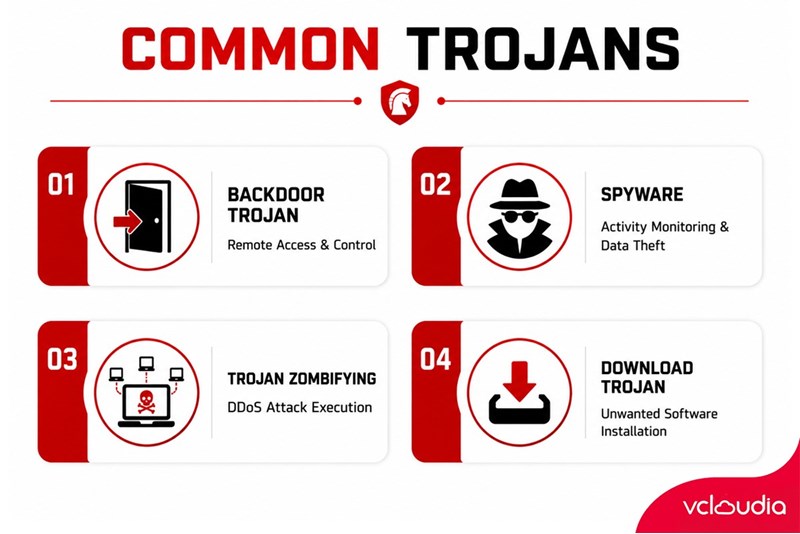
Depending on the purpose of the attack, there are many different types of Trojans. Below are the common types of Trojans today:
- Backdoor Trojan: This type of Trojan creates a backdoor in the victim's system, allowing attackers to access and control the computer remotely.
- Spyware: This is spyware that silently monitors all user activities to steal crucial personal information such as bank accounts.
- Trojan Zombifying: This type of Trojan executes DDoS attacks by seizing control of the computer.
- Download Trojan: This is a type of malicious code that causes the computer to automatically download unwanted software such as adware and junk software.
How a Trojan operates
A Trojan is a type of malicious code capable of hiding itself in normal files or programs to infiltrate a user's computer. It conceals itself in many different forms, such as software applications, page download links, advertising links, etc. At that point, if users are off their guard and click on them, the spyware will swiftly penetrate the computer system to steal user data. Therefore, to prevent these situations, we should avoid clicking on unknown links.
How to prevent Trojans
To prevent Trojans, users must absolutely not open any unfamiliar files, links, or software. This is because Trojans can only spread and propagate within the system when users click on content containing them. In addition, users can apply the following measures to prevent Trojans:
- Use antivirus software or a firewall.
- Regularly update the computer's vulnerability patches.
- Do not access unsafe websites, those without SSL certificates, or URLs that do not use the HTTPS protocol.
- Do not indiscriminately open links in emails unless absolutely certain they are from a legitimate source.
- Do not install programs lacking credibility.
Looking for a high-performance, secure solution?
Explore the services offered by Vcloudia – a leading provider of Cloud Computing and Data Center solutions. Contact us for expert consultation and find the right model for your needs:
- Hotline: +855 888 55 66 08 (free of charge)
- Fanpage: https://www.facebook.com/vcloudia/
- Website: https://vcloudia.com/
Featured news
Related news
What is a Snapshot? The Difference Between Snapshot and Backup
Snapshot is a familiar concept in data management and protection. In the context of the information technology boom, where data is a major asset for businesses, understanding Snapshots as well as their application is a key factor for enterprises to maximize technological efficiency.
What is a Firewall? The Role and Importance of Firewalls for Users
In the context of ever-increasing cyberattacks, system security has become a top priority for many enterprises. Alongside deploying antivirus software and controlling connection ports, firewalls are also considered a key solution to effectively enhance cybersecurity.
What is DDoS? Signs, Mitigation Strategies, and Effective Prevention
DDoS is a highly dangerous cyberattack that leaves severe consequences for enterprises. Therefore, gaining a clear understanding of DDoS attacks, as well as how to detect and prevent them, is a topic of significant interest to many.
What is Cloud Backup? Classification, benefits, and limitations
Cloud Backup is a solution that plays an important role in backing up and recovering data when an incident occurs. So what exactly is Cloud Backup? Let's find out the details with Vcloudia in the following article.
What is Cloud Storage? Features and Benefits of Using It
Cloud Storage is the perfect storage solution alternative to bulky, space-consuming physical hard drives. So, what is Cloud Storage? Let's explore the details with Vcloudia through the following article.
What is an API? Characteristics and applications in website design
API, short for Application Programming Interface, is a concept no longer unfamiliar in the information technology field. So what exactly is an API and why is it so important? Let's find out with Vcloudia.
What is Node.js? Instructions on how to install Node.js on cPanel
Currently, it is easy to see that Node.js is being used by quite a lot of people. This is because Node.js can support users in running on multiple platforms and multiple devices.
What is Vultr VPS? Should you use Vultr VPS?
Vultr VPS is one of the best cloud storage solutions in the world. In this article, you will learn the concept: "What is Vultr VPS?", as well as understand its advantages and disadvantages.
Zoom Cloud Meeting: What is it? Basic Things You Should Know About Zoom Cloud Meeting
In 2020, Zoom Cloud Meeting became one of the leading video conferencing software applications. It allows you to virtually interact with colleagues when in-person meetings aren't possible, and it has also been very successful for social events.