



.png)



















.png)





What is DDoS? Signs, Mitigation Strategies, and Effective Prevention
Sep 21, 2026DDoS is a highly dangerous cyberattack that leaves severe consequences for enterprises. Therefore, gaining a clear understanding of DDoS attacks, as well as how to detect and prevent them, is a topic of significant interest to many. In the following article, let's explore this issue in detail with Vcloudia!
What is DDoS?
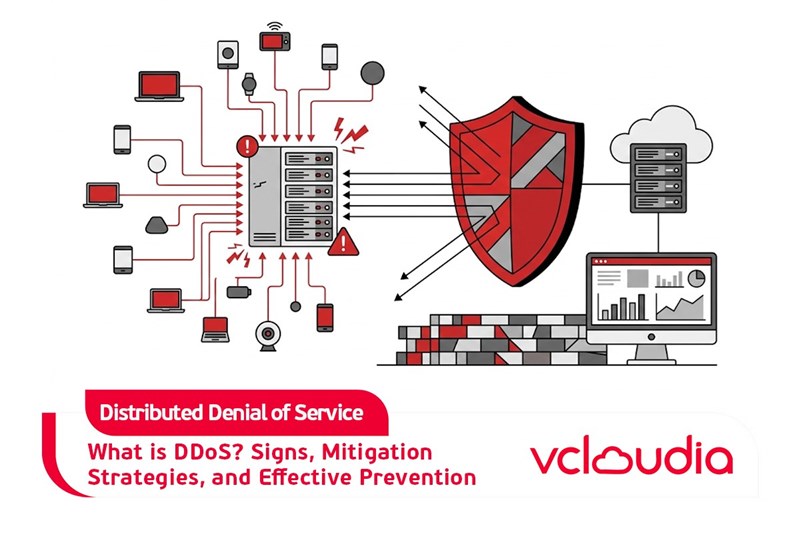
DDoS (Distributed Denial of Service) is a type of denial-of-service attack aimed at disrupting the normal operations of a server, a computer network, or an online service by overwhelming it with a massive volume of illegitimate traffic from multiple different sources. This causes the server to become overloaded, resulting in sluggish performance, unresponsiveness, or a complete shutdown.
The reach of DDoS attacks is not limited to any specific industry but can target all companies worldwide. A DDoS attack not only compromises information security but also impacts a business's revenue and reputation.
How a DDoS Attack Works
When executing a DDoS attack, hackers will send a swarm of bots or a botnet to the website leading to a site flood, which forces legitimate users out of the website due to traffic overload. The consequence of this attack is that the service and website are disrupted for a period of time. Exploiting this vulnerability, hackers can gain access to sensitive corporate information.
Common Types of DDoS Attacks Today
1. SYN Flood Attack
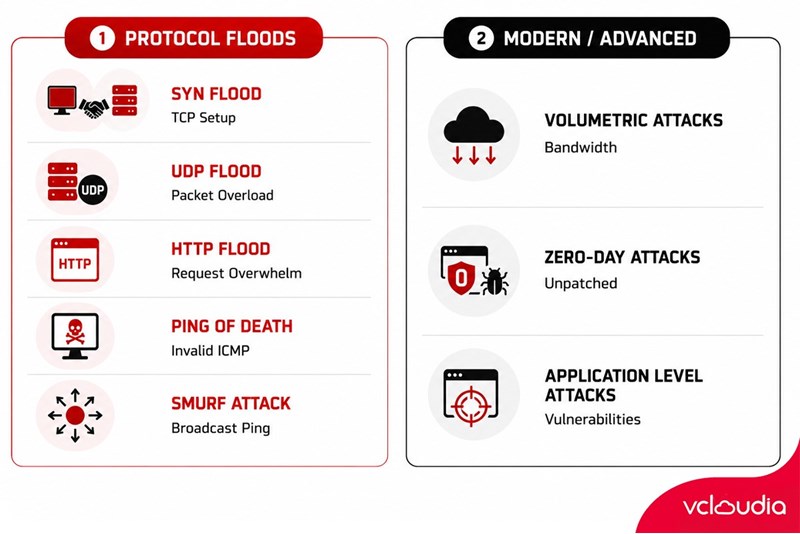
A SYN Flood attack is a type of Distributed Denial of Service (DDoS) attack that targets the TCP connection setup process. TCP is a widely used communication protocol on the Internet designed to ensure data is transmitted accurately and reliably.
2. UDP Flood Attack
In a UDP Flood attack, the attacker sends a massive amount of UDP packets to the target system from multiple different sources. This forces the system to process an overload of packets, leading to resource exhaustion and, ultimately, service disruption.
3. HTTP Flood Attack
An HTTP Flood attack is one of the most common methods for crippling online services. By sending a massive volume of spoofed HTTP requests, the attacker overwhelms the server, leading to severe disruptions in system operations.
4. Ping of Death Attack
The Ping of Death attack is a form of attack executed by sending a massive amount of invalid ICMP (Internet Control Message Protocol) packets to a computer or network, causing the target to freeze or reboot abruptly.
5. Smurf Attack
A Smurf Attack sends a massive volume of ping requests with a spoofed source IP address to a broadcast network. When the computers within this network respond to these requests, the target system receives a massive flood of replies, leading to an overload and shutdown.
6. Volumetric Attacks
Leveraging the available bandwidth of the target server, attackers consume larger bandwidth capacities to render the server inaccessible.
7. Zero-day DDoS Attack
This type of attack exploits unpatched vulnerabilities on the server to cause a system overload.
8. Application Level Attacks
This is a type of attack targeting applications with multiple vulnerabilities rather than focusing on the entire server.
How to Identify a DDoS Attack
Below are several signs indicating that the system is under a DDoS attack:
- An abnormal spike in website traffic originating from a single IP address or an IP range.
- During usage, your network or the system's network becomes unusually slow when accessing a Website or opening files, even though the Internet connection remains stable.
- Inability to access a specific page on the Website.
- The website, online store, or offline service goes completely down.
- Receiving an unusually high and abnormal amount of spam in your account.
How to Prevent DDoS Attacks
To protect your enterprise's system against DDoS attacks, you can reference the following strategies:
- Conduct periodic risk assessments to promptly detect and address emerging issues.
- Allocate dedicated personnel to respond to DDoS attacks for rapid resolution when issues arise.
- Utilize continuous monitoring tools, software, and services to rapidly detect and eliminate threats. These services are developed with the objective of maximizing the prevention of attacks on IT systems. This ensures the continuous and seamless operation of the enterprise.
What to Do During a DDoS Attack?
When the system has been attacked, you should immediately contact cybersecurity technicians and your server hosting provider for timely support.
Conclusion
Thus, gaining a clear understanding of what a DDoS is is critically important. In practice, understanding what DDoS is will help users implement better and more appropriate solutions to defend against these cyberattacks. Hopefully, this article by Vcloudia on what DDoS is will provide readers with highly useful information.
Looking for a high-performance, secure solution?
Explore the services offered by Vcloudia – a leading provider of Cloud Computing and Data Center solutions. Contact us for expert consultation and find the right model for your needs:
- Hotline: +855 888 55 66 08 (free of charge)
- Fanpage: https://www.facebook.com/vcloudia/
- Website: https://vcloudia.com/
Featured news
Related news
What is a Snapshot? The Difference Between Snapshot and Backup
Snapshot is a familiar concept in data management and protection. In the context of the information technology boom, where data is a major asset for businesses, understanding Snapshots as well as their application is a key factor for enterprises to maximize technological efficiency.
What is a Firewall? The Role and Importance of Firewalls for Users
In the context of ever-increasing cyberattacks, system security has become a top priority for many enterprises. Alongside deploying antivirus software and controlling connection ports, firewalls are also considered a key solution to effectively enhance cybersecurity.
What is a Trojan? How to Detect, Avoid, and Prevent It
A Trojan is a type of malicious code or software that can cause severe consequences to computer operations. So, what is a Trojan? How can you prevent a Trojan from infiltrating your computer? In the following article, Vcloudia will provide detailed information on these issues.
What is Cloud Backup? Classification, benefits, and limitations
Cloud Backup is a solution that plays an important role in backing up and recovering data when an incident occurs. So what exactly is Cloud Backup? Let's find out the details with Vcloudia in the following article.
What is Cloud Storage? Features and Benefits of Using It
Cloud Storage is the perfect storage solution alternative to bulky, space-consuming physical hard drives. So, what is Cloud Storage? Let's explore the details with Vcloudia through the following article.
What is an API? Characteristics and applications in website design
API, short for Application Programming Interface, is a concept no longer unfamiliar in the information technology field. So what exactly is an API and why is it so important? Let's find out with Vcloudia.
What is Node.js? Instructions on how to install Node.js on cPanel
Currently, it is easy to see that Node.js is being used by quite a lot of people. This is because Node.js can support users in running on multiple platforms and multiple devices.
What is Vultr VPS? Should you use Vultr VPS?
Vultr VPS is one of the best cloud storage solutions in the world. In this article, you will learn the concept: "What is Vultr VPS?", as well as understand its advantages and disadvantages.
Zoom Cloud Meeting: What is it? Basic Things You Should Know About Zoom Cloud Meeting
In 2020, Zoom Cloud Meeting became one of the leading video conferencing software applications. It allows you to virtually interact with colleagues when in-person meetings aren't possible, and it has also been very successful for social events.