



.png)



















.png)





What is Cloud Backup? Classification, benefits, and limitations
Sep 21, 2026Cloud Backup is a solution that plays an important role in backing up and recovering data when an incident occurs. So what exactly is Cloud Backup? Let's find out the details with Vcloudia in the following article.
What is Cloud Backup?
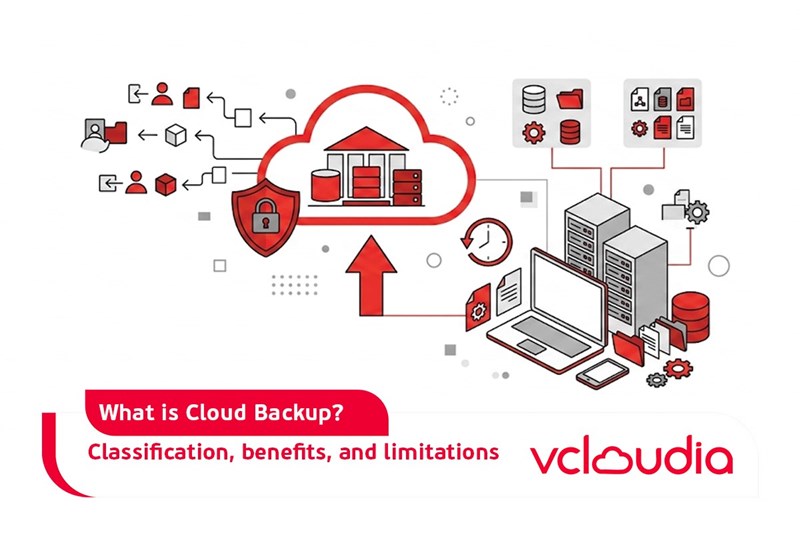
Cloud Backup (cloud data backup) is a data storage solution on remote servers typically managed by cloud service providers. Instead of storing data directly on a computer or local storage device, you will copy data to a cloud computing platform.
The backup of cloud data - Cloud Backup can help enhance the protection of critical data for businesses, especially when software errors, malware infections, or hacker attacks,... occur frequently as they do today. These very issues will cause businesses to lose important data, but with Cloud Backup services, the data will be safely protected.
Popular types of Cloud Backup
Full Backups
This is the method of backing up all data during a specific period (weekly, monthly,...) and can be used for recovery if an incident occurs. However, this backup method takes up quite a lot of cloud storage space.
Incremental Backups
Incremental backups only copy data that has changed since the last backup. Therefore, unchanged data will not need to be backed up again, helping to increase backup speed.
However, recovering all data in this case can take a lot of time. For example, when an incident occurs on Thursday, you will have to review all backups from Sunday to Wednesday to identify the changes and recover them gradually.
Differential Backups
Differential backups will proceed to copy all data that has changed since the last full backup. For example, if the most recent full backup falls on Sunday, the backup on Wednesday will copy all data that has changed since Sunday (including changes from Monday and Tuesday). The data recovery speed of this backup method will be faster than incremental backup because the recovered data only requires the last full backup and the first full backup.
Comparison between Cloud Backup and traditional data backup
In this section, we will explore what makes using Cloud Backup different compared to traditional backup.
Traditional data backup
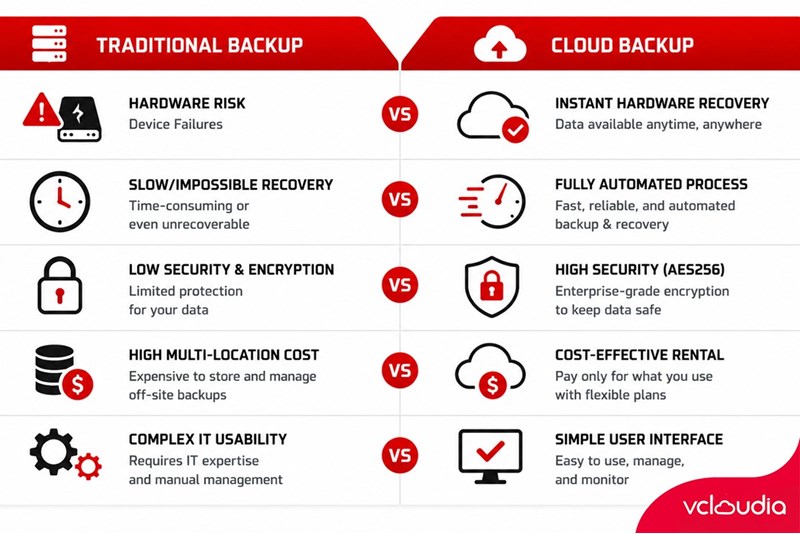
- Hardware failure issues: In the event of storage device failures, this causes the loss of important data.
- Recovery issues: When data is lost, it takes a considerable amount of time and effort to recover the data. Even in some cases, this recovery is almost impossible to perform.
- Security issues: Security is a major issue. Managing a physical server to ensure secure storage is not an easy task, especially for small businesses. Data encryption is not guaranteed, and information security is low.
- Cost issues: Backing up data at multiple locations is quite expensive and time-consuming.
- Usability issues: When users want to check the status of their data, or the data backup process itself is also an issue. It is particularly difficult for those without IT expertise.
Cloud Backup
- Hardware failure issues: When users unfortunately encounter data trouble, the recovery process with Cloud Backup is not a problem; this only takes a short amount of time.
- Recovery issues: Data backup on Cloud Backup happens completely automatically, without the need for user intervention. This is extremely easy and convenient.
- Security issues: Besides the automatic backup feature, the backup process is also constantly updated for users. When using Cloud Backup, data is encrypted with the latest standards (AES256, DES 64, RC2 128,...) ensuring a high level of security. Data is stored at the Data Center, widely distributed across server rooms nationwide. Data on Cloud Backup stored on storage devices and the cloud can help reduce service downtime.
- Cost issues: By renting individual service packages, users can save the maximum amount of costs they would spend on their data backup needs.
- Usability issues: Using Cloud Backup is quite simple with a relatively easy-to-use UI/UX interface. For the most part, these are basic operations intended for non-professionals.
Benefits of using Cloud Backup
For users utilizing data backup services, an element that they pay special attention to is the issue of security. If important data is unfortunately leaked or distributed externally, it will cause a lot of trouble for the users. Imagine when using Cloud Backup, data will be uploaded to the cloud via the Internet. Therefore, to secure information, Cloud Backup service providers will proceed to encrypt the data throughout the transit process.
Besides the fact that Cloud Backup can back up data conveniently, users can easily access it from multiple locations. Thus, access control on Cloud Backup is executed well to further ensure data security. Users can decentralize access permissions to the backups previously stored on the cloud. Not only that, but users can also set various modes such as read-only or write-only to help protect the backup data from being overwritten, altered, or deleted.
Potential limitations of Cloud Backup
Besides the outstanding benefits above, using Cloud Backup still has some limitations such as:
- Backup speed depends on bandwidth and latency.
- Costs can increase significantly when backing up a large amount of data to the cloud.
- User control over data is limited.
Conclusion
Thus, the online data backup service - Cloud Backup will make it more convenient and easier for users to back up data, with high security and rapid data recovery. Hopefully, this article by Vcloudia will give you a better overview in choosing between Cloud Backup and traditional data backup.
Looking for a high-performance, secure solution?
Explore the services offered by Vcloudia – a leading provider of Cloud Computing and Data Center solutions. Contact us for expert consultation and find the right model for your needs:
- Hotline: +855 888 55 66 08 (free of charge)
- Fanpage: https://www.facebook.com/vcloudia/
- Website: https://vcloudia.com/
Featured news
Related news
What is a Snapshot? The Difference Between Snapshot and Backup
Snapshot is a familiar concept in data management and protection. In the context of the information technology boom, where data is a major asset for businesses, understanding Snapshots as well as their application is a key factor for enterprises to maximize technological efficiency.
What is a Firewall? The Role and Importance of Firewalls for Users
In the context of ever-increasing cyberattacks, system security has become a top priority for many enterprises. Alongside deploying antivirus software and controlling connection ports, firewalls are also considered a key solution to effectively enhance cybersecurity.
What is DDoS? Signs, Mitigation Strategies, and Effective Prevention
DDoS is a highly dangerous cyberattack that leaves severe consequences for enterprises. Therefore, gaining a clear understanding of DDoS attacks, as well as how to detect and prevent them, is a topic of significant interest to many.
What is a Trojan? How to Detect, Avoid, and Prevent It
A Trojan is a type of malicious code or software that can cause severe consequences to computer operations. So, what is a Trojan? How can you prevent a Trojan from infiltrating your computer? In the following article, Vcloudia will provide detailed information on these issues.
What is Cloud Storage? Features and Benefits of Using It
Cloud Storage is the perfect storage solution alternative to bulky, space-consuming physical hard drives. So, what is Cloud Storage? Let's explore the details with Vcloudia through the following article.
What is an API? Characteristics and applications in website design
API, short for Application Programming Interface, is a concept no longer unfamiliar in the information technology field. So what exactly is an API and why is it so important? Let's find out with Vcloudia.
What is Node.js? Instructions on how to install Node.js on cPanel
Currently, it is easy to see that Node.js is being used by quite a lot of people. This is because Node.js can support users in running on multiple platforms and multiple devices.
What is Vultr VPS? Should you use Vultr VPS?
Vultr VPS is one of the best cloud storage solutions in the world. In this article, you will learn the concept: "What is Vultr VPS?", as well as understand its advantages and disadvantages.
Zoom Cloud Meeting: What is it? Basic Things You Should Know About Zoom Cloud Meeting
In 2020, Zoom Cloud Meeting became one of the leading video conferencing software applications. It allows you to virtually interact with colleagues when in-person meetings aren't possible, and it has also been very successful for social events.