



.png)



















.png)





What is Cloud Elasticity? Operating principles, benefits, and practical applications
May 29, 2026Cloud Elasticity is the ability to automatically increase or decrease resources such as CPU, RAM, memory, or bandwidth according to actual usage demands. Thanks to this flexible scaling mechanism, the system can ensure stable performance when traffic surges and simultaneously optimize operating costs when demand drops. Join Vcloudia in better understanding what Cloud Elasticity is, its operating mechanisms, and its practical applications in enterprises.
What is Cloud Elasticity?
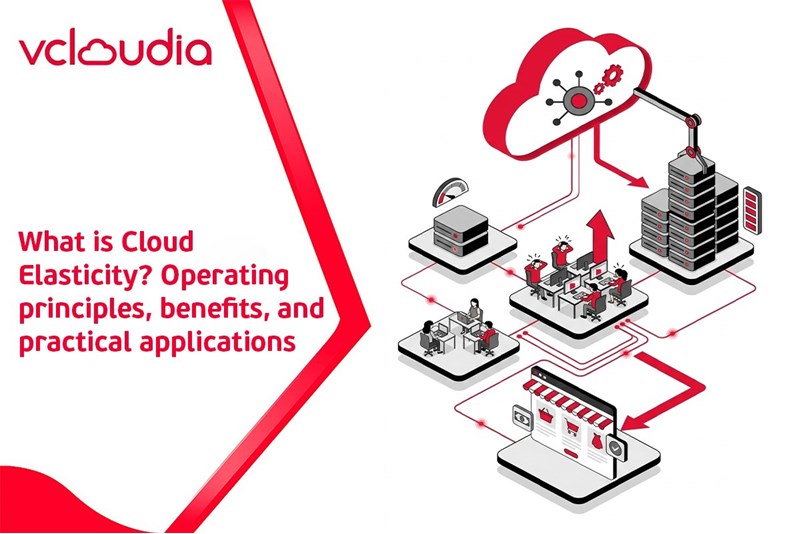
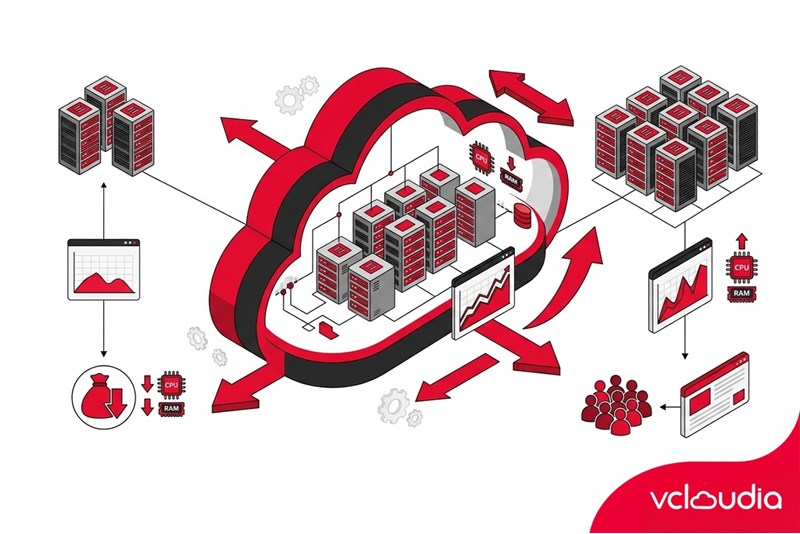
Cloud Elasticity (cloud elasticity) is the ability to automatically increase or decrease computing resources (CPU, RAM, storage) according to actual demands, helping to optimize performance and costs. When traffic or workloads surge, the system will automatically expand resources to ensure performance. Conversely, when demand decreases, resources are also scaled down to save costs.
The easiest example to understand is an e-commerce website. During major promotional events, the number of visitors can multiply many times compared to normal. If the system lacks elasticity, the servers may become overloaded. However, with Elastic Cloud Computing, the system will automatically supplement more resources to meet the surged traffic.
Operating principles of Cloud Elasticity
To understand how Cloud Elasticity operates, it is necessary to look at the automated mechanisms that help cloud systems adjust resources according to demand. In Elastic Cloud Computing, this process occurs continuously to ensure stable performance and optimize operating costs.
- Resource monitoring: The system continuously tracks metrics such as CPU, RAM, storage capacity, and bandwidth to detect changes in usage demand.
- Data analysis: Based on the collected information, the system evaluates resource usage trends and predicts the timing for adjustments.
- Automatic scaling: When the system load exceeds the threshold, the auto scaling mechanism will activate to add or remove servers in order to balance the workload.
- Load balancing: Load balancing distributes traffic across multiple different servers to avoid overload and ensure performance.
- Cost optimization: When demand drops, the system automatically shrinks resources to eliminate unnecessary infrastructure and save costs.
Benefits when enterprises use Cloud Elasticity technology
In the digital business environment, the demand for technology resources often changes continuously and is hard to predict. Thanks to the automatic resource expansion and contraction mechanism, Elastic Cloud Computing brings many practical benefits to organizations and enterprises.
Adapting to changing resource demands
Enterprises often encounter times of strongly surged traffic, such as advertising campaigns, peak shopping seasons, or new product launches. Cloud Elasticity allows the system to automatically expand resources when the load increases and shrink them when demand decreases, whereby applications always operate stably and user experiences are not interrupted.
Reducing infrastructure operating costs
One of the major advantages of Elastic Cloud Computing is that enterprises only pay for the amount of resources they actually use. When the workload drops, the system will automatically release surplus resources. This helps enterprises avoid wasting costs on servers or services that are no longer necessary.
Enhancing system stability and recovery capabilities
Elastic computing helps the system distribute workloads across multiple different resources. If one server encounters an issue, the system can automatically transfer the load to other servers. This mechanism helps minimize the risk of service disruption and elevates the reliability of the technology infrastructure.
Helping enterprises adapt quickly to market fluctuations
In a highly competitive environment, enterprises need the ability to quickly deploy or adjust services. Thanks to Cloud Elasticity, applications can be expanded or have their configurations changed in a short time to meet the new demands of the market or users.
Creating conditions for enterprises to easily expand operational scales
As an enterprise grows and the number of users increases, the infrastructure system must also expand accordingly. With Elastic Cloud Computing, increasing resources can be done flexibly without the need for immediate investments in new hardware. This helps enterprises focus their budgets on more important business activities.
Managing resources more automatically and efficiently
Modern cloud platforms provide many tools that help manage resources smartly. Thereby, elastic computing helps reduce manual workloads for system administration teams. Instead of spending time configuring infrastructure, they can focus on strategic tasks such as optimizing performance and developing products.
Advantages and disadvantages of Cloud Elasticity elastic computing
After clearly understanding what Cloud Elasticity means, many enterprises start considering the application of this model into their technology infrastructure. However, like any technology, Elastic Cloud Computing also has prominent benefits that come alongside certain limitations.
Practical applications of Elastic Cloud Computing
In reality, Cloud Elasticity is often deployed in systems with largely fluctuating user numbers or needing to process data at massive scales. Below are some typical sectors currently strongly applying this technology.
E-commerce
E-commerce platforms are a prime example of applying Elastic Cloud Computing. During major promotional events like Black Friday or seasonal sales campaigns, visitor numbers can multiply many times compared to normal. Thanks to elastic computing, systems can automatically supplement resources to ensure stable website operations, avoiding server overloads.
Streaming and online entertainment platforms
Video streaming, music listening, or livestreaming services usually see massive user increases at specific times. Elastic Cloud Computing allows the system to expand server resources to serve millions of simultaneous viewers. When user numbers decrease, resources are also scaled down to optimize operating costs.
SaaS applications and web services
Software as a Service (SaaS) platforms usually serve many enterprises with different usage scales. Applying elastic clouds helps systems automatically adjust resources based on user numbers and workloads. This ensures application performance remains continuously stable despite changing traffic.
Data analysis and artificial intelligence
In big data or AI projects, the volume of data that needs processing can vary immensely by stage. Elastic Cloud Computing enables the enhancement of computing resources when massive-scale data analysis is needed and reduces them when the workload drops. Therefore, enterprises can optimize costs while still ensuring data processing performance.
Comparing Cloud Elasticity and Cloud Scalability
In the field of cloud computing, two concepts frequently mentioned together are Cloud Elasticity and Cloud Scalability. Both relate to a system's ability to expand resources to meet increasingly growing usage demands. However, their purposes and operating methods are not entirely identical.
When should you use Cloud Elasticity?
Not every cloud system needs to deploy Cloud Elasticity. This technology exerts its highest efficiency in environments with frequently changing or hard-to-predict resource demands.
Frequently Asked Questions about Cloud Elasticity (FAQ)
What does Cloud Elasticity mean?
What does Cloud Elasticity mean? This is a cloud computing system's capability to automatically increase or decrease resources according to usage demands. Thus, systems can accommodate changing workloads while still optimizing operating costs.
Is Elastic Cloud Computing different from Auto Scaling?
Auto Scaling is a technical mechanism that helps deploy Elastic Cloud Computing. While Cloud Elasticity is a holistic concept regarding a system's elastic capabilities, Auto Scaling is a specific tool to execute that.
Is Cloud Elasticity the same as Cloud Scalability?
Cloud Elasticity and Cloud Scalability are related but not the same. Elasticity focuses on adjusting resources in real time, whereas Scalability aims at a system's long-term expansion capabilities.
Conclusion
In the context of increasingly developing online services, clearly understanding what Cloud Elasticity is and correctly applying it will help enterprises maximize the benefits of cloud computing. This is also a crucial foundation for technology systems to flexibly expand, well accommodate user demands, and support sustainable growth in the future.
Vcloudia Cloud Server – The Cloud You Can Count On
If you're concerned about the potential limitations of Cloud Servers, Cloud server by Vcloudia is a reliable solution for businesses of all sizes. With a modern infrastructure and comprehensive customer support, Vcloudia delivers a cloud experience with:
- Powerful connectivity to ensure stable 24/7 access
- Advanced security standards, compliant with international certifications such as ISO 27001:2013, ISO 20000:2018, ISO 9001:2015
- Flexible pricing packages tailored to your specific business needs
- Expert technical support, making migration and system deployment fast, safe, and compatible
Contact information:
- Hotline: +855 888 55 66 08 (free of charge)
- Fanpage: https://www.facebook.com/vcloudia/
- Website: https://vcloudia.com
Featured news
Related news
What is a Snapshot? The Difference Between Snapshot and Backup
Snapshot is a familiar concept in data management and protection. In the context of the information technology boom, where data is a major asset for businesses, understanding Snapshots as well as their application is a key factor for enterprises to maximize technological efficiency.
What is a Firewall? The Role and Importance of Firewalls for Users
In the context of ever-increasing cyberattacks, system security has become a top priority for many enterprises. Alongside deploying antivirus software and controlling connection ports, firewalls are also considered a key solution to effectively enhance cybersecurity.
What is DDoS? Signs, Mitigation Strategies, and Effective Prevention
DDoS is a highly dangerous cyberattack that leaves severe consequences for enterprises. Therefore, gaining a clear understanding of DDoS attacks, as well as how to detect and prevent them, is a topic of significant interest to many.
What is a Trojan? How to Detect, Avoid, and Prevent It
A Trojan is a type of malicious code or software that can cause severe consequences to computer operations. So, what is a Trojan? How can you prevent a Trojan from infiltrating your computer? In the following article, Vcloudia will provide detailed information on these issues.
What is Cloud Backup? Classification, benefits, and limitations
Cloud Backup is a solution that plays an important role in backing up and recovering data when an incident occurs. So what exactly is Cloud Backup? Let's find out the details with Vcloudia in the following article.
What is Cloud Storage? Features and Benefits of Using It
Cloud Storage is the perfect storage solution alternative to bulky, space-consuming physical hard drives. So, what is Cloud Storage? Let's explore the details with Vcloudia through the following article.
What is an API? Characteristics and applications in website design
API, short for Application Programming Interface, is a concept no longer unfamiliar in the information technology field. So what exactly is an API and why is it so important? Let's find out with Vcloudia.
What is Node.js? Instructions on how to install Node.js on cPanel
Currently, it is easy to see that Node.js is being used by quite a lot of people. This is because Node.js can support users in running on multiple platforms and multiple devices.
What is Vultr VPS? Should you use Vultr VPS?
Vultr VPS is one of the best cloud storage solutions in the world. In this article, you will learn the concept: "What is Vultr VPS?", as well as understand its advantages and disadvantages.
Zoom Cloud Meeting: What is it? Basic Things You Should Know About Zoom Cloud Meeting
In 2020, Zoom Cloud Meeting became one of the leading video conferencing software applications. It allows you to virtually interact with colleagues when in-person meetings aren't possible, and it has also been very successful for social events.