



.png)



















.png)





Reasons for sudden spikes in Cloud costs and how businesses can control them effectively
Apr 23, 2026Cloud computing brings flexibility and efficiency, but many businesses face the causes of unexpected and sudden spikes in Cloud costs. Understanding these factors clearly is the first step to controlling costs. In this article, Vcloudia will clearly analyze 7 common reasons for sudden spikes in Cloud costs and provide practical solutions for better optimization for businesses.
7 main reasons causing sudden spikes in Cloud costs
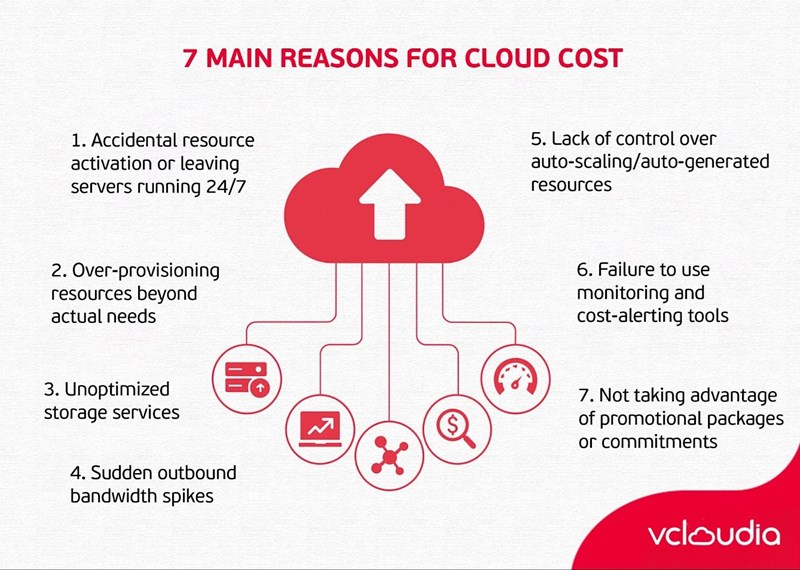
Uncontrolled Cloud usage can cause costs to multiply many times compared to the initial plan. Below are 7 reasons for sudden spikes in Cloud costs that businesses need to pay special attention to.
1. Accidentally turning on resources or leaving servers running 24/7
This is one of the most common and easily made reasons for sudden spikes in Cloud costs, especially in development and testing environments. Test and staging machines are not turned off when not in use. Testing environments (test, staging, dev) usually only need to operate during working hours or in a certain period. However, if there is no clear process to turn off or cancel these resources when not in use, they will continue to consume costs 24/7.
Unloaded VMs (no-load) still consume CPU/RAM/Disk resources. Even when a virtual machine (VM) does not process any requests, it still consumes costs for the allocated CPU, RAM, and disk space. Failing to identify and turn off these "forgotten" resources is a significant waste.
2. Utilizing resources excessively compared to needs
Overly generous resource provisioning compared to the actual needs of the application is a silent but very significant reason for sudden spikes in Cloud costs. Administrators often tend to choose a virtual machine (VM instance) configuration larger than necessary to ensure performance or "just in case" for the future. For example, an application that only needs 2 vCPU and 4GB RAM is allocated 8 vCPU and 16GB RAM. Without detailed performance and resource usage monitoring tools, businesses will not be able to know which resources are being wasted and need to be downsized (right-sizing), leading to paying for underutilized resources.
3. Unoptimized storage services
Storage costs can account for a large portion of the Cloud bill if not managed carefully. One of the mistakes is not using tiering storage, meaning storing all data on high-speed, expensive storage types, even rarely accessed data that could otherwise be placed in cheaper cold storage tiers.
Furthermore, snapshots and backups are very important for data safety, but they also consume storage space and incur costs. Failing to delete old, unneeded snapshots or backups on a regular schedule is also a common reason for sudden spikes in Cloud costs that many businesses ignore.
4. Sudden spikes in outbound bandwidth
Bandwidth costs, especially data transfer bandwidth out of the Cloud (outbound data transfer), are often an unexpected factor causing cost increases. Every time data is transferred from your Cloud service out to the internet (for example: users downloading files, APIs returning data to client applications), you will have to pay a fee. If a large amount of data is downloaded or a DDoS attack aims at consuming bandwidth, this cost can skyrocket uncontrollably.
In addition, using the Cloud for content delivery without configuring a CDN (Content Delivery Network) or optimizing caching means each request to load content will go directly to the origin server and consume outbound bandwidth, leading to unnecessarily high costs.
5. Failing to control automatically generated resources
Automation features like auto-scaling can be a double-edged sword if not configured and monitored carefully. If auto-scaling is configured too "sensitively" or has no maximum limit, the system can automatically increase the number of servers (instances) beyond what is necessary when there is a small traffic spike or an attack. This incurs huge costs without being controlled.
Similarly, in Microservices or Containerized environments (like Kubernetes), containers/services automatically initializing too many instances due to misconfiguration or application errors can also cause sudden spikes in costs, making budget management difficult.
6. Not using cost tracking and alerting tools
The lack of visibility and proactive control over costs is a serious reason for sudden spikes in Cloud costs, usually only realized when receiving the end-of-period bill. If there is no specific budget set up for each project, department, or service, costs can increase indiscriminately without anyone noticing. Furthermore, just looking at the total bill without the ability to analyze costs by specific service, application, or resource group will make identifying the cause of waste impossible, causing difficulty in making optimal decisions.
7. Not taking advantage of promotional packages or commitments
Cloud providers often have significant discount programs for committing to long-term resource usage. Using a 100% On-demand payment model instead of signing up for a cheaper commit package is a huge waste if the business has a stable and prolonged resource need. Committed usage packages (Reserved Instances, Savings Plans) can help save significantly.
In addition, individual resources are often not eligible for promotional packages, but if grouped together (for example: grouping multiple VMs with similar configurations), the business may qualify for Reserved Instance packages or larger prepaid packages with higher discounts, which many businesses have not fully utilized.
Identifying and thoroughly resolving these reasons for sudden spikes in Cloud costs is crucially important so that businesses can maximize the benefits of Cloud Computing without encountering unwanted financial burdens.
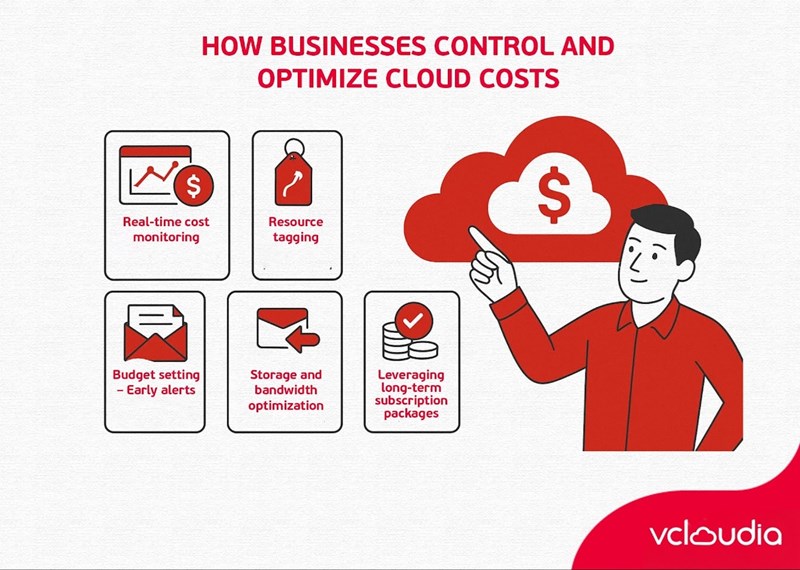
How businesses can control and optimize Cloud costs
After identifying the reasons for sudden spikes in Cloud costs, the next step is to build an effective control and optimization strategy. Applying the methods below will help businesses manage the Cloud budget more strictly, ensuring that investing in the cloud brings sustainable value.
1. Monitor costs in real-time
One of the most effective ways to control the reasons for sudden spikes in Cloud costs is to deploy a real-time cost tracking system. Through intuitive dashboards and detailed reports, businesses can analyze costs by each service, application, or department.
Major Cloud providers such as AWS Billing or GCP Cost Explorer all provide powerful tools to do this. Tracking costs in real-time all support sending alerts when spending levels exceed set thresholds, thereby helping businesses handle cost deviations promptly.
2. Tagging resources by application/project group
Tagging each Cloud resource (virtual machines, databases, storage, etc.) by application group, project, department, or cost center is a best practice in cloud cost management. This allows businesses to analyze costs in a detailed and accurate manner, clearly understanding how many Cloud resources each department, team, or product is consuming. From there, management can easily identify specifically where the reasons for sudden spikes in Cloud costs arise from, assign clear responsibilities, and make optimization decisions based on specific data, instead of just looking at vague total costs.
3. Setting budgets – early warnings
Setting specific budgets for each service, project, or department on the Cloud is a proactive control measure. Besides setting spending limits, businesses need to configure the system to automatically send early warnings (via email, Slack, or other notification channels) when spending levels reach certain thresholds (for example: 50%, 80% of the budget). This helps stakeholders quickly become aware of the situation, timely adjust resource usage before costs exceed control and become one of the difficult-to-handle reasons for sudden spikes in Cloud costs.
4. Optimizing storage and bandwidth
Optimizing storage and bandwidth costs is an important strategy to deal with data-related reasons for sudden spikes in Cloud costs. Businesses should proactively filter and delete old snapshots, unneeded backups, or junk data to reduce storage capacity. Applying data compression methods can help significantly reduce storage and transmission bandwidth costs. At the same time, it is necessary to minimize transferring large files out of the Cloud unnecessarily, and consider using CDN (Content Delivery Network) services if there is a need for widespread content distribution to minimize outbound bandwidth costs.
5. Utilizing long-term subscription packages
One of the most effective ways to reduce overall Cloud costs is to utilize long-term subscription packages or commitment (commit) programs from providers. Instead of using resources under the highest-priced On-demand model, businesses can register for committed usage packages. This helps reduce costs by up to 20-40% compared to sporadic usage. This is a smart financial strategy, turning a portion of the potential reasons for sudden spikes in Cloud costs into a cost advantage if the business has a stable resource need and a plan for long-term usage.
Vcloudia Cloud Server – The Cloud You Can Count On
If you're concerned about the potential limitations of Cloud Servers, Cloud server by Vcloudia is a reliable solution for businesses of all sizes. With a modern infrastructure and comprehensive customer support, Vcloudia delivers a cloud experience with:
- Powerful connectivity to ensure stable 24/7 access
- Advanced security standards, compliant with international certifications such as ISO 27001:2013, ISO 20000:2018, ISO 9001:2015
- Flexible pricing packages tailored to your specific business needs
- Expert technical support, making migration and system deployment fast, safe, and compatible
Contact information:
- Hotline: +855 888 55 66 08 (free of charge)
- Fanpage: https://www.facebook.com/vcloudia/
- Website: https://vcloudia.com
Featured news
Related news
What is a Snapshot? The Difference Between Snapshot and Backup
Snapshot is a familiar concept in data management and protection. In the context of the information technology boom, where data is a major asset for businesses, understanding Snapshots as well as their application is a key factor for enterprises to maximize technological efficiency.
What is a Firewall? The Role and Importance of Firewalls for Users
In the context of ever-increasing cyberattacks, system security has become a top priority for many enterprises. Alongside deploying antivirus software and controlling connection ports, firewalls are also considered a key solution to effectively enhance cybersecurity.
What is DDoS? Signs, Mitigation Strategies, and Effective Prevention
DDoS is a highly dangerous cyberattack that leaves severe consequences for enterprises. Therefore, gaining a clear understanding of DDoS attacks, as well as how to detect and prevent them, is a topic of significant interest to many.
What is a Trojan? How to Detect, Avoid, and Prevent It
A Trojan is a type of malicious code or software that can cause severe consequences to computer operations. So, what is a Trojan? How can you prevent a Trojan from infiltrating your computer? In the following article, Vcloudia will provide detailed information on these issues.
What is Cloud Backup? Classification, benefits, and limitations
Cloud Backup is a solution that plays an important role in backing up and recovering data when an incident occurs. So what exactly is Cloud Backup? Let's find out the details with Vcloudia in the following article.
What is Cloud Storage? Features and Benefits of Using It
Cloud Storage is the perfect storage solution alternative to bulky, space-consuming physical hard drives. So, what is Cloud Storage? Let's explore the details with Vcloudia through the following article.
What is an API? Characteristics and applications in website design
API, short for Application Programming Interface, is a concept no longer unfamiliar in the information technology field. So what exactly is an API and why is it so important? Let's find out with Vcloudia.
What is Node.js? Instructions on how to install Node.js on cPanel
Currently, it is easy to see that Node.js is being used by quite a lot of people. This is because Node.js can support users in running on multiple platforms and multiple devices.
What is Vultr VPS? Should you use Vultr VPS?
Vultr VPS is one of the best cloud storage solutions in the world. In this article, you will learn the concept: "What is Vultr VPS?", as well as understand its advantages and disadvantages.
Zoom Cloud Meeting: What is it? Basic Things You Should Know About Zoom Cloud Meeting
In 2020, Zoom Cloud Meeting became one of the leading video conferencing software applications. It allows you to virtually interact with colleagues when in-person meetings aren't possible, and it has also been very successful for social events.