



.png)



















.png)





What is a Cyber Attack? Types of Attacks and Prevention Methods
Apr 23, 2026Data security against cyber attacks is always a challenging issue for every business during the deployment and operation of information technology infrastructure. So, how can we promptly detect and prevent the risk of attacks and data theft? Let's find the answers with Vcloudia through the following article.
What is a Cyber Attack?
A cyber attack is a form of unauthorized access to computer networks, databases, websites, information technology infrastructure, etc., of any individual or organization via the internet. The purpose of cyber attacks is often to steal, alter, encrypt, and destroy data systems, cause disruption, hinder services, or exploit resources to display malicious code, advertisements, etc.
Types of Cyber Attacks
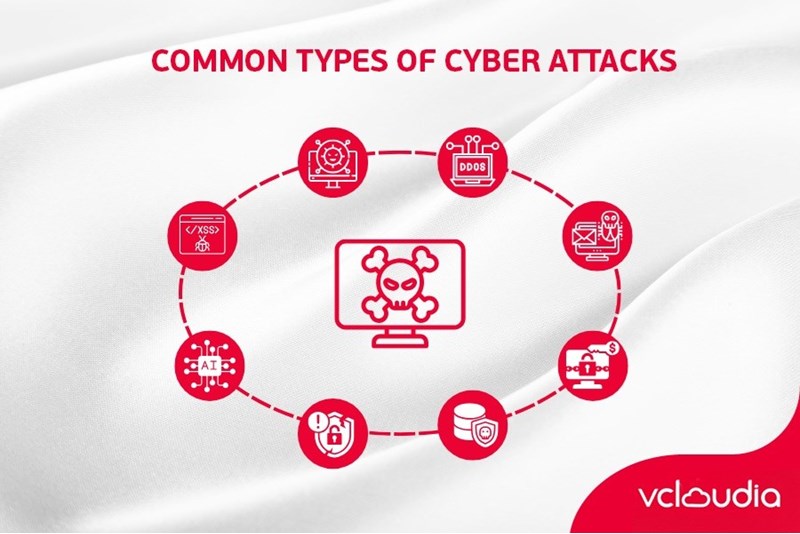
The types of cyber attacks are quite diverse, including:
- DDoS (Distributed Denial of Service attack): This is one of the most common forms of cyber attacks today. DDoS can overload a target server with a flood of requests from many different devices, making the server unable to serve legitimate requests. This leads to system disruption, or even a complete shutdown.
- Malware (Malicious software attack): After infecting a computer system through fake websites, emails, USBs, etc., malware will take control, thereby stealing data and causing harm to the system. Common types of malware include trojans, viruses, spyware, and worms.
- Phishing attack (Spoofing attack): In this form of attack, scammers often impersonate reputable units and organizations and request users to download files or click on links containing malicious code, with the aim of stealing sensitive information such as bank PINs, login accounts, credit card information, etc.
- Ransomware (Data encryption attack): Hackers use programming languages to encrypt data and steal sensitive information. Then, they use this information to threaten and extort money from the victims.
- Zero day attack (Attack exploiting Zero-day vulnerabilities): Zero-day vulnerabilities are security flaws that have not been discovered and do not have an official patch. Hackers will exploit these vulnerabilities to easily infiltrate computer systems, steal information, spread malware, etc. If not prevented in time, a Zero-day attack can cause severe consequences for businesses and internet users.
- SQL Injection (Web application security attack): SQL Injection occurs when a web application does not handle user input correctly, leading to hackers infiltrating and inserting malicious SQL code into the database. From there, hackers will gain control of the data and can modify or delete sensitive data.
- Cross-Site Scripting (XSS): Scammers will insert malicious code into web applications. If a user accesses the website, the browser will automatically execute the installed malicious code. XSS includes three common forms of attack: DOM-based XSS, Reflected XSS, and Stored XSS.
- Attacks using AI and exploiting AI vulnerabilities: Scammers exploit artificial intelligence technology to automate the attack process or find new attack methods, such as deepfakes.
Some Recent Cyber Attacks
Currently, cyber attacks are taking place in a very sophisticated and complex manner. They not only cause serious financial damage but also stall the business and production activities of enterprises and affect millions of users.
Below are some cyber attacks around the world:
- Ransomware attack at VNDirect Securities Corporation on March 24, 2024: Disrupted all trading activities on the stock exchange, affecting the company's reputation and profits.
- Ransomware attack at PetroVietnam Oil Corporation (PVOIL) on April 2, 2024: Caused PVOIL's information technology system to stall, in which the electronic invoice issuance system for sales could temporarily not be implemented.
- Large-scale malware attack at Kadokawa Group (Japan) on June 8, 2024: Disrupted many online services, including Niconico - a video-sharing platform, and tracking press conferences of government officials.
- Cyber attack at Sibanye-Stillwater mining company (South Africa) on July 8, 2024: Crashed the company's servers and disrupted systems globally.
- Cyber attack at Seattle-Tacoma International Airport (SEA-TAC) on August 24, 2024: Caused the information technology system to stop working, delaying many flights and forcing SEA-TAC to isolate critical systems to mitigate damage.
How to Prevent Cyber Attacks
To prevent cyber attacks, businesses should apply measures such as:
- Use security software such as Antivirus, firewalls, and Anti-malware.
- Back up regularly to promptly recover data in case of incidents.
- Monitor and update software and applications to the latest versions.
- Combine multi-factor authentication methods to control access activities.
- Train employees on cybersecurity knowledge within the business.
- Use data storage and security services from reputable providers.
Vcloudia Cloud Server – The Cloud You Can Count On
If you're concerned about the potential limitations of Cloud Servers, Cloud server by Vcloudia is a reliable solution for businesses of all sizes. With a modern infrastructure and comprehensive customer support, Vcloudia delivers a cloud experience with:
- Powerful connectivity to ensure stable 24/7 access
- Advanced security standards, compliant with international certifications such as ISO 27001:2013, ISO 20000:2018, ISO 9001:2015
- Flexible pricing packages tailored to your specific business needs
- Expert technical support, making migration and system deployment fast, safe, and compatible
Contact information:
- Hotline: +855 888 55 66 08 (free of charge)
- Fanpage: https://www.facebook.com/vcloudia/
- Website: https://vcloudia.com
Featured news
Related news
What is a Snapshot? The Difference Between Snapshot and Backup
Snapshot is a familiar concept in data management and protection. In the context of the information technology boom, where data is a major asset for businesses, understanding Snapshots as well as their application is a key factor for enterprises to maximize technological efficiency.
What is a Firewall? The Role and Importance of Firewalls for Users
In the context of ever-increasing cyberattacks, system security has become a top priority for many enterprises. Alongside deploying antivirus software and controlling connection ports, firewalls are also considered a key solution to effectively enhance cybersecurity.
What is DDoS? Signs, Mitigation Strategies, and Effective Prevention
DDoS is a highly dangerous cyberattack that leaves severe consequences for enterprises. Therefore, gaining a clear understanding of DDoS attacks, as well as how to detect and prevent them, is a topic of significant interest to many.
What is a Trojan? How to Detect, Avoid, and Prevent It
A Trojan is a type of malicious code or software that can cause severe consequences to computer operations. So, what is a Trojan? How can you prevent a Trojan from infiltrating your computer? In the following article, Vcloudia will provide detailed information on these issues.
What is Cloud Backup? Classification, benefits, and limitations
Cloud Backup is a solution that plays an important role in backing up and recovering data when an incident occurs. So what exactly is Cloud Backup? Let's find out the details with Vcloudia in the following article.
What is Cloud Storage? Features and Benefits of Using It
Cloud Storage is the perfect storage solution alternative to bulky, space-consuming physical hard drives. So, what is Cloud Storage? Let's explore the details with Vcloudia through the following article.
What is an API? Characteristics and applications in website design
API, short for Application Programming Interface, is a concept no longer unfamiliar in the information technology field. So what exactly is an API and why is it so important? Let's find out with Vcloudia.
What is Node.js? Instructions on how to install Node.js on cPanel
Currently, it is easy to see that Node.js is being used by quite a lot of people. This is because Node.js can support users in running on multiple platforms and multiple devices.
What is Vultr VPS? Should you use Vultr VPS?
Vultr VPS is one of the best cloud storage solutions in the world. In this article, you will learn the concept: "What is Vultr VPS?", as well as understand its advantages and disadvantages.
Zoom Cloud Meeting: What is it? Basic Things You Should Know About Zoom Cloud Meeting
In 2020, Zoom Cloud Meeting became one of the leading video conferencing software applications. It allows you to virtually interact with colleagues when in-person meetings aren't possible, and it has also been very successful for social events.