



.png)



















.png)





5 Common Mistakes That Make Cloud Adoption Ineffective for Businesses
Apr 23, 2026Thanks to its flexible scalability and operational performance optimization, Cloud has become the top choice for many organizations and enterprises. However, not every business can fully exploit the potential of cloud technology. Let Vcloudia help you explore the 5 common mistakes that make cloud adoption ineffective, as well as some sustainable cloud deployment solutions through the article below.
Why do many businesses use Cloud but fail to achieve expected results?
Despite bringing many practical benefits and contributing to the digital transformation process, Cloud is not a "panacea" if businesses use it incorrectly. Reality shows that many organizations and enterprises transition to the Cloud mechanically and hastily, without thoroughly assessing the current system status or building a specific roadmap. Additionally, businesses often simply migrate from On-premise to the cloud environment without restructuring their infrastructure. This leads to inefficient resource utilization and high costs without bringing significant improvements in operational performance.
The fact that businesses use Cloud but do not achieve the expected efficiency can also stem from a shortage of expert teams. The process of operating a cloud platform requires personnel to have a deep understanding of system optimization, resource management, and other related skills. Without high-level professional human resources, businesses will face many difficulties in deploying, monitoring, and managing IT infrastructure.
Furthermore, some businesses still underestimate the security factor when using Cloud. Without fully equipping information security measures, businesses are easily targeted by cyberattacks and data theft. Simultaneously, choosing the wrong service or cooperating with untrustworthy providers also significantly affects system operational efficiency, causing many difficulties for businesses in their production and business processes.
5 common mistakes that make cloud adoption ineffective for businesses
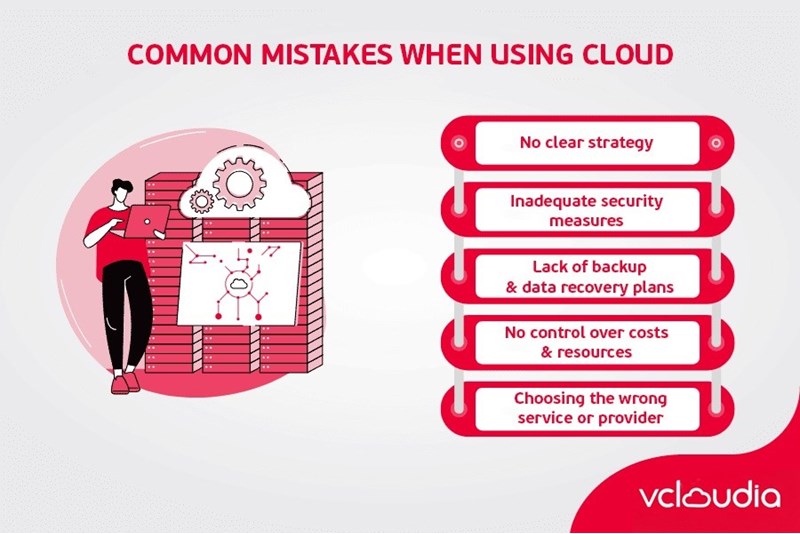
Transitioning to the Cloud without a clear strategy
Lack of a clear strategy and roadmap is one of the most common reasons why businesses use Cloud ineffectively. Many businesses simply follow technology trends without identifying specific goals, such as cost savings, performance enhancement, or information security strengthening.
The Cloud deployment process is also implemented in a fragmented manner without focusing on core services. Besides, businesses often neglect building plans for internal workflow transformation and personnel training. Consequently, businesses not only miss opportunities for system optimization and upgrades but also face wasted time and budget on unnecessary services.
Choosing the wrong type of Cloud service (or provider)
Many businesses still hold the perception that only Cloud services from foreign providers guarantee prestige and quality. However, they often overlook factors such as domestic legal regulations and access speeds when using international services.
In addition, choosing the right cloud model is also a significant challenge. Not a few businesses still do not truly understand the pros and cons of each type of service, leading to wrong decisions. For example, they might choose Public Cloud for applications requiring high security or vice versa.
Furthermore, businesses often do not thoroughly evaluate the cloud provider's capacity before collaborating. Factors such as infrastructure, international certifications, and technical support play an extremely important role, yet not every business considers this.
Failure to control Cloud costs and resources
Negligence in monitoring the system operation process causes many businesses to face wasted resources and services. Instead of optimizing infrastructure configuration, businesses allow systems to operate 24/7 unnecessarily. On the other hand, not understanding the Pay-as-you-go billing model is also silently "eroding" business budgets, thereby reducing the efficiency of using cloud services.
Loose security, data prone to leakage
A common mistake among businesses when applying Cloud technology is not tightening information security measures. Activating multi-factor authentication, integrating firewalls, permission management, backup, and encryption of sensitive data are essential. However, many businesses are subjective and skip these steps, creating conditions for malicious actors to exploit security vulnerabilities. Bad actors can infiltrate from inside or outside the system, causing serious damage to the business.
Lack of backup and Disaster Recovery (DR) plans
Monitoring and periodically testing data recovery capabilities are still being underestimated by businesses. As a result, a business's network infrastructure system can fall into a state of total paralysis if unexpected incidents such as cyberattacks, power outages, or accidental data deletion occur.
Additionally, some businesses often do not prepare backups in different locations and do not use DRaaS services. This causes many difficulties for businesses in restoring original data, as well as greatly affecting production and business activities.
Effective and Sustainable Cloud Deployment Solutions for Businesses
Below are some effective cloud deployment solutions that businesses should refer to and apply:
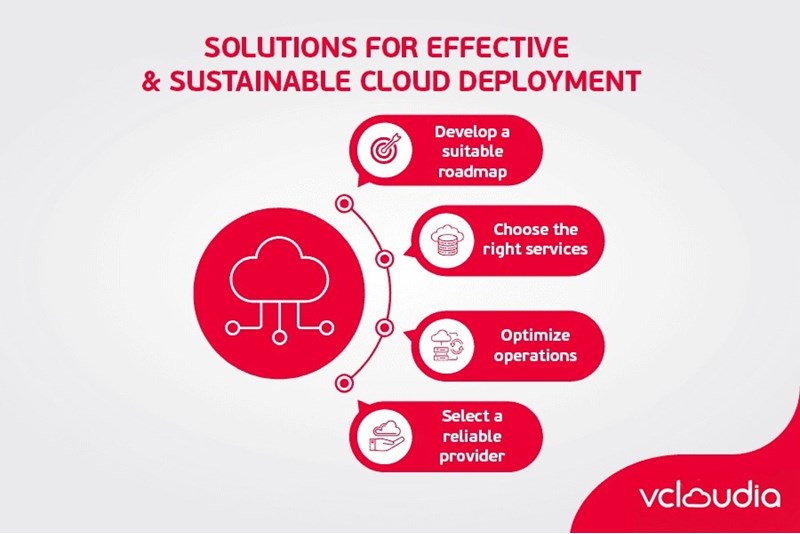
- Building a suitable roadmap: Before starting to apply cloud technology, businesses should identify goals and comprehensively assess operational scale to develop a detailed and clear strategy. This approach will help businesses minimize risks and optimize budgets and resources effectively.
- Choosing the right service: Depending on practical purposes and needs, businesses need to consider using appropriate Cloud services, such as Cloud Server, VPC, Cloud Storage, DRaaS, Cloud PC, etc. Furthermore, businesses should also consider pricing and security factors to make the right choice.
- Optimizing operations: To ensure the system operates continuously without interruption, businesses need to strengthen resource monitoring and track all access activities. Additionally, promoting automated backup solutions will help businesses minimize the risk of data leakage and loss.
- Collaborating with reliable providers: Businesses should only choose providers with strong infrastructure, transparency commitments regarding operational performance and security capabilities, as well as quick and timely technical support. To ensure compliance with domestic legal regulations, businesses should prioritize collaborating with local Cloud providers.
Vcloudia Cloud Server – The Cloud You Can Count On
If you're concerned about the potential limitations of Cloud Servers, Cloud server by Vcloudia is a reliable solution for businesses of all sizes. With a modern infrastructure and comprehensive customer support, Vcloudia delivers a cloud experience with:
- Powerful connectivity to ensure stable 24/7 access
- Advanced security standards, compliant with international certifications such as ISO 27001:2013, ISO 20000:2018, ISO 9001:2015
- Flexible pricing packages tailored to your specific business needs
- Expert technical support, making migration and system deployment fast, safe, and compatible
Contact information:
- Hotline: +855 888 55 66 08 (free of charge)
- Fanpage: https://www.facebook.com/vcloudia/
- Website: https://vcloudia.com
Featured news
Related news
What is a Snapshot? The Difference Between Snapshot and Backup
Snapshot is a familiar concept in data management and protection. In the context of the information technology boom, where data is a major asset for businesses, understanding Snapshots as well as their application is a key factor for enterprises to maximize technological efficiency.
What is a Firewall? The Role and Importance of Firewalls for Users
In the context of ever-increasing cyberattacks, system security has become a top priority for many enterprises. Alongside deploying antivirus software and controlling connection ports, firewalls are also considered a key solution to effectively enhance cybersecurity.
What is DDoS? Signs, Mitigation Strategies, and Effective Prevention
DDoS is a highly dangerous cyberattack that leaves severe consequences for enterprises. Therefore, gaining a clear understanding of DDoS attacks, as well as how to detect and prevent them, is a topic of significant interest to many.
What is a Trojan? How to Detect, Avoid, and Prevent It
A Trojan is a type of malicious code or software that can cause severe consequences to computer operations. So, what is a Trojan? How can you prevent a Trojan from infiltrating your computer? In the following article, Vcloudia will provide detailed information on these issues.
What is Cloud Backup? Classification, benefits, and limitations
Cloud Backup is a solution that plays an important role in backing up and recovering data when an incident occurs. So what exactly is Cloud Backup? Let's find out the details with Vcloudia in the following article.
What is Cloud Storage? Features and Benefits of Using It
Cloud Storage is the perfect storage solution alternative to bulky, space-consuming physical hard drives. So, what is Cloud Storage? Let's explore the details with Vcloudia through the following article.
What is an API? Characteristics and applications in website design
API, short for Application Programming Interface, is a concept no longer unfamiliar in the information technology field. So what exactly is an API and why is it so important? Let's find out with Vcloudia.
What is Node.js? Instructions on how to install Node.js on cPanel
Currently, it is easy to see that Node.js is being used by quite a lot of people. This is because Node.js can support users in running on multiple platforms and multiple devices.
What is Vultr VPS? Should you use Vultr VPS?
Vultr VPS is one of the best cloud storage solutions in the world. In this article, you will learn the concept: "What is Vultr VPS?", as well as understand its advantages and disadvantages.
Zoom Cloud Meeting: What is it? Basic Things You Should Know About Zoom Cloud Meeting
In 2020, Zoom Cloud Meeting became one of the leading video conferencing software applications. It allows you to virtually interact with colleagues when in-person meetings aren't possible, and it has also been very successful for social events.