



.png)
















.png)





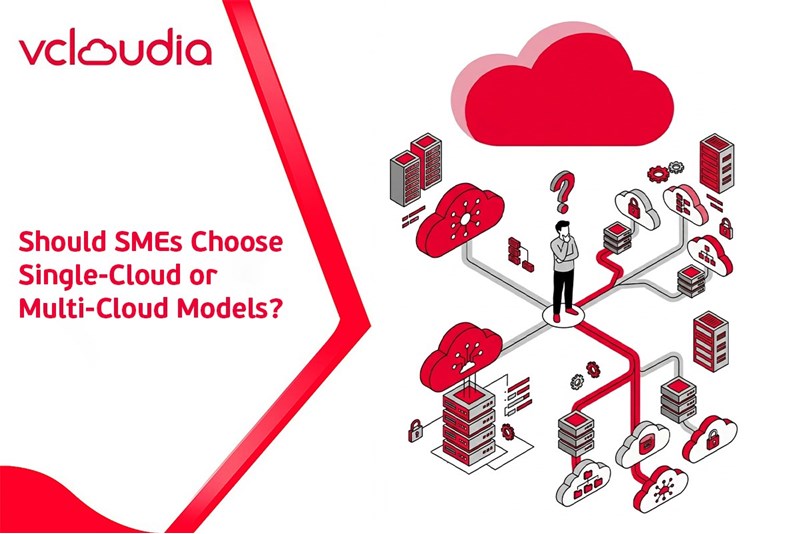
Should SMEs Choose Single-Cloud or Multi-Cloud Models?
Apr 23, 2026Digital transformation has been becoming a strategic priority for many small and medium-sized enterprises (SMEs). In this process, choosing the right cloud computing model plays a crucial role, directly affecting operational efficiency, costs, and future scalability. However, many SMEs are currently wondering between two popular models: Single-Cloud and Multi-Cloud – which is the right choice for the current development stage?
In the article below, Vcloudia will analyze each model in detail, point out the pros and cons, and provide a suggested roadmap so that SMEs can start in the right direction and gradually optimize according to scale and actual needs.
Overview of Single-Cloud and Multi-Cloud
Before choosing the right Cloud model, SMEs need to clearly understand the differences between Single-Cloud and Multi-Cloud. Each model brings its own benefits in terms of deployment, operation, and system expansion.
What is Single-Cloud?
Single-Cloud is a model in which an enterprise uses the entire infrastructure and services from a single Cloud provider. All resources – including storage, processing, software, and security – are deployed and operated within the same environment. This is a popular choice for SMEs just starting digital transformation because of its simplicity, ease of management, and centralized support.
What is Multi-Cloud?
Multi-Cloud is a model in which an enterprise combines multiple different Cloud providers to deploy services, data, and applications depending on specific purposes. For example, an SME can use Cloud A for data storage, Cloud B for AI/ML services, and Cloud C for backup and redundancy. This approach helps businesses leverage the unique strengths of each provider and enhance flexibility in system architecture.
Pros and Cons of Each Model for SMEs
For SMEs, each choice comes with its own benefits and challenges, directly affecting operational efficiency and investment costs. Below is an analysis of the pros and cons to help businesses consider realistically.
Advantages of Single-Cloud
Single-Cloud is a popular choice for SMEs thanks to its simplicity in operation and management. Businesses only need to work with a single provider, so it is easy to deploy, monitor the system, and receive technical support when needed.
This model helps centralize technical support contact points, from configuration and operation to troubleshooting – reducing administration time and costs. With lower initial deployment costs compared to Multi-Cloud, this is a suitable choice for small and medium enterprises that do not yet have much budget for infrastructure investment.
Using a single platform also helps businesses easily build a synchronous system architecture, avoiding issues arising from technological discrepancies or lack of compatibility between providers.
Disadvantages of Single-Cloud
However, Single-Cloud poses a risk of dependence on a single provider – also known as vendor lock-in. If the provider encounters technical issues, changes pricing policies, or stops providing services, the business may be passive and find it difficult to switch to another platform in a short time.
In addition, as the scale and demand for service usage increase, businesses may find it difficult to optimize costs due to limits on service packages or the level of flexibility in expansion of a single provider.
Advantages of Multi-Cloud
The Multi-Cloud model brings high flexibility as businesses can leverage the unique strengths of each provider. For example, one Cloud has cheap storage prices, another Cloud is strong in AI/ML, and businesses can combine them to optimize costs and performance.
Another outstanding strength is the ability to minimize the risk of disruption, thanks to dispersing data and applications across multiple platforms. If one Cloud service encounters an issue, the remaining systems can still operate stably, avoiding total system disruption.
Multi-Cloud is also flexible when scaling, especially for SMEs with many branches, serving customers in many regions, or needing to deploy specialized services by each module.
Disadvantages of Multi-Cloud
However, along with flexibility comes complexity in management and system integration. Businesses must work with many different management interfaces and simultaneously handle compatibility issues between Cloud platforms.
This model also requires an IT team with broad knowledge of many technologies and platforms, leading to higher personnel costs or dependence on external consulting units.
If strict control processes are not established, Multi-Cloud can easily cause hidden costs – such as service duplication, excessive bandwidth, or underutilized resources.
Which Model Should SMEs Choose? What Does It Depend On?
There is no "one-size-fits-all" Cloud model – the important thing is to choose a solution that fits the capacity, goals, and development stage of the business. For SMEs just starting their digital transformation journey, Single-Cloud is a reasonable choice because it is easy to deploy, requires less manpower, and helps businesses focus on operations instead of handling infrastructure.
For SMEs with many branches, serving customers in many geographic areas, or needing to ensure stable access speeds, Multi-Cloud will be an option to consider. This model is also suitable for businesses that need high availability systems, continuous operation, and cannot allow downtime to affect revenue.
In cases where SMEs do not have a strong IT team, choosing Single-Cloud helps reduce the technical burden and optimize deployment time. Conversely, if businesses use specific services such as AI, big data analysis, or advanced data recovery, then Multi-Cloud will open up opportunities to leverage intensive services from many different providers.
Suggested Roadmap for SMEs: From Single-Cloud to Multi-Cloud if Needed
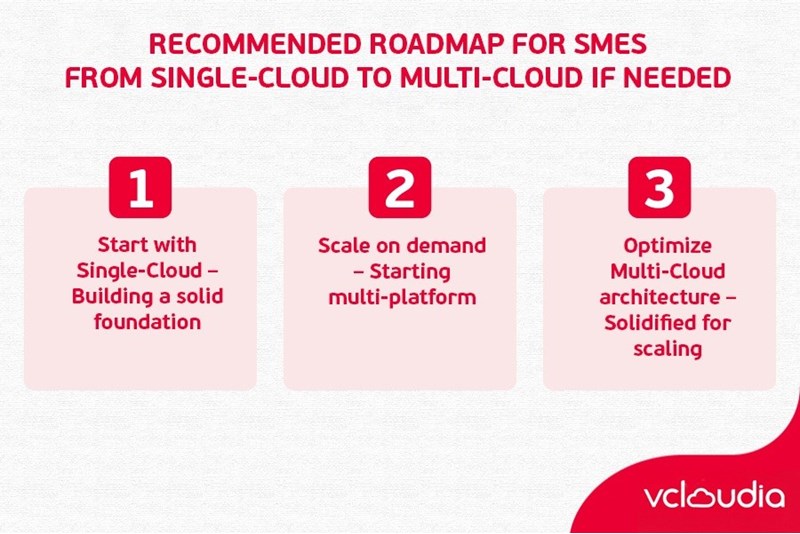
For SMEs, choosing the right Cloud model depends not only on the current scale but also on future expansion capabilities. A suitable roadmap usually starts from a simple, easy-to-deploy model like Single-Cloud and gradually upgrades to Multi-Cloud when operational needs become increasingly complex. Below is a suggested 3-stage roadmap, successfully applied by many businesses.
Stage 1: Starting with Single-Cloud – Building a Solid Foundation
At the early stage of digital transformation, SMEs should start with a reputable Cloud provider to deploy core systems such as websites, business email, accounting software, or sales management systems (POS, CRM, ERP...). The Single-Cloud model helps businesses control costs well, reduce technical infrastructure load, and focus on optimizing operations. Especially, working with a single provider will help the technical support, troubleshooting, and upgrade processes happen quickly with less risk.
Stage 2: Expanding According to Needs – Starting Multi-Platform
When a business grows in scale or starts expanding business activities such as e-commerce, logistics, or branch chains, the Single-Cloud model may start to show bottlenecks. Businesses should re-evaluate operational needs: is there a need for specialized services like AI/ML, advanced data analysis, independent backup, or enhanced system availability? If the answer is "yes," this is the right time to add a second Cloud – serving specific purposes that the first Cloud does not optimize. Parallel deployment will help reduce dependence and open up opportunities to optimize resources by each category.
Stage 3: Optimizing Multi-Cloud Architecture – Ready for Scaling
When a business's system starts expanding across many geographic regions, many specialized services, or when data and applications become increasingly dispersed, the business needs to re-architect its infrastructure according to a complete Multi-Cloud model. This stage requires businesses to have a clear access authorization plan, establish cross-platform security policies, and ensure stable connections between Cloud services. If done well, Multi-Cloud will help businesses enhance system availability, reduce the risk of downtime, control costs better, and be ready to expand by market without being bound by the limits of a single provider.
This roadmap not only helps SMEs transform digitally step-by-step but also reduces the risk of massive investment from the beginning. More importantly, it helps businesses maintain flexibility – a vital factor in the context of constantly changing technology and markets.
Vcloudia Cloud Server – The Cloud You Can Count On
If you're concerned about the potential limitations of Cloud Servers, Cloud server by Vcloudia is a reliable solution for businesses of all sizes. With a modern infrastructure and comprehensive customer support, Vcloudia delivers a cloud experience with:
- Powerful connectivity to ensure stable 24/7 access
- Advanced security standards, compliant with international certifications such as ISO 27001:2013, ISO 20000:2018, ISO 9001:2015
- Flexible pricing packages tailored to your specific business needs
- Expert technical support, making migration and system deployment fast, safe, and compatible
Contact information:
- Hotline: +855 888 55 66 08 (free of charge)
- Fanpage: https://www.facebook.com/vcloudia/
- Website: https://vcloudia.com
Featured news
Related news
What is a Snapshot? The Difference Between Snapshot and Backup
Snapshot is a familiar concept in data management and protection. In the context of the information technology boom, where data is a major asset for businesses, understanding Snapshots as well as their application is a key factor for enterprises to maximize technological efficiency.
What is a Firewall? The Role and Importance of Firewalls for Users
In the context of ever-increasing cyberattacks, system security has become a top priority for many enterprises. Alongside deploying antivirus software and controlling connection ports, firewalls are also considered a key solution to effectively enhance cybersecurity.
What is DDoS? Signs, Mitigation Strategies, and Effective Prevention
DDoS is a highly dangerous cyberattack that leaves severe consequences for enterprises. Therefore, gaining a clear understanding of DDoS attacks, as well as how to detect and prevent them, is a topic of significant interest to many.
What is a Trojan? How to Detect, Avoid, and Prevent It
A Trojan is a type of malicious code or software that can cause severe consequences to computer operations. So, what is a Trojan? How can you prevent a Trojan from infiltrating your computer? In the following article, Vcloudia will provide detailed information on these issues.
What is Cloud Backup? Classification, benefits, and limitations
Cloud Backup is a solution that plays an important role in backing up and recovering data when an incident occurs. So what exactly is Cloud Backup? Let's find out the details with Vcloudia in the following article.
What is Cloud Storage? Features and Benefits of Using It
Cloud Storage is the perfect storage solution alternative to bulky, space-consuming physical hard drives. So, what is Cloud Storage? Let's explore the details with Vcloudia through the following article.
What is an API? Characteristics and applications in website design
API, short for Application Programming Interface, is a concept no longer unfamiliar in the information technology field. So what exactly is an API and why is it so important? Let's find out with Vcloudia.
What is Node.js? Instructions on how to install Node.js on cPanel
Currently, it is easy to see that Node.js is being used by quite a lot of people. This is because Node.js can support users in running on multiple platforms and multiple devices.
What is Vultr VPS? Should you use Vultr VPS?
Vultr VPS is one of the best cloud storage solutions in the world. In this article, you will learn the concept: "What is Vultr VPS?", as well as understand its advantages and disadvantages.
Zoom Cloud Meeting: What is it? Basic Things You Should Know About Zoom Cloud Meeting
In 2020, Zoom Cloud Meeting became one of the leading video conferencing software applications. It allows you to virtually interact with colleagues when in-person meetings aren't possible, and it has also been very successful for social events.