



.png)














.png)





Why do Cambodian enterprises often fail when moving to the Cloud too late?
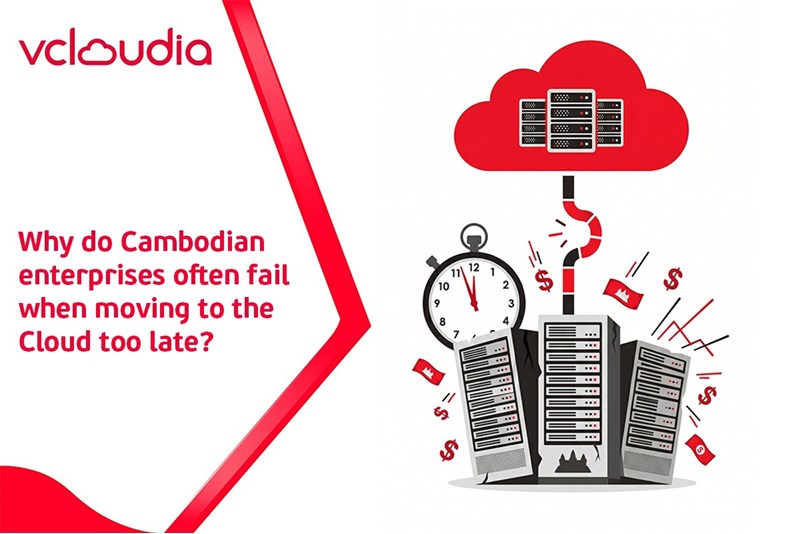
Apr 23, 2026Cloud computing is becoming the top choice for many organizations and enterprises when there is a need to scale up and optimize system performance. However, enterprises in Cambodia are still delaying the transition process to the Cloud, which entails adverse consequences. So why do Cambodian enterprises often fail when moving to the Cloud too late? Let's find out more with Vcloudia through the article below.
The reality of Cambodian enterprises still being slow in transitioning to the Cloud
It is undeniable that Cloud is a powerful tool helping enterprises operate and manage IT infrastructure effectively. However, Cambodian enterprises are still quite slow in transitioning to the cloud platform.
Reality shows that many enterprises only focus on solving immediate operational issues, but have not really focused on building long-term infrastructure. In addition, the conservative mentality and fear of change are also a huge barrier, holding back enterprises on the journey of transitioning to the Cloud. Many enterprises, especially SMEs, often worry about investment costs, technical personnel... when deploying new solutions and technologies. It is this apprehension that has accidentally caused enterprises to miss the opportunity to improve operational performance and optimize workflows.
On the other hand, the lack of a methodical data strategy also poses many difficulties and challenges for organizations and enterprises. When data is stored scattered and lacks synchronization, enterprises may be delayed in integrating and expanding the system. This not only directly affects the data management process, but also reduces the operational and business efficiency of the enterprise.
5 consequences of moving to the Cloud too late
Overlapping legacy systems, difficult integration, taking a lot of time & cost to "untangle"
Legacy systems usually have relatively low operational performance, are difficult to scale, and are prone to disruption. If only maintaining the outdated infrastructure architecture without converting to the cloud computing environment, the enterprise will have to spend a lot of time and budget to "rebuild from scratch" the entire system. This can lead to stagnation in the production and distribution of products and services to the market.
Fragmented, dispersed data, impossible to synchronously move to the Cloud
The Cloud platform allows enterprises to store and manage data centrally, while ensuring the synchronization and integrity of information. If the enterprise moves to the Cloud too late, data can become outdated, duplicated, or even lost due to a lack of effective security and backup processes.
Conversely, shortening the transition time also poses many risks for the enterprise. If the steps of cleaning and standardizing information are skipped, the enterprise will face the risk of leaking and deviating important data. This also contributes to increasing concerns about cybersecurity due to security vulnerabilities not being strictly controlled.
Missing the opportunity to accelerate business when the market booms
With the ability to process data quickly, integrating many advanced technologies such as AI, Machine Learning... the cloud platform helps enterprises optimize the production process and shorten the service deployment time. Enterprises that have moved to the Cloud early will maintain their competitive advantage, easily grasp market trends and approach diverse potential customer segments.
Meanwhile, those enterprises still "struggling" with legacy systems will face difficulties in expanding their scale, as well as being unable to catch up with the changes of the market. This means that the enterprise is losing its growth opportunities and becoming increasingly lagging behind its competitors.
Risks when legacy systems encounter incidents, without Cloud Backup, cannot be quickly recovered
On-premises infrastructure systems are often not equipped with Cloud Backup solutions to help backup and recover after a disaster. Therefore, it is very easy for an enterprise to face the risk of leaking and losing internal data when sudden incidents occur (natural disasters, cyber attacks, hardware failures...).
If the enterprise only relies on physical infrastructure without preparing a remote backup plan, recovering data to its original state is almost impossible. As a consequence, the entire operational process can be disrupted, directly affecting the revenue and reputation of the enterprise in the eyes of partners and customers.
Being excluded from supply chains, large projects, or international markets due to non-standard infrastructure
Meeting international standards such as ISO, GDPR, SOC... has become a key condition for evaluating the operational activities and infrastructure of the enterprise. Financial institutions and multinational corporations often set strict requirements regarding security, data storage, and compliance with legal regulations. If delayed in transitioning to the Cloud, the enterprise will not be able to meet these standards, thereby leading to the risk of being excluded from the global supply chain, as well as losing opportunities to cooperate and participate in large-scale projects.
When should you start moving to the Cloud?
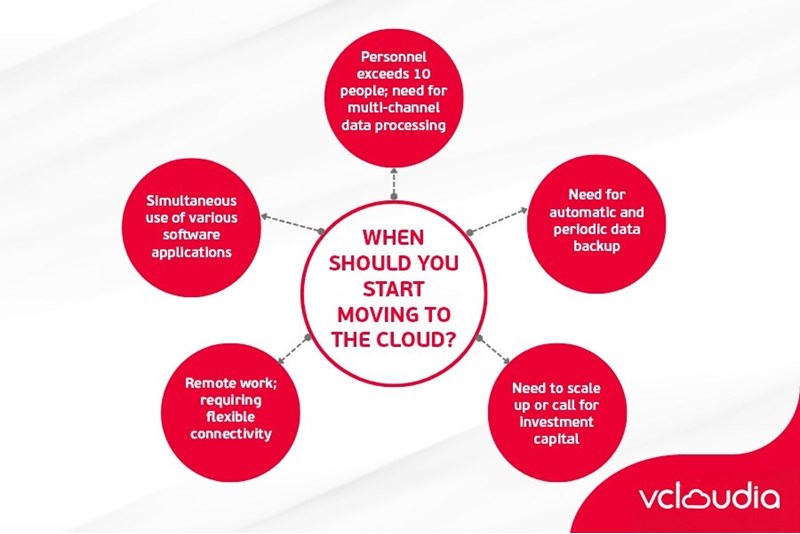
Enterprises should transition to the cloud platform in cases:
- The personnel team exceeds 10 people, requiring omnichannel data processing.
- Using multiple different software simultaneously (CRM, accounting, sales, inventory management software...).
- Needing automatic and periodic data backup, ensuring the system is not interrupted.
- Deploying a remote working model, requiring flexible connection and access capabilities.
- The enterprise has plans to expand its scale or raise investment capital, needing to build a solid technological infrastructure.
Moving to the Cloud does not require a large investment, just follow the right roadmap
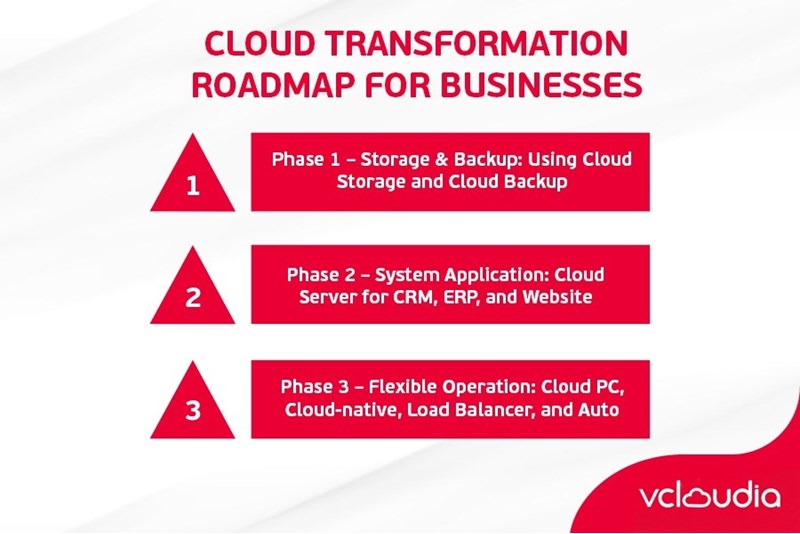
Below is the roadmap for transitioning to the Cloud to help enterprises save costs and improve system performance.
Phase 1 – Storage & Backup: Using Cloud Storage, Cloud Backup
Instead of investing in physical servers, enterprises should choose Cloud Storage, Cloud Backup to store and backup internal data. By leveraging cloud computing solutions, enterprises can reduce the costs of installing and upgrading equipment, while protecting data against potential threats in the network environment. In addition, Cloud Storage and Cloud Backup also provide flexible scalability, allowing enterprises to easily adjust the resource scale without being limited by hard drive capacity.
Phase 2 – System application: Cloud Server for CRM, ERP, website
After completing the data storage and backup process, enterprises can move critical applications and services to Cloud Server. The choice of virtual server configuration will depend on the budget and practical needs of the enterprise. When launching the CRM, ERP, website systems... on the cloud server, enterprises can access and work flexibly anytime and anywhere, while maintaining system performance at a stable level.
Phase 3 – Flexible operation: Cloud PC, Cloud-native, Load Balancer, Auto Scale
In phase 3, enterprises need to combine multiple advanced solutions and technologies to ensure the operational process takes place flexibly and efficiently:
- Cloud PC: Provides virtual computers to meet remote working needs, enhancing security and monitoring all data of the enterprise.
- Cloud-native: Allows leveraging cloud architecture (containers, microservices...) to develop applications with flexible scalability, helping optimize operational performance.
- Load Balancer: Distributes traffic, limiting system overload and congestion.
- Auto Scale: Automatically adjusts the resource scale, ensuring the system operates continuously even when traffic increases suddenly.
Vcloudia Cloud Server – The Cloud You Can Count On
If you're concerned about the potential limitations of Cloud Servers, Cloud server by Vcloudia is a reliable solution for businesses of all sizes. With a modern infrastructure and comprehensive customer support, Vcloudia delivers a cloud experience with:
- Powerful connectivity to ensure stable 24/7 access
- Advanced security standards, compliant with international certifications such as ISO 27001:2013, ISO 20000:2018, ISO 9001:2015
- Flexible pricing packages tailored to your specific business needs
- Expert technical support, making migration and system deployment fast, safe, and compatible
Contact information:
- Hotline: +855 888 55 66 08 (free of charge)
- Fanpage: https://www.facebook.com/vcloudia/
- Website: https://vcloudia.com
Featured news
Related news
What is a Snapshot? The Difference Between Snapshot and Backup
Snapshot is a familiar concept in data management and protection. In the context of the information technology boom, where data is a major asset for businesses, understanding Snapshots as well as their application is a key factor for enterprises to maximize technological efficiency.
What is a Firewall? The Role and Importance of Firewalls for Users
In the context of ever-increasing cyberattacks, system security has become a top priority for many enterprises. Alongside deploying antivirus software and controlling connection ports, firewalls are also considered a key solution to effectively enhance cybersecurity.
What is DDoS? Signs, Mitigation Strategies, and Effective Prevention
DDoS is a highly dangerous cyberattack that leaves severe consequences for enterprises. Therefore, gaining a clear understanding of DDoS attacks, as well as how to detect and prevent them, is a topic of significant interest to many.
What is a Trojan? How to Detect, Avoid, and Prevent It
A Trojan is a type of malicious code or software that can cause severe consequences to computer operations. So, what is a Trojan? How can you prevent a Trojan from infiltrating your computer? In the following article, Vcloudia will provide detailed information on these issues.
What is Cloud Backup? Classification, benefits, and limitations
Cloud Backup is a solution that plays an important role in backing up and recovering data when an incident occurs. So what exactly is Cloud Backup? Let's find out the details with Vcloudia in the following article.
What is Cloud Storage? Features and Benefits of Using It
Cloud Storage is the perfect storage solution alternative to bulky, space-consuming physical hard drives. So, what is Cloud Storage? Let's explore the details with Vcloudia through the following article.
What is an API? Characteristics and applications in website design
API, short for Application Programming Interface, is a concept no longer unfamiliar in the information technology field. So what exactly is an API and why is it so important? Let's find out with Vcloudia.
What is Node.js? Instructions on how to install Node.js on cPanel
Currently, it is easy to see that Node.js is being used by quite a lot of people. This is because Node.js can support users in running on multiple platforms and multiple devices.
What is Vultr VPS? Should you use Vultr VPS?
Vultr VPS is one of the best cloud storage solutions in the world. In this article, you will learn the concept: "What is Vultr VPS?", as well as understand its advantages and disadvantages.
Zoom Cloud Meeting: What is it? Basic Things You Should Know About Zoom Cloud Meeting
In 2020, Zoom Cloud Meeting became one of the leading video conferencing software applications. It allows you to virtually interact with colleagues when in-person meetings aren't possible, and it has also been very successful for social events.