


.png)













.png)




Differences between Data Center Tier 3 vs Tier 4
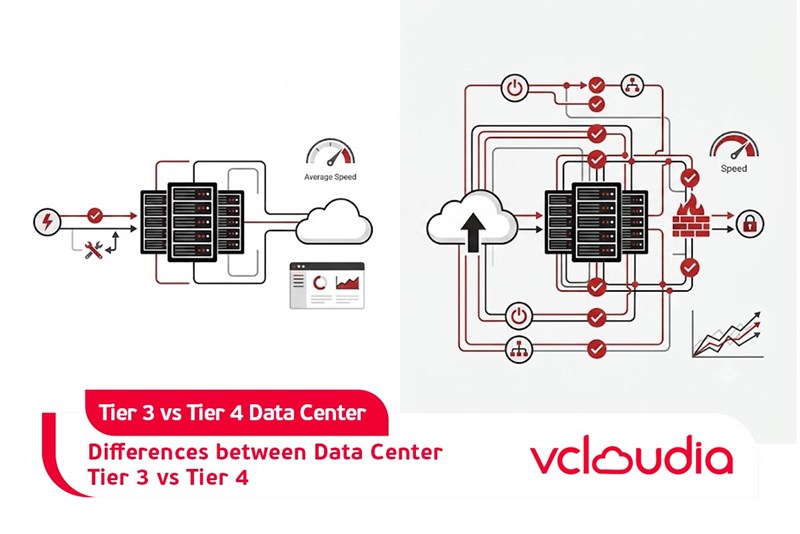
Jun 30, 2026Data Centers play a foundational role in determining the continuity and operational performance of an organization. The classification system established by the Uptime Institute is currently the globally recognized standard for infrastructure assessment. Among these, the difference between Data Center Tier 3 vs Tier 4 is always the focal point of analysis for businesses when investing in information technology systems.
Join Vcloudia in clarifying the core technical characteristics between these two levels to guide the selection of optimal infrastructure solutions.
What is a Tier 3 Data Center?
A Tier 3 Data Center is a data center standard designed to ensure continuity for business operations. This level provides an availability level of 99.982%, equivalent to unplanned downtime not exceeding 1.6 hours per year. This capability provides a significantly higher level of stability compared to the approximately 22-hour downtime limit of the Tier 2 standard.
The core design characteristics of Tier 3 are based on N+1 redundancy architecture:
- Critical equipment is configured according to the necessary N number plus one backup unit.
- The power system uses independent supply streams. When the main power source encounters an issue, the backup UPS system automatically activates with a switching speed measured in milliseconds.
- The cooling system integrates additional auxiliary air conditioning units to maintain server temperature at standard levels.
- This design prevents service interruption due to failures from a single component. The Tier 3 architecture creates a balance between reliability and investment budget, suitable for handling continuous tasks such as Enterprise Resource Planning (ERP) systems and medium-scale e-commerce platforms.
What is a Tier 4 Data Center?
A Tier 4 Data Center is the highest infrastructure certification level from the Uptime Institute, designed specifically for critical information technology systems with the strictest continuous operation requirements.
This level provides an availability level of up to 99.995%, limiting maximum unplanned downtime to 26 minutes per year. The switching process of backup systems occurs almost instantaneously, ensuring that underlying hardware failures do not impact the user experience.
In terms of architecture, Tier 4 establishes comprehensive Fault Tolerance through a 2N or 2N+1 redundancy mechanism:
- The infrastructure system is equipped with completely independent high-voltage power supply streams, multiple generator sets running at full load, and dual backup UPS systems.
- This structure ensures the data center remains fully operational even if a power supply stream and a generator set encounter physical failures simultaneously.
- Thanks to possessing multiple independent backup and redundancy layers, the Tier 4 standard meets the risk control requirements of global financial institutions and core data centers belonging to government agencies.
Analysis of 4 differences between Data Center Tier 3 vs Tier 4
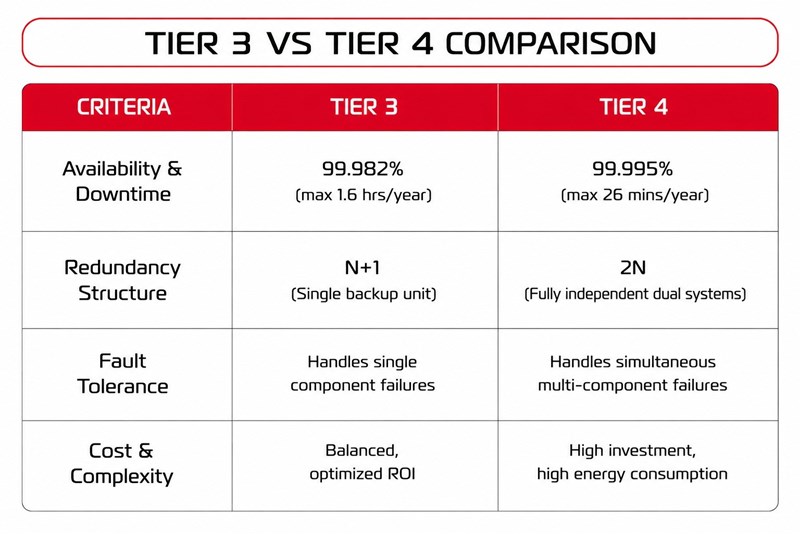
The difference between Tier 3 and Tier 4 lies not only in quantitative parameters but reflects changes in network architectural foundations and reliability levels. Below is a detailed analysis across 4 technical aspects:
Uptime and Downtime
Downtime parameters directly reflect the system's ability to maintain service.
- Tier 3: Achieves 99.982% availability, equivalent to a maximum of 1.6 hours of downtime per year. This capability handles single component failures well. However, complex failure scenarios, such as the power storage system failing simultaneously with a delay in generator startup, can still cause service interruption in a short period.
- Tier 4: Achieves 99.995% availability, limiting downtime to under 26 minutes per year. The design eliminates single points of failure, helping the system continue to operate even when multiple components fail simultaneously. This requirement is mandatory for applications requiring millisecond latency such as electronic financial transactions or telemedicine.
System Redundancy Structure
Redundancy design determines how a data center allocates reserve resources.
- Tier 3: Applies N+1 redundancy architecture. Critical components such as power and cooling systems are equipped with one backup unit. When the main equipment encounters an issue, the backup system activates to maintain operations. The limitation of this architecture is its low response capability when simultaneous errors occur on multiple devices.
- Tier 4: Applies 2N dual system redundancy architecture. All critical systems are set up into two independent configuration streams that operate without interfering with each other. Typically, in power systems, the architecture includes two independent utility power lines and two separate generator sets. If one system fails completely, the other is still capable of carrying the full load of the data center.
Troubleshooting and Error Handling
Fault tolerance characterizes the system's resistance to physical disruptive impacts.
- Tier 3: Possesses concurrent maintainability, meeting cases of single component errors. The design allows technicians to maintain or replace equipment without interrupting overall operations. However, simultaneous multi-component errors can affect the data processing flow.
- Tier 4: Provides fault tolerance through multiple redundancy layers and physical isolation. For cooling systems, each loop integrates independent redundant components. When multiple parts encounter issues, the equipment still maintains standard operating temperatures, protecting the data flow against complex system failure scenarios.
Investment and Operational Costs
The budget for building and maintaining a data center is proportional to the level of redundancy.
- Tier 4: Requires a high construction investment budget due to strict requirements for redundancy and physical isolation. Hardware costs increase from purchasing dual power and cooling systems. The process of reinforcing structural design and separating floor layouts also increases construction costs. Operational costs remain at high levels due to continuous electricity consumption from parallel-running devices and specialized requirements from the technical team.
- Tier 3: Optimizes initial investment and operational maintenance budgets. This model provides a balanced solution, suitable for businesses needing to control budgets but still placing high requirements on network infrastructure continuity.
Advantages and limitations of Data Center Tier 3
Core advantages
- Optimizing cost-efficiency: By establishing a balance point between availability rates and budget, Tier 3 effectively supports core tasks such as 24/7 e-commerce transaction processing systems and internal management platforms (OA), ensuring maximum Return on Investment (ROI) for businesses.
- Flexible expansion architecture: Applying modular design principles, this architecture supports dynamic expansion needs such as adjusting the number of server racks and seamlessly upgrading Uninterruptible Power Supply (UPS) capacity. The scaling process occurs favorably without reducing the stability of the overall system.
- Design convenient for maintenance: A streamlined system structure combined with standardized operating procedures allows internal IT teams to handle periodic inspection tasks and basic troubleshooting themselves. This factor helps reduce dependence on external technical experts and optimizes personnel costs.
Limitations
- Limited fault tolerance capacity: The architecture only supports backup switching when an issue occurs on a single component. The system does not have the ability to withstand situations where multiple devices fail simultaneously, posing a risk of service interruption in wide-scale failure scenarios.
- Does not yet meet strict continuity requirements: The availability level of Tier 3 is not sufficient to operate services requiring less than 1 hour of downtime per year, such as high-frequency financial transaction systems or real-time data processing platforms.
Advantages and limitations of Data Center Tier 4
Core advantages
- Ensuring maximum availability: Providing up to 99.995% uptime, establishing a solid infrastructure foundation for critical services requiring the strictest system stability levels.
- Comprehensive fault tolerance: Dual redundancy design allows the system to automatically handle multiple hardware failures occurring at the same time. The data center maintains full-load operating status even under harsh operating conditions, excelling in risk resistance.
- Compliance with strict legal regulations: The isolation and physical security structure fully meet specialized data management standards, including Europe's GDPR privacy protection regulations and America's HIPAA health data safety standards, helping organizations minimize legal risks.
Limitations
- Large cost barriers: Requires a massive investment budget for both the physical infrastructure construction phase and the actual operational maintenance process.
- High level of resource consumption: Backup equipment systems serving the high-availability structure not only occupy large physical space but also consume continuous amounts of electricity. This characteristic creates challenges for businesses pursuing green and sustainable technology development strategies.
- Resource redundancy for basic tasks: For conventional business models or startups, the complex redundancy architecture of Tier 4 often exceeds actual usage needs, leading to unnecessary performance waste.
Should businesses choose Tier 3 or Tier 4 standards?
Specialized regulations and standards
Legal requirements of each sector directly impact the data center level that needs to be applied. Industries with strict availability requirements such as finance, healthcare, and energy are often required to apply Tier 4 standards. High-frequency stock trading systems require annual downtime of less than 30 minutes, which fits perfectly with the 26-minute limit of Tier 4 structure.
The maximum 1.6-hour downtime of Tier 3 is entirely acceptable for ERP systems in manufacturing or retail, where maintenance work can be performed at night or outside of office hours.
Organizational scale and growth roadmap
Long-term development orientation determines the scalability of infrastructure architecture.
- Medium and growing businesses: For systems with moderate transaction volumes and no sudden expansion plans, Tier 3 provides an optimal solution in terms of cost-efficiency.
- Large-scale businesses: Nationwide e-commerce platforms or cloud service providers with aggressive expansion roadmaps should prioritize Tier 4 or apply an expandable Tier 3 architecture. This method includes preparing space and a second power supply stream to upgrade to 2N redundancy in the future.
Investment budget and priority level
Capital allocation strategy determines the boundary between controlling costs and maximizing availability. When budgets are limited and cost-control policies are prioritized, the Tier 3 structure is the most reasonable choice.
If financial damage due to service interruption far exceeds the cost of maintaining the data center, for example, a banking system losing significant revenue for every hour of downtime, investing the budget into Tier 4 infrastructure provides practical risk prevention value.
Risk tolerance level
Organizations need to perform a quantitative calculation of losses due to system downtime. For a large-scale e-commerce platform, the revenue loss during 1.6 hours of Tier 3 standard downtime may be greater than the investment cost difference to upgrade to Tier 4 standard infrastructure. In this scenario, the Tier 4 architecture brings a greater strategic advantage in protecting revenue and strengthening customer trust.
Conclusion
The decision to invest in network infrastructure does not depend on racing toward the highest standard, but on the ability to accurately identify the intersection between business requirements and financial capacity. The difference between Data Center Tier 3 vs Tier 4 clearly defines two distinct infrastructure strategies: budget optimization with the high reliability of the Tier 3 standard, or eliminating interruption risks for critical systems through the Tier 4 standard. Depending on industry specifics and risk tolerance, organizations need to establish corresponding implementation roadmaps to maintain service continuity.
Looking for a high-performance, secure solution?
Explore the services offered by Vcloudia – a leading provider of Cloud Computing and Data Center solutions. Contact us for expert consultation and find the right model for your needs:
- Hotline: +855 888 55 66 08 (free of charge)
- Fanpage: https://www.facebook.com/vcloudia/
- Website: https://vcloudia.com
Featured news
Related news
What is a Snapshot? The Difference Between Snapshot and Backup
Snapshot is a familiar concept in data management and protection. In the context of the information technology boom, where data is a major asset for businesses, understanding Snapshots as well as their application is a key factor for enterprises to maximize technological efficiency.
What is a Firewall? The Role and Importance of Firewalls for Users
In the context of ever-increasing cyberattacks, system security has become a top priority for many enterprises. Alongside deploying antivirus software and controlling connection ports, firewalls are also considered a key solution to effectively enhance cybersecurity.
What is DDoS? Signs, Mitigation Strategies, and Effective Prevention
DDoS is a highly dangerous cyberattack that leaves severe consequences for enterprises. Therefore, gaining a clear understanding of DDoS attacks, as well as how to detect and prevent them, is a topic of significant interest to many.
What is a Trojan? How to Detect, Avoid, and Prevent It
A Trojan is a type of malicious code or software that can cause severe consequences to computer operations. So, what is a Trojan? How can you prevent a Trojan from infiltrating your computer? In the following article, Vcloudia will provide detailed information on these issues.
What is Cloud Backup? Classification, benefits, and limitations
Cloud Backup is a solution that plays an important role in backing up and recovering data when an incident occurs. So what exactly is Cloud Backup? Let's find out the details with Vcloudia in the following article.
What is Cloud Storage? Features and Benefits of Using It
Cloud Storage is the perfect storage solution alternative to bulky, space-consuming physical hard drives. So, what is Cloud Storage? Let's explore the details with Vcloudia through the following article.
What is an API? Characteristics and applications in website design
API, short for Application Programming Interface, is a concept no longer unfamiliar in the information technology field. So what exactly is an API and why is it so important? Let's find out with Vcloudia.
What is Node.js? Instructions on how to install Node.js on cPanel
Currently, it is easy to see that Node.js is being used by quite a lot of people. This is because Node.js can support users in running on multiple platforms and multiple devices.
What is Vultr VPS? Should you use Vultr VPS?
Vultr VPS is one of the best cloud storage solutions in the world. In this article, you will learn the concept: "What is Vultr VPS?", as well as understand its advantages and disadvantages.
Zoom Cloud Meeting: What is it? Basic Things You Should Know About Zoom Cloud Meeting
In 2020, Zoom Cloud Meeting became one of the leading video conferencing software applications. It allows you to virtually interact with colleagues when in-person meetings aren't possible, and it has also been very successful for social events.