



.png)



















.png)





Applications of Cloud Computing in the Finance Industry
Feb 27, 2026Cloud Computing has opened up new opportunities in financial management, operational efficiency enhancement, and innovation across the banking and financial services sector. In this article, together with Vcloudia, we explore the Finance industry in greater depth, examine why Cloud Computing has become an indispensable foundation, highlight key applications, and analyze the benefits, challenges, and future trends of this technology in the financial sector.
Overview of the Finance Industry
The Finance industry is a diverse sector encompassing banking, securities, insurance, asset management, and other financial services. Due to its inherent need to process large volumes of data with high accuracy and stringent security requirements, Finance has consistently been among the leading industries in adopting new technologies to enhance efficiency and competitiveness.
In today’s digital era, the Finance industry has undergone a significant transformation from traditional operating models to digitalized systems, with Cloud Computing playing a central role. Banks and financial institutions increasingly rely on cloud platforms to process transactions, analyze data, and deliver superior customer experiences, while still meeting strict security and regulatory compliance standards.
Why Does the Finance Industry Need Cloud Computing?
The Finance industry faces growing pressure from competition, increasing demands for transaction processing speed, and the need to strengthen data security. To keep pace with these challenges, adopting Cloud Computing is no longer optional—it has become mission-critical.
Migrating to cloud-based models enables financial institutions to optimize resources, reduce capital expenditures on hardware and software infrastructure, and easily scale operations up or down according to real market demand. In addition, Cloud Computing allows organizations to rapidly adopt emerging technologies such as artificial intelligence, big data analytics, process automation, and blockchain applications in financial services.
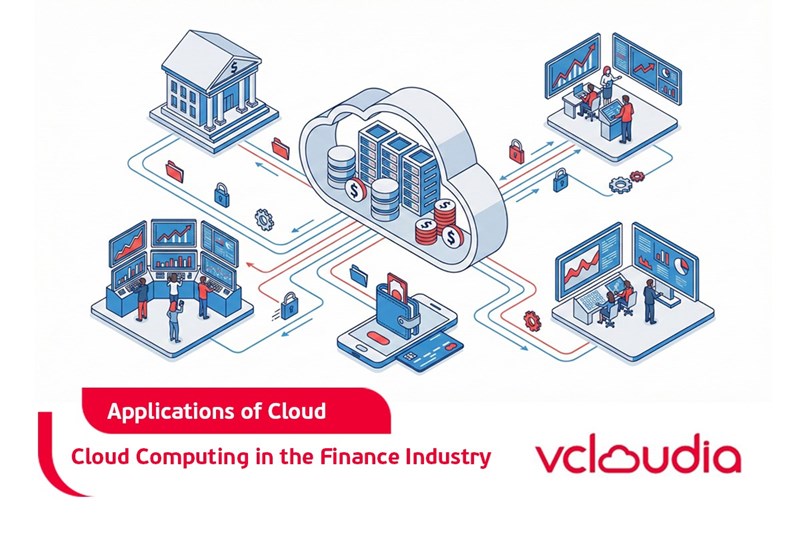
Key Applications of Cloud Computing in Finance
1. Digital Banking Systems
Digital banking systems represent one of the most prominent applications of Cloud Computing in the Finance industry. Thanks to high scalability and the ability to process large transaction volumes within short timeframes, banks can offer 24/7 services while significantly reducing customer wait times.
Cloud-based digital banking systems also minimize system failure risks, enable easy data backup and recovery, and integrate advanced features such as biometric identification and multi-factor authentication. These capabilities enhance security and convenience for remote transactions, driving the growth of digital banks and open banking services and shaping new trends in the financial sector.
2. Online Transactions and Payments
Online transactions and digital payments have become integral to modern daily life. With cloud platforms, payment systems are more flexible, secure, and scalable to meet evolving market demands.
Cloud-based payment systems can process millions of transactions per day without performance degradation. Advanced security measures—such as AI-powered fraud detection, biometric authentication, and data encryption—provide customers with greater confidence when making online payments. Cloud platforms not only enhance user experience but also accelerate the expansion of cashless payment ecosystems.
3. Risk Management
Risk management is a critical factor determining the sustainability and long-term success of financial institutions. Organizations must analyze large datasets, forecast trends, and detect fraudulent activities in a timely manner to minimize losses.
Cloud Computing enables comprehensive data processing and real-time analytics, allowing managers to make faster and more accurate decisions. Cloud-based AI and machine learning tools support risk forecasting, customer identification, and automated fraud detection, thereby strengthening risk prevention capabilities and reducing organizational losses.
4. Customer Service
Customer service is a key differentiator in today’s highly competitive financial market. Banks, securities firms, and insurance companies require optimized solutions to interact with customers more effectively while delivering personalized experiences.
Cloud platforms make it easier to deploy chatbots, automated advisory systems, and 24/7 online support services. By analyzing customer data, these services can personalize recommendations and offers, improving customer satisfaction and loyalty. Additionally, cloud-based automation reduces response times and enhances service convenience and efficiency.
5. Data Backup and Disaster Recovery
In a highly sensitive industry such as Finance, rapid data backup and recovery during incidents is critical. Cloud Computing provides automated data backup, real-time redundancy, and fast recovery capabilities.
Financial institutions can deploy distributed backup systems to ensure data availability in the event of cyberattacks, hardware failures, or natural disasters. These capabilities also support compliance with data protection and security regulations while reducing risks and costs associated with maintaining traditional backup infrastructure.
Benefits of Cloud Computing for the Finance Industry
Transitioning to cloud platforms delivers benefits that extend far beyond expectations, enabling financial organizations to improve operational efficiency while fostering innovation.
1. Reduced Operating Costs
One of the most significant benefits of Cloud Computing is the substantial reduction in capital expenditure on hardware, software, and system maintenance. Financial institutions no longer need to manage on-premises data centers, server procurement, upgrades, or in-house security infrastructure.
Instead, they adopt a pay-as-you-go pricing model, optimizing budgets while reducing energy consumption, labor costs, and maintenance expenses, thereby strengthening market competitiveness.
2. Improved Operational Performance
With elastic scalability, cloud-based systems allow financial institutions to process massive data volumes and transaction loads without delays or service disruptions. Automation and real-time analytics improve employee productivity and operational workflows, resulting in faster and more accurate service delivery.
Furthermore, cloud platforms support continuous software updates, security patching, and feature enhancements without interrupting daily business operations, maximizing innovation potential and competitive advantage.
3. Agile Innovation
In a rapidly changing economic environment, adaptability is essential. Cloud Computing enables rapid scalability, quick adoption of new technologies, and easy experimentation with innovative business models.
Financial organizations can test new services and deploy AI, blockchain, or other emerging technologies without concerns over infrastructure limitations or technical risks. This flexibility allows them to stay at the forefront of innovation and fully leverage advanced technologies.
4. Seamless System Integration
Cloud platforms facilitate seamless integration across financial systems, enabling efficient data sharing and collaboration between departments. This connectivity reduces errors, optimizes workflows, and enhances accuracy in internal operations and customer services.
Additionally, integration with third-party services—such as analytics tools, AI platforms, payment gateways, and open banking ecosystems—enhances competitiveness through flexibility and rapid adaptation to emerging market trends.
Challenges in Implementing Cloud Computing in Finance
Despite its advantages, cloud adoption in Finance presents notable challenges. Data security and information protection remain major concerns due to the sensitive nature of personal and corporate financial data.
Moreover, increasingly stringent regulations regarding data governance, privacy, anti-money laundering (AML), and fraud prevention require strict compliance when deploying cloud solutions.
The transition from traditional infrastructure to cloud platforms also demands changes in mindset, technical capabilities, and human resources. Not all organizations are equally prepared for rapid adaptation, and initial investments in employee training and technical restructuring can present significant obstacles.
Future Trends
In the coming years, financial institutions will continue to accelerate the adoption of emerging technologies such as artificial intelligence, machine learning, blockchain, and big data analytics on cloud platforms. The development of 5G and IoT will further enable new use cases in banking and financial services, enhancing customer experience and internal operations.
Additionally, cloud-based digital banking and open banking models will become increasingly prevalent, fostering healthy competition and enabling more personalized and diversified customer services. Regulatory frameworks are also expected to become more aligned, supporting the safe and sustainable adoption of new technologies.
Conclusion
The application of Cloud Computing in the Finance industry has become an inevitable trend, empowering financial institutions to improve operational efficiency, reduce costs, enhance security, and drive innovation. In an increasingly competitive environment with rising service expectations, cloud-based digital transformation is a long-term strategy for maintaining market leadership.
At the same time, security and regulatory challenges must be addressed carefully to ensure sustainable industry growth. With positive momentum and growing readiness among organizations, Cloud Computing is set to remain a central pillar of the Finance industry’s digital transformation journey in the years ahead.
Looking for a high-performance, secure solution?Explore the services offered by Vcloudia – a leading provider of cloud computing and data center solutions. Contact us for expert consultation and find the right model for your needs:
- Hotline: +855 888 55 66 08 (free of charge)
- Fanpage: https://www.facebook.com/vcloudia/
- Website: https://vcloudia.com
Featured news
Related news
What is a Snapshot? The Difference Between Snapshot and Backup
Snapshot is a familiar concept in data management and protection. In the context of the information technology boom, where data is a major asset for businesses, understanding Snapshots as well as their application is a key factor for enterprises to maximize technological efficiency.
What is a Firewall? The Role and Importance of Firewalls for Users
In the context of ever-increasing cyberattacks, system security has become a top priority for many enterprises. Alongside deploying antivirus software and controlling connection ports, firewalls are also considered a key solution to effectively enhance cybersecurity.
What is DDoS? Signs, Mitigation Strategies, and Effective Prevention
DDoS is a highly dangerous cyberattack that leaves severe consequences for enterprises. Therefore, gaining a clear understanding of DDoS attacks, as well as how to detect and prevent them, is a topic of significant interest to many.
What is a Trojan? How to Detect, Avoid, and Prevent It
A Trojan is a type of malicious code or software that can cause severe consequences to computer operations. So, what is a Trojan? How can you prevent a Trojan from infiltrating your computer? In the following article, Vcloudia will provide detailed information on these issues.
What is Cloud Backup? Classification, benefits, and limitations
Cloud Backup is a solution that plays an important role in backing up and recovering data when an incident occurs. So what exactly is Cloud Backup? Let's find out the details with Vcloudia in the following article.
What is Cloud Storage? Features and Benefits of Using It
Cloud Storage is the perfect storage solution alternative to bulky, space-consuming physical hard drives. So, what is Cloud Storage? Let's explore the details with Vcloudia through the following article.
What is an API? Characteristics and applications in website design
API, short for Application Programming Interface, is a concept no longer unfamiliar in the information technology field. So what exactly is an API and why is it so important? Let's find out with Vcloudia.
What is Node.js? Instructions on how to install Node.js on cPanel
Currently, it is easy to see that Node.js is being used by quite a lot of people. This is because Node.js can support users in running on multiple platforms and multiple devices.
What is Vultr VPS? Should you use Vultr VPS?
Vultr VPS is one of the best cloud storage solutions in the world. In this article, you will learn the concept: "What is Vultr VPS?", as well as understand its advantages and disadvantages.
Zoom Cloud Meeting: What is it? Basic Things You Should Know About Zoom Cloud Meeting
In 2020, Zoom Cloud Meeting became one of the leading video conferencing software applications. It allows you to virtually interact with colleagues when in-person meetings aren't possible, and it has also been very successful for social events.