



Benefits of Cloud Server for e-commerce in the online selling era
May 29, 2026In the online selling era, e-commerce is no longer merely a simple sales website but has become a complex ecosystem, where speed, user experience, load-bearing capacity, and data security play a vital role. Therefore, technological infrastructure, especially Cloud Server, is increasingly considered the core foundation helping e-commerce websites operate stably. Let's join Vcloudia to learn in detail about the benefits of Cloud Server for e-commerce in the article below!
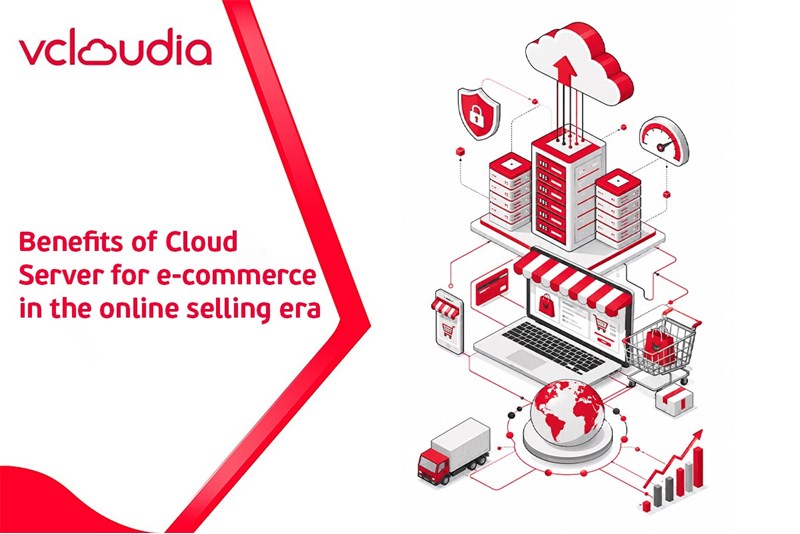
Understanding Cloud Server
Cloud Server is a virtual server model built on the cloud computing platform, allowing businesses to use server resources such as CPU, RAM, storage capacity, and bandwidth through a distributed infrastructure system. Instead of depending on a fixed physical server, Cloud Server leverages various different physical servers to create a flexible operating environment with high scalability and fault tolerance.
The biggest difference of Cloud Server compared to traditional hosting or physical servers is the ability to allocate resources according to actual needs. Businesses can increase or decrease resources in just a few minutes, instead of having to perform complex and costly hardware upgrades. For e-commerce websites, where traffic and orders can fluctuate strongly by season or by marketing campaigns, Cloud Server becomes the optimal choice in terms of both technicality and cost.
Why should sales websites use Cloud Server?
Unlike blogs or corporate introduction websites, online sales websites must simultaneously process a series of complex tasks such as product queries, shopping carts, payments, order management, inventory synchronization, user account processing, and personal data security.
In that context, traditional infrastructure often reveals many limitations. When traffic suddenly surges, servers are easily overloaded, and websites become slow or inaccessible. Failing to upgrade resources in a timely manner causes user experience to decline, bounce rates to skyrocket, and revenue to be directly affected. Cloud Server thoroughly resolves these problems with flexible scalability, smart load balancing, and stable operation even when traffic increases many times compared to normal.
Advantages of Cloud Server for e-commerce
Flexible scalability during sudden traffic surges
One of the most outstanding benefits of Cloud Server for e-commerce is the ability to flexibly scale resources according to actual needs. When a website enters peak periods such as sale seasons, holidays, or major marketing campaigns, Cloud Server allows increasing CPU, RAM, or expanding the number of instances in a very short time.
This helps the website maintain stable performance even when the number of visitors suddenly surges, maximally limiting website crashes or service interruptions. After the campaign ends, businesses can reduce resources to save costs, instead of having to continuously maintain high configurations like the traditional server model.
Fast website loading speed, improving user experience
Cloud Server is often deployed on modern infrastructure with high-speed SSDs, optimized internal networks, and smart load-balancing capabilities. Thanks to that, the server's response time is faster, helping the website load pages smoothly even when processing multiple simultaneous requests.
Fast loading speed not only improves the user experience but also directly impacts the conversion rate. Users tend to abandon websites if the loading time exceeds a few seconds, especially on mobile devices. Cloud Server helps significantly reduce latency, thereby increasing customer retention and order completion rates.
High stability and uptime for sales websites
For e-commerce websites, downtime means lost revenue. Cloud Server is designed according to a distributed model, helping minimize the risk of service interruption when a part of the infrastructure encounters issues. If one node fails, the system can automatically switch to another node to ensure the website still operates normally.
Many Cloud Server providers guarantee an uptime of up to 99.9% or higher, bringing peace of mind to businesses during operation. This is an especially important factor for sales websites operating 24/7 and serving customers across many different time zones.
Better security for customer data and orders
Security is a vital element in e-commerce, where personal data, payment information, and shopping histories need strict protection. Modern Cloud Servers often pre-integrate security layers such as firewalls, anti-DDoS, data encryption, and automatic backup systems.
Additionally, businesses have the right to proactively configure security according to their needs, controlling access and decentralizing user permissions much more tightly than shared hosting. This helps reduce the risk of data leakage and elevates the brand's reliability level in the eyes of customers.
Optimizing operating costs for e-commerce businesses
At first glance, Cloud Server might make many businesses worry about costs. However, in the long term, this is actually a budget-optimizing solution thanks to a flexible pay-as-you-go model based on usage levels. Businesses only pay for the resources they actually use, avoiding waste like when investing in physical servers or fixed hosting packages. Besides, Cloud Server helps reduce maintenance costs, hardware upgrades, and operating personnel, as many tasks have been automated or supported by the service provider.

How does Cloud Server support SEO optimization and business performance?
Cloud Server is not only an infrastructure solution but also indirectly supports SEO and business performance for e-commerce websites. Fast and stable page loading speed helps improve Core Web Vitals, one of the crucial factors in Google rankings. A stably operating website with minimal downtime also helps search bots crawl data more effectively.
In addition, flexible scalability helps businesses confidently deploy major marketing campaigns without worrying about website crashes. When the user experience is better, conversion rates increase, and onsite time is higher, thereby creating positive signals for SEO and overall business effectiveness.
Comparing Cloud Server and Hosting for e-commerce
Compared to traditional hosting, Cloud Server brings many outstanding advantages to e-commerce websites. Shared hosting is usually limited in resources and easily affected by other websites on the same server. When traffic surges, performance noticeably decreases, and it is difficult to scale up promptly.
Conversely, Cloud Server provides private resources, flexible scalability, and higher stability. Businesses have complete control over configuration, security, and system optimization according to business needs. For medium and large-scale sales websites, Cloud Server is almost a mandatory choice if they want sustainable growth.
How to choose a suitable Cloud Server for e-commerce websites
To maximize the benefits of Cloud Server, businesses need to choose a solution suitable for their scale and business goals. First, it is necessary to evaluate the average traffic and projected future growth to select a reasonable CPU, RAM, and bandwidth configuration.
Next, prioritize providers with stable infrastructure, good technical support, and clear uptime commitments. The server placement location is also a crucial factor, especially if customers are concentrated in a specific geographical area. Furthermore, businesses should pay attention to complementary services such as backup, security, and monitoring to ensure the system operates safely and effectively.
Conclusion
In the online selling era, where speed, experience, and stability determine the survival of a business, Cloud Server is not only a technological choice but also a long-term infrastructure strategy for e-commerce. With flexible scalability, high performance, good security, and optimized costs, Cloud Server helps sales websites operate stably, ready to grow and compete effectively in the digital market.
Vcloudia Cloud Server – The Cloud You Can Count On
If you're concerned about the potential limitations of Cloud Servers, Cloud server by Vcloudia is a reliable solution for businesses of all sizes. With a modern infrastructure and comprehensive customer support, Vcloudia delivers a cloud experience with:
- Powerful connectivity to ensure stable 24/7 access
- Advanced security standards, compliant with international certifications such as ISO 27001:2013, ISO 20000:2018, ISO 9001:2015
- Flexible pricing packages tailored to your specific business needs
- Expert technical support, making migration and system deployment fast, safe, and compatible
Contact information:
- Hotline: +855 888 55 66 08 (free of charge)
- Fanpage: https://www.facebook.com/vcloudia/
- Website: https://vcloudia.com
Related news
Does Cloud Server comply with GDPR? Enterprises need to understand correctly before deployment
In the digital transformation process, Cloud Server is becoming a popular infrastructure platform for many enterprises thanks to its flexibility, fast scalability, and optimal costs. However, along with the use of Cloud, a major question is frequently raised: Does Cloud Server comply with GDPR?
When to scale up, when to scale out? A guide to choosing an effective model
In the process of operating IT systems, especially websites, web applications, and digital service platforms, the problem of resource expansion (scaling) is almost inevitable. However, how to expand is a question that leaves many businesses and technical teams confused.
Do you need DevOps to operate a Cloud Server? Analysis from deployment reality
In recent years, Cloud Server has become a popular infrastructure platform for most IT systems, from small business websites to large-scale applications. However, along with the flexibility and scalability of the Cloud comes an increasingly complex operational problem. Many organizations raise the question: is DevOps needed to operate a Cloud Server, or is a traditional IT team sufficient?
Is It Possible to Recover Accidentally Deleted Data in the Cloud?
Whether it is possible to recover accidentally deleted data in the cloud is a very common question among users today. Cloud storage services such as Dropbox, Google Drive, or Microsoft OneDrive all integrate data protection mechanisms by temporarily saving deleted files for a certain period of time.
Can a Cloud Server be used for gaming servers? A detailed explanation
Not simply just a data storage server, a Cloud Server can also be used to run games directly, operate game server systems, or support Cloud Gaming. Vcloudia will help you clearly understand the capabilities of a Cloud Server in the gaming sector as well as how to choose a suitable configuration.
Is Cloud Server suitable for running a WordPress website? A detailed explanation
WordPress is a popular website building platform, but to operate stably, the system requires a sufficiently powerful and flexible server infrastructure. Therefore, many businesses ask the question of whether a Cloud Server is suitable for running a WordPress website when choosing a hosting environment for their website.
How to Increase Cloud Server Performance? Suggestions for the Best Optimization Tips
How to increase Cloud Server performance is a question that many businesses are interested in when operating websites or applications on cloud computing platforms. If the server operates slowly or processes data poorly, the system can encounter many problems regarding speed and user experience.
How does Cloud Storage differ from Cloud Server? Detailed service comparison
How Cloud Storage differs from Cloud Server is a common question for many businesses when they start using cloud computing services. Although both belong to the cloud platform, Cloud Storage and Cloud Server have completely different usage purposes and functions in storing and operating systems.
What is an Image Server? How it works and its role in a website system
An image server is a specialized server used to store, process, and distribute images for websites or applications. Thanks to its dedicated optimization and distribution mechanism, an image server helps accelerate page load speeds, reduce the load on the main server, and improve the user experience when accessing the system.