



.png)



















.png)





What is an Image Server? How it works and its role in a website system
May 29, 2026An image server is a specialized server used to store, process, and distribute images for websites or applications. Thanks to its dedicated optimization and distribution mechanism, an image server helps accelerate page load speeds, reduce the load on the main server, and improve the user experience when accessing the system. Join Vcloudia to explore what an Image Server is in the article below.
What is an image server?
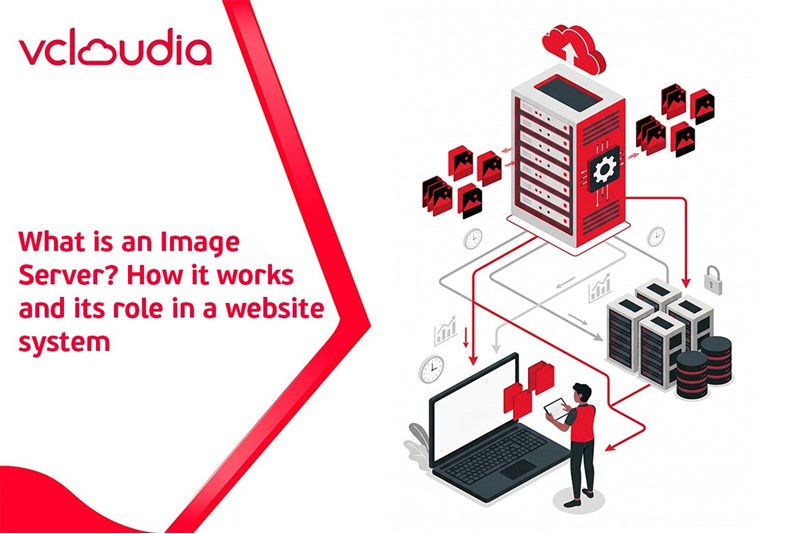
An image server is a type of specialized server used to store, manage, and distribute images for websites or applications. Instead of storing all images directly on the main web server, the image server system will exclusively handle the task of processing image files such as product photos, banners, avatars, or media content.
In many large systems, images account for the majority of data storage and bandwidth. If all image loading requests are processed by the main web server, the system can become overloaded when traffic increases significantly. An image server helps solve this problem by separating the storage and distribution of images into a dedicated system.
What is the operating mechanism of an image server?
An image server operates based on a model that separates image processing from the main web server. When a user accesses a website, the browser will send a request to load necessary resources such as HTML, CSS, JavaScript, and images.
In the case of using an image server, the image loading request will be routed to the image server instead of the main web server. The image server will process the request, retrieve the image from the storage system, and send it back to the user.
The operating process typically occurs in the following steps:
- The user accesses the website and opens a page containing images.
- The browser sends a request to the image server to load the image file.
- The image server retrieves data from the storage system or cache.
- The image is optimized and sent back to the user's browser.
Benefits of using an image server
Deploying an image server brings many important benefits to a website system, especially for platforms with large traffic or containing a lot of media content.
Accelerate page load speed
One of the biggest benefits of an image server is improving page load speed. When images are served from a specialized server or a CDN system, data can be distributed faster to users.
Additionally, an image server often integrates optimization technologies such as image compression or lazy loading. This helps reduce the size of image files and accelerate the display speed of content on the browser.
Reduce load on the web server
If the web server has to process both application logic and image loading, the system can quickly become overloaded when traffic surges. An image server helps separate the task of image distribution into an independent system. Thanks to this, the web server can focus on processing data and user requests, while the image server handles the large bandwidth associated with media.
System scalability
An image server helps the system easily scale as the volume of image data increases. Businesses can add more image servers or combine them with a CDN system to serve users globally. This scalability is particularly important for e-commerce platforms, social networks, or websites with a large amount of content.
Automated image optimization
Some modern image servers can automatically process images before sending them to users. For example, the system can automatically resize images according to screen dimensions or convert formats to WebP to reduce file size.

Popular image server technologies
Currently, there are many technologies and solutions used to build image server systems for websites or applications:
Nginx image server
Nginx is often used as an image server due to its high performance and ability to handle multiple requests simultaneously. The system can be configured to serve static images at fast speeds while consuming fewer resources.
Furthermore, Nginx supports caching and integrates well with CDN systems to optimize image distribution performance.
CDN image server
A Content Delivery Network (CDN) is one of the most popular image server solutions today. A CDN distributes images through multiple servers located in different geographical locations. When a user accesses the website, the image will be loaded from the nearest server, helping to reduce latency and accelerate page load speed.
Object storage image server
Some systems use object storage such as Amazon S3 or cloud storage platforms to store images. The image server will retrieve data from this storage system and distribute it to users. This model helps store large amounts of data at a reasonable cost and is easy to scale as the system grows.
When should you use an image server?
Not every website needs to deploy an image server from the very beginning. For small systems, storing images directly on the web server can still meet operational needs. However, as the website grows and the volume of image data becomes larger, an image server will help optimize performance and reduce the load on the system. Below are some common scenarios where deploying an image server is recommended.
- Websites with many images: E-commerce websites or content platforms often contain thousands of product images or articles, so an image server helps manage and distribute images more efficiently.
- Websites with large traffic: When traffic surges, an image server helps reduce the load on the web server by processing image loading requests separately.
- Systems that need to scale: Deploying an image server makes the system architecture more flexible and easier to scale as data volume or user count increases.
- Mobile applications or social networks: Content-sharing applications or social networks often need an image server to process and distribute massive amounts of images quickly and stably.
Conclusion
Having a clear understanding of what an image server is will help businesses design a more efficient system architecture when building websites or applications with rich media content. An image server not only helps store and distribute images but also optimizes page load speeds, reduces the load on the web server, and improves the user experience. For website systems or applications that require the deployment of an image server, choosing a stable server infrastructure with flexible scalability is a crucial factor.
Vcloudia Cloud Server – The Cloud You Can Count On
If you're concerned about the potential limitations of Cloud Servers, Cloud server by Vcloudia is a reliable solution for businesses of all sizes. With a modern infrastructure and comprehensive customer support, Vcloudia delivers a cloud experience with:
- Powerful connectivity to ensure stable 24/7 access
- Advanced security standards, compliant with international certifications such as ISO 27001:2013, ISO 20000:2018, ISO 9001:2015
- Flexible pricing packages tailored to your specific business needs
- Expert technical support, making migration and system deployment fast, safe, and compatible
Contact information:
- Hotline: +855 888 55 66 08 (free of charge)
- Fanpage: https://www.facebook.com/vcloudia/
- Website: https://vcloudia.com
Featured news
Related news
What is a Snapshot? The Difference Between Snapshot and Backup
Snapshot is a familiar concept in data management and protection. In the context of the information technology boom, where data is a major asset for businesses, understanding Snapshots as well as their application is a key factor for enterprises to maximize technological efficiency.
What is a Firewall? The Role and Importance of Firewalls for Users
In the context of ever-increasing cyberattacks, system security has become a top priority for many enterprises. Alongside deploying antivirus software and controlling connection ports, firewalls are also considered a key solution to effectively enhance cybersecurity.
What is DDoS? Signs, Mitigation Strategies, and Effective Prevention
DDoS is a highly dangerous cyberattack that leaves severe consequences for enterprises. Therefore, gaining a clear understanding of DDoS attacks, as well as how to detect and prevent them, is a topic of significant interest to many.
What is a Trojan? How to Detect, Avoid, and Prevent It
A Trojan is a type of malicious code or software that can cause severe consequences to computer operations. So, what is a Trojan? How can you prevent a Trojan from infiltrating your computer? In the following article, Vcloudia will provide detailed information on these issues.
What is Cloud Backup? Classification, benefits, and limitations
Cloud Backup is a solution that plays an important role in backing up and recovering data when an incident occurs. So what exactly is Cloud Backup? Let's find out the details with Vcloudia in the following article.
What is Cloud Storage? Features and Benefits of Using It
Cloud Storage is the perfect storage solution alternative to bulky, space-consuming physical hard drives. So, what is Cloud Storage? Let's explore the details with Vcloudia through the following article.
What is an API? Characteristics and applications in website design
API, short for Application Programming Interface, is a concept no longer unfamiliar in the information technology field. So what exactly is an API and why is it so important? Let's find out with Vcloudia.
What is Node.js? Instructions on how to install Node.js on cPanel
Currently, it is easy to see that Node.js is being used by quite a lot of people. This is because Node.js can support users in running on multiple platforms and multiple devices.
What is Vultr VPS? Should you use Vultr VPS?
Vultr VPS is one of the best cloud storage solutions in the world. In this article, you will learn the concept: "What is Vultr VPS?", as well as understand its advantages and disadvantages.
Zoom Cloud Meeting: What is it? Basic Things You Should Know About Zoom Cloud Meeting
In 2020, Zoom Cloud Meeting became one of the leading video conferencing software applications. It allows you to virtually interact with colleagues when in-person meetings aren't possible, and it has also been very successful for social events.