






















What is Linux Cloud? The Differences Between Linux Cloud and Windows Cloud?
Sep 16, 2026Linux Cloud is the perfect combination of the open-source Linux operating system and the cloud computing platform (Cloud). What values will this combination bring to users? Let's explore this in more detail with Vcloudia in this article.
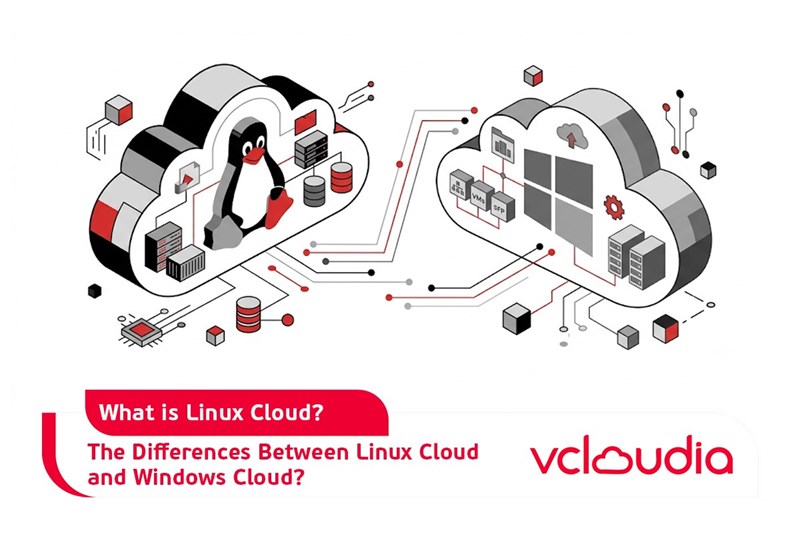
Overview of Linux Cloud
Many enterprises today are focusing on having a Cloud-based system in their IT infrastructure because they are more reliable, robust, and can be set up quickly. Although a Cloud-based system can increase the workload of monitoring and managing the architecture, enterprises are continuously optimizing these processes. This is one of the main reasons why many enterprises use Linux Cloud systems. Simply put, Linux Cloud helps save costs, is secure, scalable, open-source, and optimized for the community.
Thanks to the flexibility of Linux Cloud, IT organizations can optimize their infrastructure using other open-source tools. The integration within Linux Cloud brings outstanding advantages to users. It is interesting to note that over 75% of enterprises using the Cloud report using Linux Cloud as their primary cloud platform. Linux is perfect for running highly available, reliable, and mission-critical workloads in cloud computing environments.
The Differences Between Linux Cloud and Windows Cloud
For a clearer understanding of Linux Cloud, in this section, we will make a small comparison between Linux Cloud and Windows Cloud to identify the superior points of this model.
Similarities
Fundamentally, both Windows and Linux Cloud are systems developed on the Cloud platform and were created to meet certain user needs such as storage (Hosting,...). Both Windows and Linux are relatively popular operating systems for the majority of users at present.
Differences
In reality, there always exist fundamental differences between Windows and Linux Cloud.
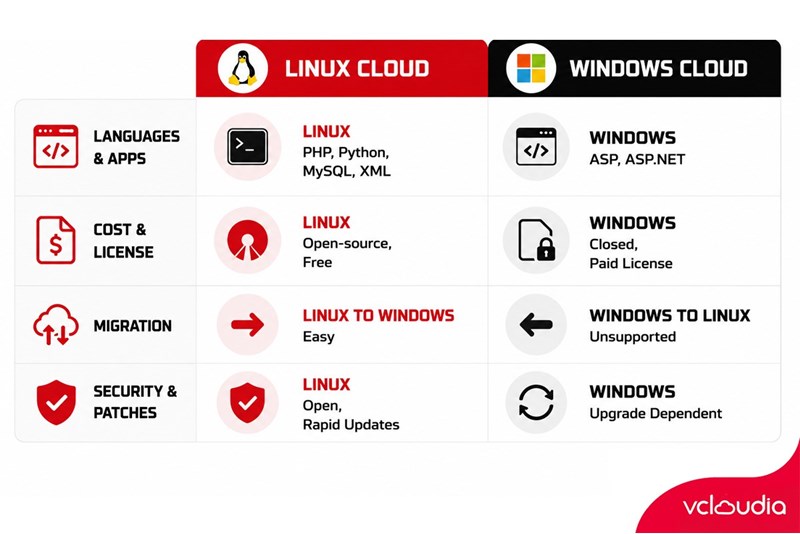
- Operating System: Linux Cloud is developed based on the Linux operating system. It is written in PHP, MySQL, Python, and XML languages. In contrast, Windows Cloud is built on the Windows operating system. It is written in languages such as ASP and ASP.net. Normally, Websites will run more smoothly on Windows Cloud Hosting instead of Linux Cloud Hosting.
- Cost: Linux Cloud uses the Linux operating system, hence they are cost-effective, secure, scalable, open-source, and optimized for the community. Conversely, Windows Cloud uses Windows, which is a closed operating system. Therefore, they are somewhat restricted and do not allow for much customization. This requires customers to purchase a License to use compared to the aforementioned Linux Cloud.
- Migration Capability: Linux Cloud users can easily migrate to Windows Cloud. Unfortunately, in the reverse direction, this is not widely supported.
- Security: Linux Cloud uses the Linux operating system, leading to higher security capabilities. The reason is that Linux is an open operating system, which allows it to be quickly updated with patches by users instead of having to wait for the next upgrade versions like Windows.
Applications of Linux Cloud
By combining cloud computing technology and the Linux operating system, one of the most popular applications of Linux Cloud is in the storage field - Linux Cloud Hosting. Linux Cloud Hosting can support programming languages such as PHP, Pear, Python, and the MySQL database management system.
Linux Cloud Hosting brings users specific advantages such as:
- Security: Linux Cloud Hosting, with the advantage of the Linux operating system, brings superiority in security capabilities. This means your Website will be able to operate stably, smoothly, and limit downtime to the maximum extent.
- Compatibility: Linux Cloud Hosting uses an open operating system, thus it brings high compatibility. It can be easily customized to help other applications run correctly on Linux servers. Thereby, it brings higher applicability and flexibility.
- Cost savings: Linux Cloud Hosting uses Linux, which is a free operating system. Thus, in theory, it helps optimize costs better for users. You will not need to pay any additional fees when using this operating system.
Conclusion
Compared to Windows Cloud, Linux Cloud brings significantly more outstanding advantages. However, that does not mean it is suitable for everyone and every need. Based on the characteristics of each type and depending on different needs, you can choose the appropriate model.
Looking for a high-performance, secure solution?
Explore the services offered by Vcloudia – a leading provider of Cloud Computing and Data Center solutions. Contact us for expert consultation and find the right model for your needs:
- Hotline: +855 888 55 66 08 (free of charge)
- Fanpage: https://www.facebook.com/vcloudia/
- Website: https://vcloudia.com/
Related news
What is SD-WAN? Technology and Practical Applications
SD-WAN addresses the increasing enterprise demands driven by IoT, SaaS, and Cloud alongside escalating cybersecurity needs, where applications demand prioritization and optimization while enterprises require reductions in deployment costs, operational labor, and time.
Software Solutions for Creating Online Virtual Machines You Should Know
Are you looking for software to create online virtual machines, both free and paid? Don't worry, this article is for you. Vcloudia will introduce you to several useful solutions to help you set up an online virtual machine as desired.
What is a free domain name? Should you use one?
A free domain name is a service provided by domain registrars that allows users to register and use a domain without incurring any costs. For an individual or a business, a website domain name is an extremely crucial factor. So, how can you register a free domain? Should you use a domain name that incurs no cost?
Comparing DigitalOcean, Linode, and Vultr VPS: Which Is the Right Choice for Your Business?
A Virtual Private Server means your website will have all the necessary power to handle your growing traffic. Likewise, if you are a developer, this added flexibility might be all you need to take your application ahead of the competition. However, to be the best, you need to work with the best.
What is ASP.NET? How to Analyze the Core Operational Architecture of the ASP.NET Platform
What is ASP.NET? It is an open-source platform chosen by software developers worldwide. The program offers superior utilities along with a distinctive approach to language utilization.
How to choose a server configuration for a business?
Choosing the right cloud configuration for your enterprise is a pivotal factor that helps optimize budgets, enhance operational performance, and ensure the system remains resilient against any changes. If the configuration is oversized, you waste valuable resources; if it is undersized, the system easily overloads, disrupting services.
Demystifying Cloud Security - The Cloud Security Trend Trusted by Enterprises
Cloud security, also known as cloud computing security, protects cloud-based systems, data, and infrastructure. Cloud security services provide cloud security solutions configured to protect data, support regulatory compliance, safeguard customer privacy, and set authentication rules for individual users and devices.
6 Benefits of Creating Virtual Machines That Users Cannot Ignore
Are you interested in creating virtual machines and want to learn more about their role? Creating a virtual machine is highly suitable for individuals or businesses involved in programming or information technology in general due to its usefulness. Creating a virtual machine helps enhance security, facilitates testing, and limits the spread of viruses.
What is a Web Portal? A comprehensive guide to essential knowledge about Web Portals
In practice, a Web Portal is a specially designed website that serves as a single point of access for updating information. However, many users are still vague about what a Web Portal is. So, what exactly is a Web Portal?
What is VXLAN? Everything about VXLAN that users should not ignore
Today, the emergence of VXLAN technology has brought many benefits to users compared to traditional VLAN technology. So what exactly is VXLAN? What makes this technology worth users' attention?