


.png)













.png)




What is Uptime Tiers? 4 levels in international standard Data Center evaluation
Aug 19, 2026Currently, the need for data storage and management is growing steadily. This makes data centers increasingly vital for ensuring business performance and operational continuity. Consequently, experts frequently use the Uptime Tier standard system to assess a Data Center's safety, stability, and resilience. So, what exactly are Uptime Tiers? Why is this a crucial metric for evaluating Data Center quality? Vcloudia will explore Uptime Tier and the international standard Data Center evaluation levels in the following article.
What is Uptime Tiers?
Uptime Tier is a standardized system developed by the Uptime Institute for assessing criteria such as a Data Center's design, construction, operation, management, and stability. This system features four distinct levels, ranging from Tier I to Tier IV, with each Tier signifying a different degree of reliability and operational sustainability. Notably, higher technical requirements correspond to greater reliability and availability for the Data Center.
Furthermore, Uptime Tier evaluates not only the ability to prevent incidents but also the capacity to manage and restore the system should an incident occur. A Data Center that achieves a higher Tier is better equipped to maintain continuous service, even when facing significant technical problems.
Levels in international standard Data Center evaluation
Tier I (Basic Capacity)
Tier I represents the lowest level within the Uptime Tier system. A Data Center at this level provides the fundamental elements necessary for maintaining IT system operations.
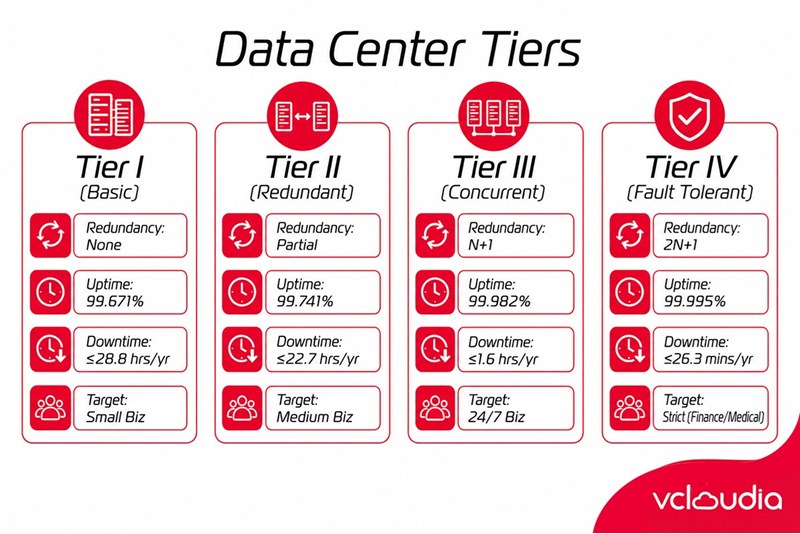
- Features: The data center can supply power and cooling but lacks redundancy features, does not include an uninterruptible power supply (UPS), and relies solely on direct power. This means that any incident would necessitate a system shutdown.
- Infrastructure availability: 99.671%
- Applications: Generally suitable for small businesses or applications that do not require continuous 24/7 uptime.
- Maximum downtime: Up to 28.8 hours per year.
Thus, Tier I is an appropriate choice for businesses that do not have extensive resource demands and can tolerate system downtime.
Tier II (Redundant Capacity Components)
Tier II offers improvements over Tier I by incorporating some redundant hardware, enabling the system to withstand certain hardware failures without impacting Data Center operations.
- Features: Includes additional redundant components such as backup power and generators for critical elements like UPS and cooling systems. Should a system component experience an issue, the redundant component will immediately take over.
- Infrastructure availability: 99.741%
- Applications: Ideal for medium-sized businesses with requirements for continuous operation that are not absolutely strict.
- Maximum downtime: Approximately 22.7 hours per year.
Tier II provides enhanced protection, helping to maintain continuity for business operations.
Tier III (Concurrent Maintainability)
Tier III is a widely adopted level, with many Data Centers in Cambodia aiming to achieve it. A Data Center reaching this level boasts high availability and continuous operation due to its ability to undergo maintenance without disrupting the overall data center operations.
- Features: Fully equipped with redundant components for all critical systems, including UPS, cooling systems, networks, and other essential equipment. The N+1 redundancy system guarantees that the data center can operate safely and continuously for a minimum of 72 hours, even during a power outage.
- Infrastructure availability: 99.982%
- Applications: Suitable for businesses that demand continuous 24/7 operation and cannot tolerate lengthy downtime.
- Maximum downtime: Approximately 1.6 hours per year.
With its concurrent maintainability and high stability, Tier III serves as an excellent choice for businesses aiming to ensure operational continuity.
Tier IV (Fault Tolerance)
Tier IV is the highest level in the Uptime Tier system, offering the capability to remain operational even during severe incidents. Data Centers achieving Tier IV are fault-tolerant, ensuring continuous system operation even when experiencing critical failure situations.
- Features: Data centers at this level are completely equipped with independent redundant components, effectively preventing any incident from having an impact. Furthermore, with a separate power system and redundant infrastructure at the 2N+1 level, the data center can continue operating through power outages lasting up to 96 hours.
- Infrastructure availability: 99.995%
- Applications: Suited for businesses with extremely stringent uptime requirements, such as financial institutions or medical facilities.
- Maximum downtime: 26.3 minutes.
Conclusion
Uptime Tier is a structured system designed to assess a Data Center's reliability and its capacity to sustain operations. This system, with its levels from Tier I to Tier IV, indicates the degree of perfection and redundancy capacity in data centers. Consequently, for businesses with critical requirements for continuity and data safety, selecting a Data Center that adheres to the Uptime Tier III or IV standard is profoundly important.
Vcloudia Cloud Server – The Cloud You Can Count On
If you're concerned about the potential limitations of Cloud Servers, Cloud Server by Vcloudia is a reliable solution for businesses of all sizes. With a modern infrastructure and comprehensive customer support, Vcloudia delivers a cloud experience with:
- Powerful connectivity to ensure stable 24/7 access
- Advanced security standards, compliant with international certifications such as ISO 27001:2013, ISO 20000:2018, ISO 9001:2015
- Flexible pricing packages tailored to your specific business needs
- Expert technical support, making migration and system deployment fast, safe, and compatible
Contact information:
- Hotline: +855 888 55 66 08 (free of charge)
- Fanpage: https://www.facebook.com/vcloudia/
- Website: https://vcloudia.com
Featured news
Related news
What is a Snapshot? The Difference Between Snapshot and Backup
Snapshot is a familiar concept in data management and protection. In the context of the information technology boom, where data is a major asset for businesses, understanding Snapshots as well as their application is a key factor for enterprises to maximize technological efficiency.
What is a Firewall? The Role and Importance of Firewalls for Users
In the context of ever-increasing cyberattacks, system security has become a top priority for many enterprises. Alongside deploying antivirus software and controlling connection ports, firewalls are also considered a key solution to effectively enhance cybersecurity.
What is DDoS? Signs, Mitigation Strategies, and Effective Prevention
DDoS is a highly dangerous cyberattack that leaves severe consequences for enterprises. Therefore, gaining a clear understanding of DDoS attacks, as well as how to detect and prevent them, is a topic of significant interest to many.
What is a Trojan? How to Detect, Avoid, and Prevent It
A Trojan is a type of malicious code or software that can cause severe consequences to computer operations. So, what is a Trojan? How can you prevent a Trojan from infiltrating your computer? In the following article, Vcloudia will provide detailed information on these issues.
What is Cloud Backup? Classification, benefits, and limitations
Cloud Backup is a solution that plays an important role in backing up and recovering data when an incident occurs. So what exactly is Cloud Backup? Let's find out the details with Vcloudia in the following article.
What is Cloud Storage? Features and Benefits of Using It
Cloud Storage is the perfect storage solution alternative to bulky, space-consuming physical hard drives. So, what is Cloud Storage? Let's explore the details with Vcloudia through the following article.
What is an API? Characteristics and applications in website design
API, short for Application Programming Interface, is a concept no longer unfamiliar in the information technology field. So what exactly is an API and why is it so important? Let's find out with Vcloudia.
What is Node.js? Instructions on how to install Node.js on cPanel
Currently, it is easy to see that Node.js is being used by quite a lot of people. This is because Node.js can support users in running on multiple platforms and multiple devices.
What is Vultr VPS? Should you use Vultr VPS?
Vultr VPS is one of the best cloud storage solutions in the world. In this article, you will learn the concept: "What is Vultr VPS?", as well as understand its advantages and disadvantages.
Zoom Cloud Meeting: What is it? Basic Things You Should Know About Zoom Cloud Meeting
In 2020, Zoom Cloud Meeting became one of the leading video conferencing software applications. It allows you to virtually interact with colleagues when in-person meetings aren't possible, and it has also been very successful for social events.