



.png)















.png)





What Is PaaS? Key Insights into Platform as a Service
Nov 21, 2025In today’s rapidly evolving digital era, both businesses and developers are seeking optimal solutions to build software quickly, efficiently, and cost-effectively. One of the most prominent solutions is PaaS – Platform as a Service. Let’s explore it in detail with Vcloudia in the following article.
What is PaaS?
PaaS (Platform as a Service) is a cloud computing service model that allows developers to build, deploy, and manage applications without worrying about managing underlying hardware or software infrastructure.
Think of PaaS as a digital playground where developers can freely create without the hassle of setting up operating systems, servers, or middleware. All of these components are provided and managed by the cloud service provider. As a result, software development becomes faster, simpler, and more efficient—ideal for businesses looking to save time and human resources.
PaaS services are typically billed on a subscription or pay-as-you-go basis, helping organizations minimize upfront hardware and software investments. What sets PaaS apart is its flexibility, scalability on demand, and seamless integration with various software development tools.
How Does PaaS Work?
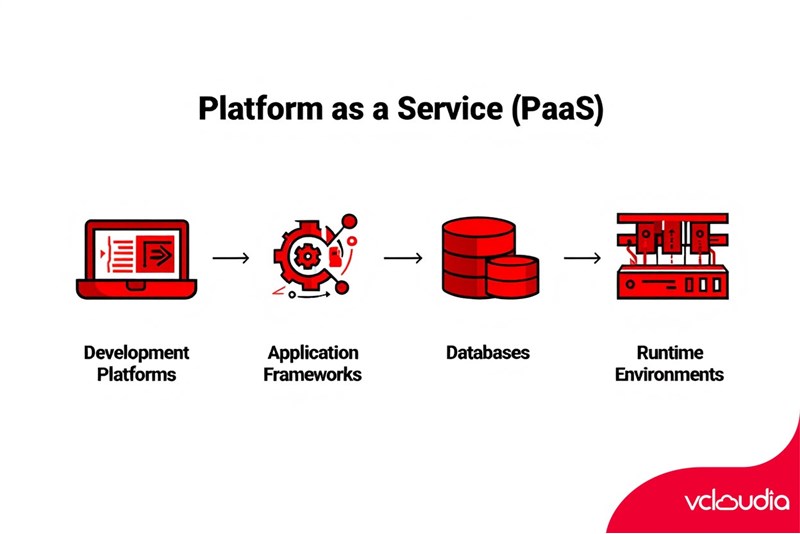
PaaS operates by providing an integrated platform that includes tools, frameworks, and services needed for building, testing, deploying, and maintaining applications. Through an easy-to-use management interface, developers or development teams can access and manage these resources conveniently.
The PaaS provider offers a complete development environment and tools such as compilers, database management systems, storage services, networking, and essential middleware. Developers use these tools to write code, test, and deploy applications directly on the platform.
PaaS automatically handles operational tasks such as load balancing, scaling, data backups, and system updates—reducing manual administrative workload. When your application needs to scale, PaaS allows you to expand resources flexibly according to actual demand, ensuring optimal performance and smooth scalability.
Moreover, PaaS providers offer built-in analytics and performance monitoring tools so businesses can easily track and optimize application performance. This makes development and operations more streamlined and continuous, aligning perfectly with DevOps and CI/CD practices.
Key Advantages of PaaS
Using PaaS offers several clear benefits for both businesses and software developers:
- Accelerated development time: With a pre-integrated environment and minimal setup, developers can start building applications immediately.
- Cost efficiency: No need for costly investments in hardware, software, or complex system administration. Scaling up or down based on actual needs helps optimize operational costs.
- Flexible scalability: In a rapidly changing market, PaaS enables easy system scaling without disrupting business operations.
- Enhanced team collaboration: PaaS provides project management tools, automated testing, continuous deployment, and other utilities that foster innovation and collaboration in modern software development.
Common Limitations of PaaS
Despite its benefits, PaaS also comes with certain challenges:
- Vendor lock-in: Heavy reliance on a specific cloud provider’s infrastructure can be risky if the provider experiences downtime or becomes unsuitable for the business.
- Security concerns: Hosting applications and data on the cloud increases the risk of cyberattacks or data breaches. Choosing a reliable provider and implementing strong security measures is essential.
- Limited customization: Certain technical restrictions—such as limited system control or configuration flexibility—can be a drawback for projects requiring specific setups or large-scale data processing.
- Long-term costs: Without proper resource optimization, PaaS costs can grow significantly over time, especially as your system scales. Hence, careful evaluation is necessary before adopting PaaS for enterprise operations.
Types of PaaS in Use Today
There are many PaaS platforms available on the market, designed to meet diverse business and development needs. PaaS can be categorized by deployment model or core functionality.
1. Based on Deployment Model
- Public Cloud PaaS: The most common model, provided by major vendors like AWS, Google Cloud, or Microsoft Azure via the internet.
- Private Cloud PaaS: Designed for organizations requiring high data security, regulatory compliance, or complete infrastructure control.
- Hybrid Cloud PaaS: A combination of both public and private models, balancing flexibility with security.
- Community Cloud PaaS: Shared infrastructure among several organizations—often non-profits or small groups—to reduce costs.
Each model offers distinct advantages suited to specific business goals and budgets.
2. Based on Functionality
PaaS can also be classified by its key features:
- Web development platforms: e.g., Heroku, Google App Engine—ideal for building web apps and APIs.
- Data-centric platforms: such as IBM Cloud or Azure Data Platform—optimized for big data and analytics applications.
- Specialized PaaS for AI, ML, IoT, or DevOps: e.g., AWS Elastic Beanstalk, Microsoft Azure Machine Learning—empowering innovation and automation.
Choosing the right PaaS depends on your business objectives, existing infrastructure, and financial resources.
When Should You Use PaaS?
PaaS adoption depends on strategic and operational factors:
- When businesses want to reduce time-to-market by streamlining traditional development processes.
- When organizations need to scale quickly to meet market demands or growth.
- When startups or SMEs seek cost optimization through subscription-based or usage-based billing.
- When teams practice DevOps or CI/CD, PaaS provides the ideal environment for continuous integration, deployment, and innovation.
The Future of PaaS
In the coming years, PaaS is expected to evolve toward greater flexibility, intelligence, and integration. Future platforms will increasingly leverage AI, machine learning, automation, and big data to optimize performance and reliability.
Providers will focus on self-optimizing and self-healing PaaS solutions, capable of predictive maintenance and performance tuning. Multi-cloud PaaS adoption will grow, allowing enterprises to avoid vendor lock-in while taking advantage of each provider’s strengths.
In addition, serverless computing will become an integral part of PaaS, eliminating infrastructure management altogether and enabling developers to focus purely on building applications. This will further enhance Agile and DevOps workflows, shortening development cycles and maximizing productivity.
Security, privacy, and global compliance standards will remain at the core of PaaS development, building greater trust among enterprise customers.
Conclusion
In summary, PaaS has become an indispensable part of modern enterprise technology strategy. With its convenience, flexibility, and cost-saving potential, PaaS opens new opportunities for businesses to innovate and compete globally.
While challenges such as vendor dependency, security risks, and long-term costs remain, ongoing advancements in cloud technology are making PaaS more diverse, powerful, and resilient.
Choosing the right PaaS that aligns with your business goals and capabilities is the key to unlocking the full potential of cloud computing—helping your organization thrive in the digital era.
Explore the services offered by Vcloudia – a leading provider of cloud computing and data center solutions. Contact us for expert consultation and find the right model for your needs:
- Hotline: +855 888 55 66 08 (free of charge)
- Fanpage: https://www.facebook.com/vcloudia/
- Website: https://vcloudia.com
Featured news
Related news
What is a Snapshot? The Difference Between Snapshot and Backup
Snapshot is a familiar concept in data management and protection. In the context of the information technology boom, where data is a major asset for businesses, understanding Snapshots as well as their application is a key factor for enterprises to maximize technological efficiency.
What is a Firewall? The Role and Importance of Firewalls for Users
In the context of ever-increasing cyberattacks, system security has become a top priority for many enterprises. Alongside deploying antivirus software and controlling connection ports, firewalls are also considered a key solution to effectively enhance cybersecurity.
What is DDoS? Signs, Mitigation Strategies, and Effective Prevention
DDoS is a highly dangerous cyberattack that leaves severe consequences for enterprises. Therefore, gaining a clear understanding of DDoS attacks, as well as how to detect and prevent them, is a topic of significant interest to many.
What is a Trojan? How to Detect, Avoid, and Prevent It
A Trojan is a type of malicious code or software that can cause severe consequences to computer operations. So, what is a Trojan? How can you prevent a Trojan from infiltrating your computer? In the following article, Vcloudia will provide detailed information on these issues.
What is Cloud Backup? Classification, benefits, and limitations
Cloud Backup is a solution that plays an important role in backing up and recovering data when an incident occurs. So what exactly is Cloud Backup? Let's find out the details with Vcloudia in the following article.
What is Cloud Storage? Features and Benefits of Using It
Cloud Storage is the perfect storage solution alternative to bulky, space-consuming physical hard drives. So, what is Cloud Storage? Let's explore the details with Vcloudia through the following article.
What is an API? Characteristics and applications in website design
API, short for Application Programming Interface, is a concept no longer unfamiliar in the information technology field. So what exactly is an API and why is it so important? Let's find out with Vcloudia.
What is Node.js? Instructions on how to install Node.js on cPanel
Currently, it is easy to see that Node.js is being used by quite a lot of people. This is because Node.js can support users in running on multiple platforms and multiple devices.
What is Vultr VPS? Should you use Vultr VPS?
Vultr VPS is one of the best cloud storage solutions in the world. In this article, you will learn the concept: "What is Vultr VPS?", as well as understand its advantages and disadvantages.
Zoom Cloud Meeting: What is it? Basic Things You Should Know About Zoom Cloud Meeting
In 2020, Zoom Cloud Meeting became one of the leading video conferencing software applications. It allows you to virtually interact with colleagues when in-person meetings aren't possible, and it has also been very successful for social events.