



.png)



















.png)





What Is Data Center Interconnect? A Complete Guide
Aug 19, 2026What is Data Center Interconnect?—in simple terms, it’s the networking infrastructure and design approach that lets you reliably connect servers, storage, and applications across separate data centers so workloads can communicate, replicate, scale, and recover. When done well, Data Center Interconnect (DCI) becomes the “nervous system” of your digital estate: it carries traffic between facilities with predictable performance, redundancy, and security—so your business can keep operating even when demand spikes or failures occur.
What Is a Data Center Interconnect?
Data Center Interconnect (DCI) is the set of network links, protocols, and architecture patterns used to connect data centers to each other. While a standard “WAN” can also connect sites, DCI is usually held to more demanding requirements: lower latency, higher availability, strict bandwidth guarantees, predictable behavior during congestion, and robust protection against failures. In practice, DCI often serves multiple business goals at once—replication for disaster recovery, live workload mobility, data synchronization, and cross-site application communication.
If I were to offer a “personal” way to frame it: DCI is less about cables and more about intent. The intent is that two independent sites—each with its own power, cooling, racks, and operations—should behave like a coordinated system. Think of it like connecting two hospitals: you can communicate by radio, but when you need to transfer critical information quickly and safely, you build a dedicated, reliable communication corridor with redundancy and governance. DCI is that corridor.
Another insight that often gets missed: DCI isn’t only about connectivity; it’s also about network design boundaries. Many enterprises underestimate how decisions like routing domains, MTU sizing, encapsulation overhead, latency budgets, and failure recovery timing will affect application behavior. DCI forces those tradeoffs into the open—so you can make deliberate choices rather than “hope the network behaves.”
How Does Data Center Interconnect Work?
DCI typically works by establishing high-capacity, resilient paths between data centers—often using fiber, managed optical services, or private network overlays. Traffic from one site is carried over the interconnect network using one or more forwarding layers: Ethernet frames, IP packets, MPLS labels, or optical wavelengths. The “shape” of the network depends on distance, required latency, expected traffic patterns, and the level of operational control desired.
At a high level, you can think of DCI as having four layers of concern: physical connectivity (e.g., fiber or leased wavelength), transport (e.g., optical transport networks or Ethernet services), network services (e.g., routing, MPLS, or overlay constructs), and application-aware behavior (e.g., how replication and failover are engineered). When you change any one of these, the end-to-end result changes. That’s why DCI planning is closer to architecture than procurement.
Here’s a practical mental model I like: imagine you’re moving a “stream” of data between cities. The stream’s volume changes over time (application workload). The path has choke points (bandwidth and scheduling). The stream can spill into alternative routes when there’s damage (redundancy and reroute). DCI’s job is to keep that stream reliable and predictable—so it doesn’t degrade into unpredictable outages or degraded performance.
What Technologies Are Used for Data Center Interconnect?
Below are common technology categories used in DCI, each with its own strengths and tradeoffs. If you’re evaluating options, consider not only what they can do on paper, but also what they can do during real incidents—because the network is never “quiet” forever.
1. Fiber Optic Connectivity
Fiber optic connectivity is the physical foundation for most DCI architectures. Dark fiber, lit fiber, or fiber leased as part of an Ethernet or optical service are typical starting points. Fiber offers the high bandwidth and low latency characteristics needed to support modern workloads, including storage replication, virtual machine mobility, and real-time replication of databases.
From a “real-world” perspective, fiber isn’t just about capacity—it’s about path diversity and manageability. DCI often uses redundant routes (for example, two physically diverse fiber paths) to reduce the chance that a single dig event, construction hazard, or regional outage interrupts service. This is particularly important because a data center interconnect is usually considered mission-critical connectivity.
Fiber design also interacts with engineering parameters like fiber type, optical reach, dispersion limits, and connector/patch panel quality. Even if you have “enough bandwidth,” poor optical quality can cause retransmissions, degrade performance, or create intermittent failures that are famously hard to troubleshoot. In DCI, those intermittent issues can become expensive and operationally stressful.
2. Ethernet
Ethernet remains one of the most common DCI service types because it aligns well with how many data centers operate internally. You can interconnect sites using Ethernet handoffs, often with provider-managed services. Ethernet circuits are widely available, relatively easy to understand, and can support a broad range of throughput requirements.
A key advantage of Ethernet for DCI is that many data centers already use Ethernet-based switching and routing patterns. This reduces the “protocol translation” complexity. Additionally, Ethernet services can be paired with VLAN tagging, subinterfaces, or higher-level overlays so that network segmentation stays consistent across sites.
However, the quality of Ethernet-based DCI depends heavily on how the provider engineers the service, including class-of-service handling, bandwidth shaping, and how failure events are managed. If your interconnect is carrying latency-sensitive traffic, you must verify how the network behaves under congestion. Otherwise, the interconnect might look fine at baseline monitoring while still causing subtle application degradation during peak utilization.
3. Optical Transport Networks
Optical Transport Networks (OTNs) are designed to carry high volumes of data efficiently over long distances using optical switching and transport mechanisms. They’re especially relevant when you want to scale bandwidth beyond what typical “single circuit” Ethernet connections provide, or when you need more control over transport behavior.
OTNs often help organizations reach higher capacities while maintaining service separation and operational observability. They can support multiple service types over the same optical layer, which is useful when you want to expand your interconnect without rebuilding everything.
The personal insight here: OTNs tend to shine when your organization is planning growth across multiple use cases—backup replication, active-active workloads, and future expansion. If you treat interconnect as a one-off project, you might choose simpler Ethernet-only paths. If you treat it as a long-term platform, OTNs become increasingly compelling.
4. DWDM and WDM
DWDM (Dense Wavelength Division Multiplexing) and WDM (Wavelength Division Multiplexing) use different wavelengths of light to carry many independent data streams through the same fiber. This increases utilization of fiber and supports very high aggregate bandwidth over long distances.
The difference between WDM and DWDM matters: DWDM typically packs more wavelengths closely together, enabling significantly higher capacity. In DCI, this can be the difference between “we can connect sites today” and “we can connect them for the next several years as workloads grow.”
WDM/DWDM also introduces new engineering and operational considerations—like optical channel management, power levels, dispersion, and wavelength planning. If you’re running mission-critical traffic, you’ll want clear processes for provisioning, monitoring, and maintenance. But if you do it well, DWDM gives you a scalable and future-proof interconnect foundation.
5. MPLS
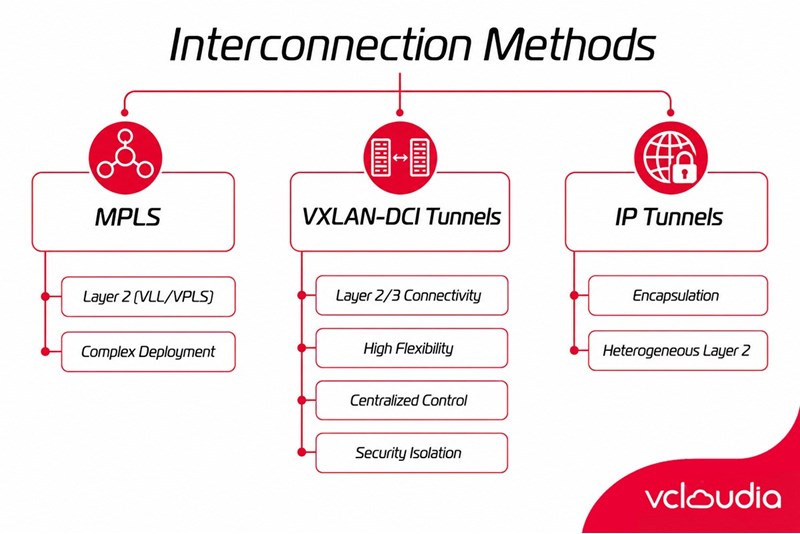
Multiprotocol Label Switching (MPLS) is widely used in provider networks and enterprise WAN designs, and it can be used in DCI to provide traffic engineering and service differentiation. MPLS can help create predictable paths, support QoS policies, and isolate traffic flows between sites.
A major benefit of MPLS-based DCI is control. Depending on implementation, MPLS can support features like virtual private network separation, deterministic forwarding behavior, and centralized policy enforcement. That can be especially valuable when you have multiple classes of traffic—like storage replication versus application synchronization—requiring different handling.
However, some organizations avoid MPLS overlays due to perceived complexity or because their network teams prefer IP-native approaches. The right answer depends on your skills, your provider’s MPLS maturity, and your performance requirements. In my experience, MPLS is often the “engineering lever” teams pull when they need consistent service behavior across distance.
6. Metro Ethernet
Metro Ethernet services are tailored for metropolitan-scale connections between data centers within a city or region. For many businesses, the first DCI move is a metro interconnect because it’s cost-effective and offers relatively short distances—meaning lower latency and faster provisioning cycles.
Metro Ethernet can support a variety of DCI use cases, including campus-to-metro extension, active-active clusters within a metropolitan area, and backup replication between nearby facilities. Many providers offer standardized service tiers, making budgeting and service-level expectations more straightforward.
What I find interesting is that metro interconnect decisions often influence later designs. If you architect segmentation well early—using consistent addressing, VLAN/VRF strategy, or overlay design—you reduce future migration pain. If you rush and create ad-hoc solutions, you may struggle later when expanding into regional DCI.
7. VXLAN and EVPN
VXLAN (Virtual Extensible LAN) and EVPN (Ethernet VPN) are overlay technologies widely used in data center fabrics to extend L2/L3 semantics across sites without relying solely on traditional VLAN scaling. They’re often used in modern multi-site designs where you want consistent networking behavior between data centers.
A typical motivation: organizations want workloads in separate data centers to communicate as if they are part of a single logical network. VXLAN helps decouple tenant segmentation from physical VLAN limitations. EVPN can provide control-plane functions for multi-site overlay connectivity.
The creative insight: VXLAN/EVPN doesn’t just solve scaling—it changes how network teams think about interconnect. Instead of treating the link as a “special circuit,” it treats the interconnect as part of the same logical fabric. But this requires careful planning: MTU, encapsulation overhead, routing symmetry, and failure handling must be engineered so the overlay remains stable during link or node failures.
8. Dark Fiber
Dark fiber refers to leasing unused fiber infrastructure without having the provider “light it.” The customer (or their equipment partner) uses their own transceivers and optical equipment to activate the circuit. Dark fiber offers strong control over network design, upgrade paths, and technology choices.
The upside is flexibility and long-term scalability. If you expect to evolve bandwidth requirements frequently, dark fiber can be attractive because you can upgrade your optics and capacity without negotiating new provider circuits every time.
But dark fiber is not plug-and-play. You take on additional responsibilities: optical engineering, power management, monitoring, and maintenance. Organizations often partner with experienced vendors or optical specialists. In DCI, dark fiber is best when your team has operational maturity or you can reliably outsource that operational burden.
9. Wavelength Services
Wavelength services provide access to specific optical wavelengths delivered over fiber paths managed by a provider. You’re not buying raw infrastructure like dark fiber; instead, you subscribe to a managed wavelength channel with defined characteristics and support.
This approach can be a middle ground between Ethernet services (simpler, less granular optical control) and dark fiber (maximum control, maximum responsibility). Wavelength services are common for long-distance DCI and for organizations that want predictable optical capacity scaling.
One key advantage is that wavelengths can often be provisioned and expanded with less friction than re-cutting physical circuits. Still, you must understand the provider’s operational model: how quickly can they restore service, what are monitoring capabilities, and how do they handle wavelength-level failures? Those operational details matter as much as the published capacity.
10. Coherent Optical Technology
Coherent optical technology enables higher spectral efficiency and longer reach by using advanced modulation and signal processing. In modern optical networks, coherent techniques allow better performance over distance and support increasing capacity without requiring as many physical fibers.
In DCI contexts, coherent optics can help when you’re pushing long distances or trying to maximize capacity while controlling signal quality and reach. It’s an increasingly important category because it supports scaling strategies that don’t rely only on “more fiber.”
The practical takeaway: coherent optics can reduce physical footprint and simplify future scaling, but they also demand sophisticated planning and monitoring. Coherent systems introduce more parameters to manage—like modulation formats, signal-to-noise ratios, and optical impairments. If you’re building a long-term DCI platform, coherent technology can be a strategic investment.
What Are the Different Types of Data Center Interconnect?
1. Campus Data Center Interconnect
Campus DCI refers to connections between data centers located within the same campus or very close proximity. Latency is typically low, and the physical distance is short, which makes it easier to engineer performance and redundancy.
This type is often used for workload clustering, high availability within the same operational region, and rapid replication between facilities. Organizations might use it to separate risk—like isolating systems by power or building—without sacrificing network performance.
A personal note: campus DCI is sometimes treated too casually because distances are short. But “short distance” doesn’t mean “zero risk.” Cooling failures, power events, and local equipment faults still happen. Building campus DCI with clear redundancy and testing can significantly reduce the chance that a local disaster becomes an outage cascade.
2. Metro Data Center Interconnect
Metro DCI connects data centers within a metropolitan region. Latency is still relatively manageable, and redundancy can often be achieved using multiple physical routes across the metro fiber footprint.
Metro interconnect is frequently used for active-active or active-passive strategies, especially for applications that require quick failover and low replication lag. It’s also commonly used for regional enterprises that have multiple facilities within a single economic area.
The creative insight: metro DCI is where “operational reality” meets “architecture.” While the distances are moderate, the network is complex—carriers, provider aggregation points, and multiple handoff layers may be involved. The best metro designs include thorough acceptance testing that measures not only throughput but also convergence behavior during real-world failure scenarios.
3. Regional Data Center Interconnect
Regional DCI spans multiple cities or within a broader geographic region. Latency and cost increase compared to metro, and the interconnect may involve more advanced transport technologies like optical transport networks or DWDM.
This category is well-suited for disaster recovery, replication over longer distances, and scalable multi-site architectures. Many organizations treat regional DCI as the backbone for business continuity plans because it offers protection against single-city failures.
However, as distance increases, synchronization needs more careful engineering. If you rely on synchronous replication for database workloads, you may quickly hit latency constraints. As a result, regional DCI often supports a mix of synchronous and asynchronous replication strategies based on application tolerance.
4. Long-Distance Data Center Interconnect
Long-distance DCI connects data centers separated by large geographic distances—often across different states, countries, or continents (depending on the definition used). Latency increases significantly, and transport technology usually becomes more sophisticated and capacity-oriented.
This type of interconnect is used when you need wide-area business continuity or must connect data centers across corporate boundaries, cloud regions, or international sites. It may also be used for global enterprises supporting multiple markets.
The personal lens: long-distance DCI is where “network certainty” becomes a product. You need provider confidence and measurable service-level agreements. The moment you can’t predict latency and restoration behavior, application failover strategies must change. In other words: the interconnect shapes the architecture of the applications.
5. Submarine Data Center Interconnect
Submarine DCI is used for international interconnect between continents or across oceanic distances via submarine cables. This is the most challenging DCI category because physical repair windows can be long and because capacity planning must consider rare but serious disruptions.
Submarine links are essential for global connectivity—particularly for enterprises, cloud services, and streaming ecosystems requiring cross-continental replication and access. They also often serve as major backbones for international network transit.
The key insight: submarine DCI pushes you to think beyond redundancy in the typical “two paths” sense. You may need geopolitical awareness, multiple cable systems, diversified routing, and realistic disaster recovery planning that accounts for extended restoration times. The network is reliable, but recovery might not be “fast”—so designs must be resilient by application and process.
What Are the Benefits of Data Center Interconnect?
Let’s break down the most common benefits and how they translate into operational outcomes.
1. Improved Business Continuity
DCI strengthens business continuity by allowing critical systems to remain accessible or recover quickly when a data center problem occurs. Instead of treating each data center as isolated, you can create a coordinated multi-site strategy.
For example, if one facility suffers an outage—whether from power loss, cooling failure, or equipment damage—DCI can enable rerouting, failover, and standby operation in another site. This reduces the duration of service disruption and helps maintain customer trust.
A creative perspective: business continuity isn’t just about “staying up.” It’s about staying predictable. When DCI is properly engineered and tested, your recovery timeline becomes more reliable—so stakeholders can make informed decisions during incidents rather than guessing.
2. Disaster Recovery and Data Replication
DCI is fundamental for disaster recovery (DR) because replication of data, configurations, and (sometimes) live workloads requires reliable inter-site transport. Whether you do block-level replication, file replication, or application-level synchronization, the network must support consistent throughput and stability.
DCI also allows different DR patterns—like warm standby, cold standby, and active-passive designs. The choice depends on application requirements and the acceptable recovery point objective (RPO) and recovery time objective (RTO).
Personal analysis: many organizations invest heavily in DR tooling but underestimate the network as a bottleneck. If replication traffic competes with production traffic or suffers from jitter and congestion, RPO targets can be missed. DCI is often the hidden lever that determines whether DR plans truly work.
3. High Availability and Redundancy
DCI supports high availability (HA) by providing redundant paths and enabling failover between sites. When you design with redundancy in mind, the interconnect reduces the chance that a single network component failure causes a full outage.
Redundancy can be achieved through multiple physical links, diverse routing paths, and careful handling of protocol convergence. Even when the underlying technology differs—Ethernet, MPLS, optical wavelengths—the goal remains the same: maintain service continuity and reduce recovery time.
In my view, the best HA designs assume failure will happen. They test how quickly traffic shifts, what happens to in-flight sessions, and whether application state can tolerate transitions. DCI HA is not just “link redundancy”—it’s “behavior redundancy.”
4. Workload Balancing
Workload balancing across data centers becomes feasible when you can reliably move traffic and, in some architectures, move workloads themselves. DCI enables you to distribute application load based on demand, maintenance windows, or hardware capacity planning.
For example, an e-commerce platform might shift certain traffic to another site during peak events or during maintenance on a primary site. In more advanced designs, systems can run partially active-active with synchronized routing and consistent network policy.
Creative insight: workload balancing isn’t only a network problem—it’s an orchestration problem. But DCI is what makes the orchestration possible. Without stable interconnect paths and consistent latency expectations, balancing becomes risky and unpredictable.
5. Resource Sharing
Resource sharing allows you to use compute and storage resources across sites more intelligently. Instead of provisioning everything per site, organizations can create pooled resources, using DCI as the fabric that ties the resource pool together.
This can help reduce overprovisioning. For instance, storage replication can allow one site to serve as a backup or extension while the primary site handles most workloads. Some architectures also support shared access to shared datasets and distributed caching systems.
Personal take: resource sharing can deliver significant efficiency, but only when access patterns and failure behavior are well understood. DCI latency and bandwidth influence which resource-sharing strategies are realistic.
6. Better Application Performance
DCI can improve application performance by enabling optimized traffic paths between application components that are distributed across data centers. If your application is split into tiers (web, app, database, analytics) and those tiers reside in different sites, DCI ensures low-latency communication.
However, “better performance” is conditional. If the interconnect uses technologies or configurations that create excessive encapsulation overhead, poor QoS settings, or unpredictable routing behavior, performance might not improve—or might degrade.
The practical insight: performance isn’t only about raw latency. It’s also about packet loss, jitter, retransmissions, and consistent throughput. When DCI is tuned—through QoS, proper MTU, and traffic engineering—application responsiveness improves measurably.
7. Lower Latency Between Data Centers
Some DCI types (especially campus and metro interconnect) can provide relatively low latency, enabling near-real-time synchronization and more aggressive HA architectures. Lower latency can be crucial for synchronous replication and for latency-sensitive applications.
Lower latency also helps with consistent end-to-end user experience, especially for applications served from multiple geographies. While DCI doesn’t replace CDN or edge optimization, it ensures the back-end connectivity doesn’t become the bottleneck.
Personal analysis: latency budgeting is one of the most underappreciated tasks in DCI. Teams often measure “average latency” but ignore the tail behavior—the worst-case latency that happens during congestion or route changes. Applications often suffer from tail latency, not average.
8. Improved Scalability
As workloads grow, DCI provides a scalable path for expanding capacity across sites. Technologies like DWDM, optical transport networks, and managed wavelength services support large bandwidth scaling without requiring separate physical networks for each new use case.
Scalability also includes operational scalability: adding new sites or new traffic classes should be possible without rewriting everything. A well-designed DCI architecture can evolve—adding new VLANs, VRFs, overlay segments, or additional capacity channels.
Creative insight: scalable DCI is about maintaining architectural consistency. If your segmentation strategy is consistent and your operational processes are standardized, scaling becomes a predictable expansion rather than a disruptive rebuild.
9. Support for Hybrid and Multicloud Infrastructure
Modern enterprises rely on hybrid and multicloud strategies: some workloads run on-premises, some run in public clouds, and many are distributed across both. DCI often serves as the bridge that connects data centers to each other and to cloud regions securely and reliably.
Cloud connectivity alone might not be sufficient for bandwidth-intensive replication or for consistent multi-site networking. DCI helps provide the performance characteristics needed for real-time data synchronization, workload mobility, and application resilience.
In my experience, hybrid architectures succeed when connectivity is treated as a product with SLAs and monitoring—rather than as a one-time setup. DCI is one of the main ways organizations professionalize that connectivity.
How Secure Is Data Center Interconnect?
DCI security is about more than encryption. Security in interconnect designs includes physical security (how fibers are protected), logical segmentation (how traffic is isolated), access control (who can reach what), monitoring (visibility into traffic patterns), and robust failure handling (so attackers can’t exploit degraded states).
Many DCI solutions use private network services or dedicated circuits to reduce exposure compared to the public internet. Additionally, organizations commonly implement encryption at the transport or overlay layer depending on their architecture and compliance requirements. For example, IPsec or VPN overlays can encrypt traffic across provider networks.
But here’s the deeper point: security is also a matter of policy correctness. In distributed systems, it’s easy for ACLs, security groups, or firewall rules to become inconsistent across sites—especially during migrations or incident-driven changes. DCI security must include change control, consistent policy deployment, and continuous verification.
Operational monitoring is another cornerstone. If you can’t detect anomalies—like unusual bandwidth spikes, unexpected route changes, or persistent packet loss—you lose the ability to respond quickly. Secure DCI therefore includes visibility: logs, telemetry, and alerting integrated with your SOC processes.
What Are the Challenges of Data Center Interconnect?
DCI challenges typically fall into engineering, operational, and business categories. Engineering challenges include latency management, bandwidth planning, and protocol behavior under failure conditions. Operational challenges include troubleshooting complexity, change management, and coordination between multiple vendors and teams.
One major challenge is meeting performance targets consistently. It’s easy to measure bandwidth at steady state; it’s harder to guarantee predictable behavior under congestion or during link failures. Tail latency, jitter, and packet loss can undermine applications even when average performance looks acceptable.
Another challenge is complexity from overlays and encapsulation. Technologies like VXLAN add overhead that affects MTU. MPLS adds operational domains. Optical transport adds provisioning and optical-channel management complexity. Each layer can be correct individually, yet still create end-to-end issues if the design isn’t holistic.
From a personal standpoint, the biggest hidden challenge is testing. Many organizations validate connectivity with “happy path” tests and then discover failures only during real incidents. DCI requires disciplined validation: failover testing, traffic replay, chaos testing in limited windows, and periodic re-verification after upgrades.
Vendor and provider coordination is another common friction point. Providers may not own the endpoint configurations, and internal teams may not own optical or carrier behavior. Without clear ownership and runbooks, incidents can stretch longer than expected.
What Is the Difference Between DCI and WAN?
DCI and WAN are related, but they aren’t identical. WAN (Wide Area Network) is a broad term describing connectivity between geographically separated sites, including enterprise offices, branches, and data centers. Data Center Interconnect is a specialized type of connectivity focused specifically on interconnecting data centers with requirements often associated with high availability, low latency, bandwidth predictability, and robust DR behaviors.
In other words, WAN is the category; DCI is the subset with stricter expectations. A WAN might support general office connectivity, cloud access, and internet browsing. DCI typically carries traffic for storage replication, distributed applications, and critical infrastructure—so it requires more deterministic behavior.
Another difference is operational emphasis. DCI usually includes more rigorous testing around failure modes, convergence, and replication impacts. It also often requires more careful QoS and segmentation planning because the applications are more sensitive.
What Is the Difference Between DCI and Network Peering?
Network peering generally refers to connectivity between networks (often autonomous systems) where traffic is exchanged under defined policies—commonly seen in internet ecosystems. Peering can involve BGP sessions, route policies, and traffic settlement or agreements.
DCI, on the other hand, is primarily about connecting data centers and enabling workload, storage, and network consistency between them. While DCI networks may use BGP internally or leverage peering-like concepts, the core intent is inter-data-center traffic with specific performance and resilience requirements.
So the distinction is in purpose and control. Peering is often about exchanging internet-bound traffic efficiently. DCI is about ensuring application and replication connectivity between dedicated facilities with predictable performance, private service characteristics, and operational governance.
However, real-world architectures can blur lines. For hybrid cloud connectivity, you might combine peering-style internet routes with private interconnects or DCI services. That’s why architectural clarity matters: you need to know which traffic flows use which paths, and why.
How to Choose a Data Center Interconnect Solution?
Choosing a DCI solution starts with understanding your requirements in measurable terms: bandwidth, latency tolerance, acceptable packet loss, replication strategy (sync vs async), DR objectives, and expected growth. It also depends on your architecture: are you building active-active, active-passive, or a hybrid model?
Then consider operational readiness. Do you have in-house expertise for optical equipment if you go with dark fiber? Are you comfortable managing MPLS domains? Can your network team manage VXLAN/EVPN overlays and handle MTU/encapsulation considerations? If not, you might prefer managed services like Ethernet handoffs or wavelength services delivered with strong provider support.
A critical step is to ask not only “what can this technology do,” but “what happens during failure.” Review provider restoration times, reroute behavior, and how quickly they can isolate and correct issues. Request test plans, and insist on verifying QoS behavior and traffic class treatment under stress conditions.
You also need to align DCI choice with your security and compliance needs. If sensitive data is replicated across sites, confirm encryption requirements, audit logging, and segmentation strategy. Ensure that identity, routing, and firewall policies are consistent across the interconnect boundary.
Finally, think in terms of lifecycle and scalability. Your initial deployment might be for DR, but the next phase could be workload mobility, expanded replication, or multi-site active-active. Choose a solution that can evolve without forcing a costly redesign.
Conclusion
What is Data Center Interconnect? It’s the engineered connectivity layer that links data centers so workloads, storage, and applications can communicate reliably across sites—supporting disaster recovery, high availability, performance optimization, and hybrid/multicloud strategies. By understanding how DCI works, selecting appropriate technologies (from fiber and Ethernet to DWDM, MPLS, and VXLAN/EVPN), and designing for real failure conditions, organizations can turn interconnect from a mere network link into a resilient platform that protects business continuity and scales with future demands.
Vcloudia Cloud Server – The Cloud You Can Count On
If you're concerned about the potential limitations of Cloud Servers, Cloud Server by Vcloudia is a reliable solution for businesses of all sizes. With a modern infrastructure and comprehensive customer support, Vcloudia delivers a cloud experience with:
- Powerful connectivity to ensure stable 24/7 access
- Advanced security standards, compliant with international certifications such as ISO 27001:2013, ISO 20000:2018, ISO 9001:2015
- Flexible pricing packages tailored to your specific business needs
- Expert technical support, making migration and system deployment fast, safe, and compatible
Contact information:
- Hotline: +855 888 55 66 08 (free of charge)
- Fanpage: https://www.facebook.com/vcloudia/
- Website: https://vcloudia.com
Featured news
Related news
What is a Snapshot? The Difference Between Snapshot and Backup
Snapshot is a familiar concept in data management and protection. In the context of the information technology boom, where data is a major asset for businesses, understanding Snapshots as well as their application is a key factor for enterprises to maximize technological efficiency.
What is a Firewall? The Role and Importance of Firewalls for Users
In the context of ever-increasing cyberattacks, system security has become a top priority for many enterprises. Alongside deploying antivirus software and controlling connection ports, firewalls are also considered a key solution to effectively enhance cybersecurity.
What is DDoS? Signs, Mitigation Strategies, and Effective Prevention
DDoS is a highly dangerous cyberattack that leaves severe consequences for enterprises. Therefore, gaining a clear understanding of DDoS attacks, as well as how to detect and prevent them, is a topic of significant interest to many.
What is a Trojan? How to Detect, Avoid, and Prevent It
A Trojan is a type of malicious code or software that can cause severe consequences to computer operations. So, what is a Trojan? How can you prevent a Trojan from infiltrating your computer? In the following article, Vcloudia will provide detailed information on these issues.
What is Cloud Backup? Classification, benefits, and limitations
Cloud Backup is a solution that plays an important role in backing up and recovering data when an incident occurs. So what exactly is Cloud Backup? Let's find out the details with Vcloudia in the following article.
What is Cloud Storage? Features and Benefits of Using It
Cloud Storage is the perfect storage solution alternative to bulky, space-consuming physical hard drives. So, what is Cloud Storage? Let's explore the details with Vcloudia through the following article.
What is an API? Characteristics and applications in website design
API, short for Application Programming Interface, is a concept no longer unfamiliar in the information technology field. So what exactly is an API and why is it so important? Let's find out with Vcloudia.
What is Node.js? Instructions on how to install Node.js on cPanel
Currently, it is easy to see that Node.js is being used by quite a lot of people. This is because Node.js can support users in running on multiple platforms and multiple devices.
What is Vultr VPS? Should you use Vultr VPS?
Vultr VPS is one of the best cloud storage solutions in the world. In this article, you will learn the concept: "What is Vultr VPS?", as well as understand its advantages and disadvantages.
Zoom Cloud Meeting: What is it? Basic Things You Should Know About Zoom Cloud Meeting
In 2020, Zoom Cloud Meeting became one of the leading video conferencing software applications. It allows you to virtually interact with colleagues when in-person meetings aren't possible, and it has also been very successful for social events.