



.png)


















.png)





What is Data Center Heat Export? Turning Data Centers into Sustainable Heat Sources
Aug 19, 2026Have you heard of Data Center Heat Export—a method that transforms waste heat from data centers into a sustainable energy source? Given that data centers consume vast amounts of electricity and contribute significantly to CO2 emissions, the reuse of waste heat is not merely an optimal solution but also a crucial step toward a green future. Join Vcloudia as we explore its functionality and its role in establishing environmentally friendly data centers in Cambodia.
What is Data Center Heat Export?
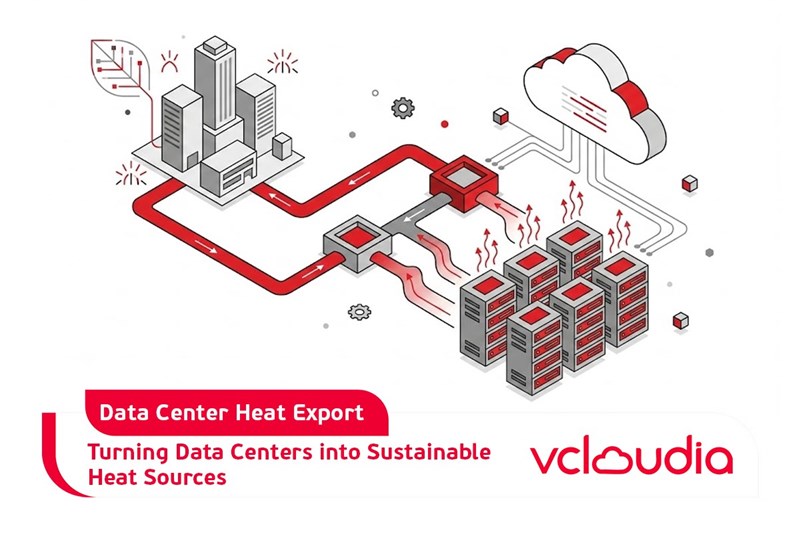
Data Center Heat Export refers to a solution for repurposing waste heat generated by data centers, converting this excess energy into a clean heat supply for nearby communities or industrial applications. This initiative is considered one of the vital steps in developing green and sustainable data centers.
Modern data centers, due to their need to process large volumes of data and operate high-performance hardware like CPUs and GPUs, produce substantial amounts of waste heat. Instead of allowing this heat to go unutilized, Data Center Heat Export enables operators to collaborate with energy providers to reuse it, thereby lowering CO₂ emissions and contributing to the circular economy.
This trend is driven not only by the necessity to optimize resources but also by stringent environmental regulations in numerous countries. For example, several European nations, including Germany and the UK, have implemented laws mandating data centers to adopt waste heat recycling measures to reduce carbon emissions.
How does Data Center Heat Export work?
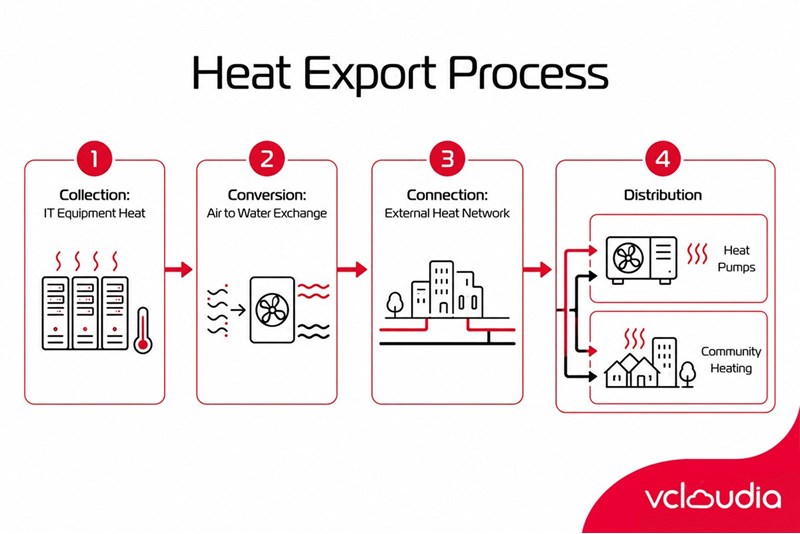
The process of exporting waste heat from data centers is a method for utilizing surplus heat, which traditionally would have been released into the environment, to fulfill heating or energy supply requirements. Specifically, this process unfolds as follows:
1. Collecting Waste Heat from IT Equipment
As IT equipment such as servers, CPUs, and GPUs operate, they generate a significant amount of heat. The data center's cooling system gathers this heat by employing fans to move hot air from the equipment into the air conditioning system.
2. Heat Conversion
The collected heat is transferred from the air to water through a heat exchange system. This water then becomes heated and circulates within the data center’s cooling system.
3. Connection to an External Heat Network
Rather than expelling all waste heat into the atmosphere, a portion of this heat is directed to external heat networks via a heat exchanger. The heat exchanger ensures that the water in the data center's cooling system remains separate from the water in the heat network operator's infrastructure.
4. Heating and Distribution
The external heat network, which is typically managed by a third party, uses heat pumps to elevate the water temperature, thus meeting the community's heating needs. The heated water is then distributed through underground pipes laid beneath roads or sidewalks, reaching residential or industrial areas requiring heat.
The Importance of Zero-Emission Data Centers - Green Data Centers
In the digital era, data centers have become an indispensable platform for storing and processing vast data volumes to support all economic and social activities. However, this advancement also raises concerns about its adverse environmental impacts.
According to a report by the International Energy Agency (IEA), data centers consume approximately 200 TWh of energy annually and contribute about 2% of global CO2 emissions—a figure comparable to the aviation industry. This presents a considerable challenge, requiring businesses to innovate rapidly and seek sustainable solutions to minimize their environmental footprint.
Green Data Centers - An Inevitable Solution for Sustainable Development
Green Data Centers represent a pioneering model aimed at minimizing negative environmental impacts through:
- Reusing Waste Heat Energy: Data Center Heat Export technology transforms surplus heat from data centers into useful energy, benefiting the community.
- Applying Advanced Cooling Technology: Utilizing liquid cooling systems and heat pumps to optimize performance.
- Transitioning to Renewable Energy: Increasing the adoption of renewable energy sources such as wind, solar, and other green energy sources.
Conclusion
Data Center Heat Export clearly demonstrates the potential for building a sustainable technology ecosystem with green data centers that not only operate efficiently but also contribute positively to reducing emissions and protecting the environment.
Vcloudia Cloud Server – The Cloud You Can Count On
If you're concerned about the potential limitations of Cloud Servers, Cloud Server by Vcloudia is a reliable solution for businesses of all sizes. With a modern infrastructure and comprehensive customer support, Vcloudia delivers a cloud experience with:
- Powerful connectivity to ensure stable 24/7 access
- Advanced security standards, compliant with international certifications such as ISO 27001:2013, ISO 20000:2018, ISO 9001:2015
- Flexible pricing packages tailored to your specific business needs
- Expert technical support, making migration and system deployment fast, safe, and compatible
Contact information:
- Hotline: +855 888 55 66 08 (free of charge)
- Fanpage: https://www.facebook.com/vcloudia/
- Website: https://vcloudia.com
Featured news
Related news
What is a Snapshot? The Difference Between Snapshot and Backup
Snapshot is a familiar concept in data management and protection. In the context of the information technology boom, where data is a major asset for businesses, understanding Snapshots as well as their application is a key factor for enterprises to maximize technological efficiency.
What is a Firewall? The Role and Importance of Firewalls for Users
In the context of ever-increasing cyberattacks, system security has become a top priority for many enterprises. Alongside deploying antivirus software and controlling connection ports, firewalls are also considered a key solution to effectively enhance cybersecurity.
What is DDoS? Signs, Mitigation Strategies, and Effective Prevention
DDoS is a highly dangerous cyberattack that leaves severe consequences for enterprises. Therefore, gaining a clear understanding of DDoS attacks, as well as how to detect and prevent them, is a topic of significant interest to many.
What is a Trojan? How to Detect, Avoid, and Prevent It
A Trojan is a type of malicious code or software that can cause severe consequences to computer operations. So, what is a Trojan? How can you prevent a Trojan from infiltrating your computer? In the following article, Vcloudia will provide detailed information on these issues.
What is Cloud Backup? Classification, benefits, and limitations
Cloud Backup is a solution that plays an important role in backing up and recovering data when an incident occurs. So what exactly is Cloud Backup? Let's find out the details with Vcloudia in the following article.
What is Cloud Storage? Features and Benefits of Using It
Cloud Storage is the perfect storage solution alternative to bulky, space-consuming physical hard drives. So, what is Cloud Storage? Let's explore the details with Vcloudia through the following article.
What is an API? Characteristics and applications in website design
API, short for Application Programming Interface, is a concept no longer unfamiliar in the information technology field. So what exactly is an API and why is it so important? Let's find out with Vcloudia.
What is Node.js? Instructions on how to install Node.js on cPanel
Currently, it is easy to see that Node.js is being used by quite a lot of people. This is because Node.js can support users in running on multiple platforms and multiple devices.
What is Vultr VPS? Should you use Vultr VPS?
Vultr VPS is one of the best cloud storage solutions in the world. In this article, you will learn the concept: "What is Vultr VPS?", as well as understand its advantages and disadvantages.
Zoom Cloud Meeting: What is it? Basic Things You Should Know About Zoom Cloud Meeting
In 2020, Zoom Cloud Meeting became one of the leading video conferencing software applications. It allows you to virtually interact with colleagues when in-person meetings aren't possible, and it has also been very successful for social events.