



.png)


















.png)





What is a Hyperscale Data Center?
Aug 20, 2026In today's digital age, characterized by Big Data, the demand for processing and storing information has become more pressing than ever. Hyperscale Data Centers offer an optimal solution, effectively meeting stringent requirements for scalability, high performance, and data security. Let's delve into the specifics of Hyperscale Data Centers with Vcloudia.
What is a Hyperscale Data Center?
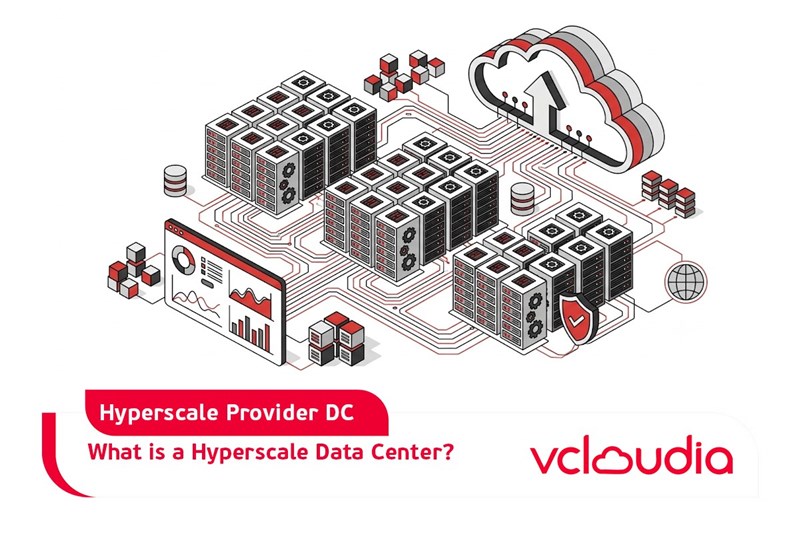
A Hyperscale Data Center, often referred to as a super-large data center, represents an IT infrastructure specifically engineered to handle the immense data processing and storage requirements of modern enterprises. It serves as an ideal model for organizations tasked with managing vast quantities of data generated by systems such as social networks, e-commerce platforms, or cloud computing services.
Key characteristics of a Hyperscale Data Center include:
- Unlimited scalability: These super-large data centers feature a modular architecture, enabling the rapid addition of resources (including servers, storage, and network infrastructure) without causing operational disruptions. This capability allows businesses to easily accommodate sudden surges in user traffic or workload demands.
- High performance: Hyperscale Data Centers are meticulously optimized to execute extensive workloads at accelerated processing speeds, achieved through the integration of advanced technologies like automated software and intelligent resource management.
- Energy optimization: Typically, these centers employ cutting-edge cooling systems and energy-efficient technologies, leading to significant reductions in both operating costs and adverse environmental impacts. A prime illustration is the Power Usage Effectiveness (PUE) of a Hyperscale Data Center, which is considerably lower than that of traditional data centers.
Given these attributes, Hyperscale Data Centers not only satisfy current demands but are also designed to support emerging technologies such as Artificial Intelligence (AI), Big Data analytics, and the Internet of Things (IoT).
Comparing Hyperscale Data Centers and Traditional Data Centers
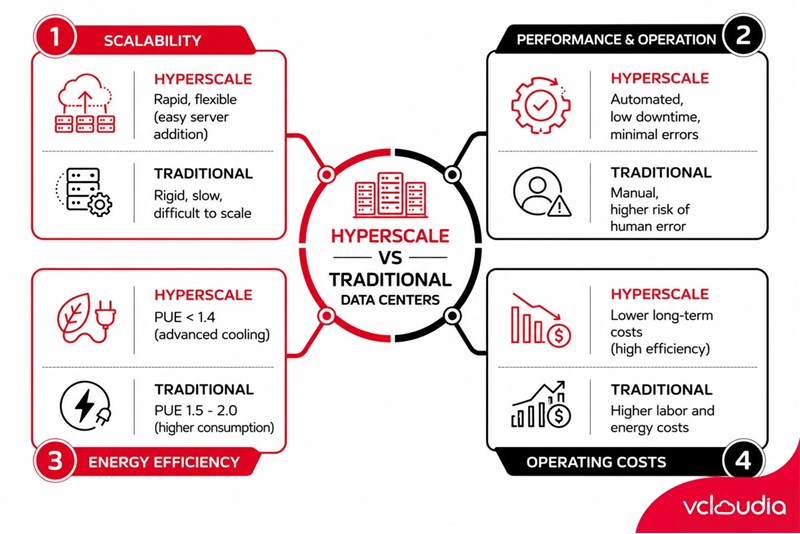
As data increasingly becomes the "golden resource" for every business, establishing an efficient infrastructure for storage and processing has become a top priority. Below are the notable distinctions between these two data center models:
Flexible Scalability
One of the most significant advantages of a Hyperscale Data Center is its capacity for rapid and efficient resource scaling. In contrast, traditional Data Centers frequently encounter difficulties when infrastructure expansion is necessary. For example, a business leveraging a Hyperscale Data Center can effortlessly add hundreds of servers in a short timeframe, thereby meeting unforeseen increases in data storage and processing requirements.
High Operational Performance
Hyperscale Data Centers achieve efficient operations by utilizing automation technology and sophisticated management software. This approach minimizes human error, boosts performance, and reduces downtime. Conversely, traditional Data Centers are heavily reliant on manual intervention, which results in higher labor costs and an elevated risk of operational mistakes.
Energy Optimization
Research indicates that traditional data centers often exhibit a PUE (Power Usage Effectiveness) ranging from 1.5 to 2.0. Meanwhile, Hyperscale Data Centers achieve a PUE below 1.4 by employing optimal liquid or air cooling technologies. This not only translates into cost savings but also diminishes carbon emissions, thereby contributing to environmental protection.
Operating Costs
With their extensive automation and optimization capabilities, Hyperscale Data Centers offer lower long-term operating costs when compared to traditional Data Centers. Although the initial investment required to construct a Hyperscale Data Center may be higher, businesses will realize substantial savings on operational expenditures due to their superior performance and energy efficiency.
Specific example: A large e-commerce company experiences an enormous surge in traffic during a major shopping season. A Hyperscale Data Center enables the company to swiftly expand its server capacity to manage the sudden influx of customers without any service interruption, whereas a traditional data center might not be able to react quickly enough.
Which Businesses Use Hyperscale Data Centers?
Hyperscale Data Centers represent more than just a technological solution; they form the "backbone" for large enterprises and organizations that require efficient, secure, and flexible processing of vast data volumes across numerous sectors.
Major Technology Companies
Corporations such as Google, Amazon, Microsoft, and Facebook exemplify entities that deploy Hyperscale Data Centers to power cloud services, social networks, and search engines. These businesses are compelled to process billions of global user requests every second, a feat that only a Hyperscale Data Center can accomplish.
The Finance and Banking Sector
Given the colossal amounts of data needing processing and storage, major banks and financial institutions are transitioning to Hyperscale Data Centers to guarantee the security and speed of transactions. Real-time trading systems and customer data analytics also demand stringent security levels, which Hyperscale Data Centers perfectly fulfill.
E-commerce Enterprises
Leading global e-commerce platforms like Alibaba, Amazon, and Shopee leverage Hyperscale Data Centers to support high traffic volumes during peak periods, such as Black Friday, double-day sales, or other significant promotional events. Their flexible scalability assists these companies in maintaining stable services and avoiding overload incidents.
Applications in Healthcare and Education
Beyond the business world, Hyperscale Data Centers also provide support for healthcare organizations in storing and analyzing patient data. In the education sector, they aid in constructing online learning platforms and housing extensive amounts of training materials.
Vcloudia Cloud Server – The Cloud You Can Count On
If you're concerned about the potential limitations of Cloud Servers, Cloud Server by Vcloudia is a reliable solution for businesses of all sizes. With a modern infrastructure and comprehensive customer support, Vcloudia delivers a cloud experience with:
- Powerful connectivity to ensure stable 24/7 access
- Advanced security standards, compliant with international certifications such as ISO 27001:2013, ISO 20000:2018, ISO 9001:2015
- Flexible pricing packages tailored to your specific business needs
- Expert technical support, making migration and system deployment fast, safe, and compatible
Contact information:
- Hotline: +855 888 55 66 08 (free of charge)
- Fanpage: https://www.facebook.com/vcloudia/
- Website: https://vcloudia.com
Featured news
Related news
What is a Snapshot? The Difference Between Snapshot and Backup
Snapshot is a familiar concept in data management and protection. In the context of the information technology boom, where data is a major asset for businesses, understanding Snapshots as well as their application is a key factor for enterprises to maximize technological efficiency.
What is a Firewall? The Role and Importance of Firewalls for Users
In the context of ever-increasing cyberattacks, system security has become a top priority for many enterprises. Alongside deploying antivirus software and controlling connection ports, firewalls are also considered a key solution to effectively enhance cybersecurity.
What is DDoS? Signs, Mitigation Strategies, and Effective Prevention
DDoS is a highly dangerous cyberattack that leaves severe consequences for enterprises. Therefore, gaining a clear understanding of DDoS attacks, as well as how to detect and prevent them, is a topic of significant interest to many.
What is a Trojan? How to Detect, Avoid, and Prevent It
A Trojan is a type of malicious code or software that can cause severe consequences to computer operations. So, what is a Trojan? How can you prevent a Trojan from infiltrating your computer? In the following article, Vcloudia will provide detailed information on these issues.
What is Cloud Backup? Classification, benefits, and limitations
Cloud Backup is a solution that plays an important role in backing up and recovering data when an incident occurs. So what exactly is Cloud Backup? Let's find out the details with Vcloudia in the following article.
What is Cloud Storage? Features and Benefits of Using It
Cloud Storage is the perfect storage solution alternative to bulky, space-consuming physical hard drives. So, what is Cloud Storage? Let's explore the details with Vcloudia through the following article.
What is an API? Characteristics and applications in website design
API, short for Application Programming Interface, is a concept no longer unfamiliar in the information technology field. So what exactly is an API and why is it so important? Let's find out with Vcloudia.
What is Node.js? Instructions on how to install Node.js on cPanel
Currently, it is easy to see that Node.js is being used by quite a lot of people. This is because Node.js can support users in running on multiple platforms and multiple devices.
What is Vultr VPS? Should you use Vultr VPS?
Vultr VPS is one of the best cloud storage solutions in the world. In this article, you will learn the concept: "What is Vultr VPS?", as well as understand its advantages and disadvantages.
Zoom Cloud Meeting: What is it? Basic Things You Should Know About Zoom Cloud Meeting
In 2020, Zoom Cloud Meeting became one of the leading video conferencing software applications. It allows you to virtually interact with colleagues when in-person meetings aren't possible, and it has also been very successful for social events.