



.png)

















.png)





Understanding the impact of noise pollution from data centers
Aug 19, 2026In the current digital age, data centers are vital infrastructure for economic progress. However, alongside their positive contributions, data centers also generate adverse effects, particularly noise pollution. The noise emanating from data centers not only impacts individuals but also harms the surrounding communities and the environment. Gaining insight into the causes and remedies for this issue is essential for ensuring sustainable growth. Let Vcloudia provide detailed information in the following article.
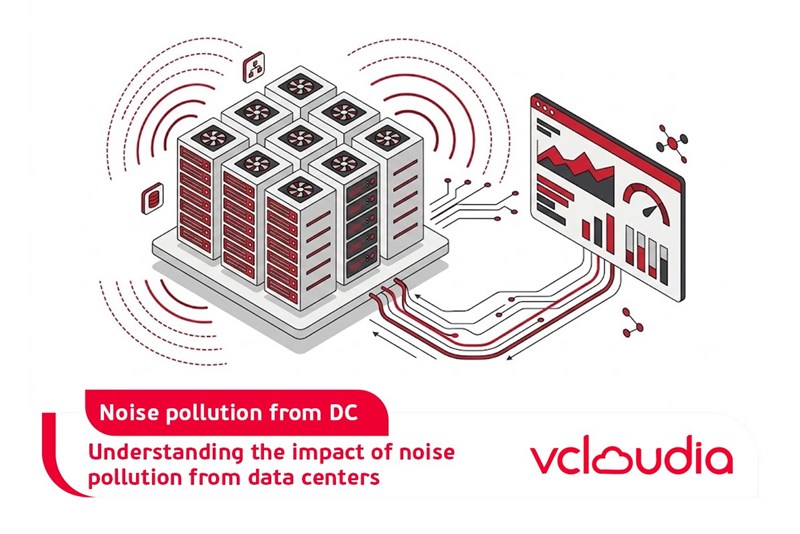
How do data centers cause noise pollution?
Cooling systems
Data center cooling systems, which include fans and air compressors, represent a significant source of noise. These components operate continuously to maintain stable temperatures for the server infrastructure. The high-frequency and high-intensity fluctuations of the fans, combined with the dynamic sounds of the air compressors, lead to severe noise pollution.
Hardware equipment
Servers and uninterruptible power supplies (UPS) are also considerable contributors to noise. During operation, servers produce sound from rotating hard drives or internal cooling fans. UPS units generate noise from their operating engines when switching power.
Construction and maintenance activities
The construction and upkeep of data centers involve numerous industrial machines such as drills, cutters, and motorized vehicles. These activities increase noise pollution in the vicinity.
Impacts of data center noise on the environment and humans
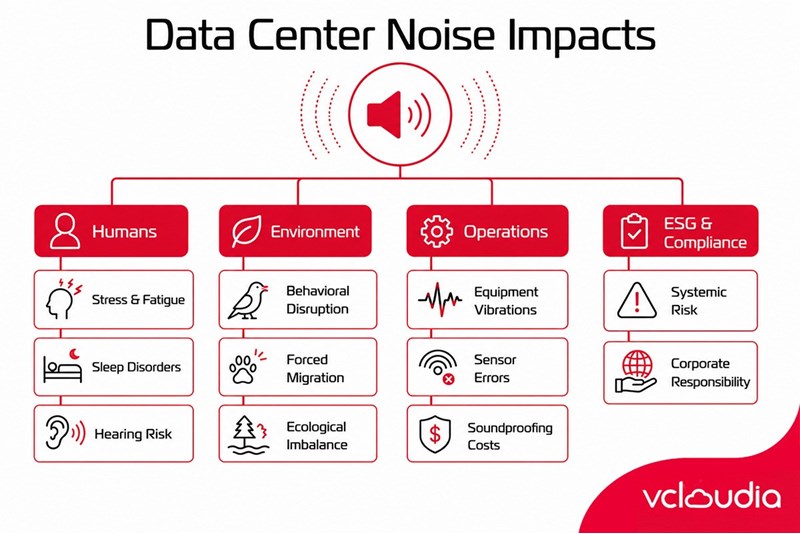
During a data center's operation, various pieces of equipment, including cooling systems, backup generators, high-capacity fans, and power cabinets, can all produce continuous, high-intensity noise. While it doesn't cause immediate disruptions like power outages or security vulnerabilities, noise is a subtle factor that profoundly affects humans, the natural environment, and the operational infrastructure.
For humans, prolonged and continuous exposure to high-intensity noise can impair concentration, lead to chronic fatigue, and elevate stress levels—particularly for those living or working near data centers. At higher intensities, noise can also cause sleep disturbances, psychological issues, and in severe situations, the risk of hearing damage if exposure is continuous and without protective measures. This becomes particularly concerning in densely populated areas where data centers are situated close to schools, hospitals, or residential zones.
Beyond affecting humans, noise from data centers also negatively impacts the natural environment. Numerous studies indicate that high-intensity artificial sound can disrupt the biological behavior of animals, interfering with their communication, reproduction, and foraging activities. For animals sensitive to sound, such as birds, insects, and small mammals, continuous noise exposure can lead to behavioral changes or even migration from their habitats, causing ecological imbalance. This is a factor often overlooked in environmental impact assessment reports but is increasingly becoming a concern in green data center projects.
Operationally, noise can also affect the efficiency of internal equipment systems. In some cases, prolonged acoustic resonance might cause slight physical vibrations, potentially affecting sensitive electromechanical parts or skewing sensor readings over time. Furthermore, high noise levels compel businesses to invest more in solutions for soundproofing, sound absorption, or acoustic isolation partitioning—leading to increased costs and more complex operating procedures. Dealing with the indirect consequences of noise also reduces the overall operational efficiency of the data center if not anticipated and managed from the design phase.
In essence, noise from data centers is not merely a supplementary technical issue, but a multifaceted factor influencing humans, the environment, and infrastructure. As ESG (Environmental, Social, and Governance) and sustainable development increasingly become standard criteria for assessing operational quality, businesses must view noise as a systemic risk requiring appropriate monitoring, control, and investment in mitigation. Proactive noise assessment and management not only help ensure compliance with legal regulations but also contribute to building the image of a responsible technology enterprise with a long-term vision.
Solutions to the problem of noise pollution from data centers
Soundproof design
Incorporating soundproofing materials and noise barriers into data center design is an effective solution. Soundproofing layers not only diminish emitted noise but also foster a quieter working environment.
Modern technology
Implementing advanced cooling systems and quieter hardware is a trend adopted by many data centers. These technological enhancements not only reduce noise but also optimize energy efficiency.
Regulatory compliance
Regularly monitoring noise levels and adhering to environmental regulations are crucial steps to minimize the impact of noise. This helps data centers operate efficiently while also protecting the community and surrounding environment.
Conclusion
Noise from data centers is an issue that warrants increased attention to minimize its negative impacts. With practical solutions such as technological advancements, soundproof designs, and stringent monitoring, data centers can operate more efficiently while safeguarding the environment.
Vcloudia Cloud Server – The Cloud You Can Count On
If you're concerned about the potential limitations of Cloud Servers, Cloud Server by Vcloudia is a reliable solution for businesses of all sizes. With a modern infrastructure and comprehensive customer support, Vcloudia delivers a cloud experience with:
- Powerful connectivity to ensure stable 24/7 access
- Advanced security standards, compliant with international certifications such as ISO 27001:2013, ISO 20000:2018, ISO 9001:2015
- Flexible pricing packages tailored to your specific business needs
- Expert technical support, making migration and system deployment fast, safe, and compatible
Contact information:
- Hotline: +855 888 55 66 08 (free of charge)
- Fanpage: https://www.facebook.com/vcloudia/
- Website: https://vcloudia.com
Featured news
Related news
What is a Snapshot? The Difference Between Snapshot and Backup
Snapshot is a familiar concept in data management and protection. In the context of the information technology boom, where data is a major asset for businesses, understanding Snapshots as well as their application is a key factor for enterprises to maximize technological efficiency.
What is a Firewall? The Role and Importance of Firewalls for Users
In the context of ever-increasing cyberattacks, system security has become a top priority for many enterprises. Alongside deploying antivirus software and controlling connection ports, firewalls are also considered a key solution to effectively enhance cybersecurity.
What is DDoS? Signs, Mitigation Strategies, and Effective Prevention
DDoS is a highly dangerous cyberattack that leaves severe consequences for enterprises. Therefore, gaining a clear understanding of DDoS attacks, as well as how to detect and prevent them, is a topic of significant interest to many.
What is a Trojan? How to Detect, Avoid, and Prevent It
A Trojan is a type of malicious code or software that can cause severe consequences to computer operations. So, what is a Trojan? How can you prevent a Trojan from infiltrating your computer? In the following article, Vcloudia will provide detailed information on these issues.
What is Cloud Backup? Classification, benefits, and limitations
Cloud Backup is a solution that plays an important role in backing up and recovering data when an incident occurs. So what exactly is Cloud Backup? Let's find out the details with Vcloudia in the following article.
What is Cloud Storage? Features and Benefits of Using It
Cloud Storage is the perfect storage solution alternative to bulky, space-consuming physical hard drives. So, what is Cloud Storage? Let's explore the details with Vcloudia through the following article.
What is an API? Characteristics and applications in website design
API, short for Application Programming Interface, is a concept no longer unfamiliar in the information technology field. So what exactly is an API and why is it so important? Let's find out with Vcloudia.
What is Node.js? Instructions on how to install Node.js on cPanel
Currently, it is easy to see that Node.js is being used by quite a lot of people. This is because Node.js can support users in running on multiple platforms and multiple devices.
What is Vultr VPS? Should you use Vultr VPS?
Vultr VPS is one of the best cloud storage solutions in the world. In this article, you will learn the concept: "What is Vultr VPS?", as well as understand its advantages and disadvantages.
Zoom Cloud Meeting: What is it? Basic Things You Should Know About Zoom Cloud Meeting
In 2020, Zoom Cloud Meeting became one of the leading video conferencing software applications. It allows you to virtually interact with colleagues when in-person meetings aren't possible, and it has also been very successful for social events.