



.png)


















.png)





The Impact of AI on Data Center Operations and Construction
Aug 20, 2026The robust growth of AI and the increasing demand for cloud computing are undeniably fueling the rapid expansion of data centers. However, this trend also presents both new opportunities and challenges for developers. This Vcloudia article will provide enterprises with a detailed understanding of AI's influence on data center construction and operation.
Overview of AI Applications in Data Centers
In an era of swift digital technology development, a data center is no longer merely a storage facility; it plays a crucial role in processing and analyzing vast amounts of data. To optimize operational performance and reduce costs, a growing number of businesses are integrating artificial intelligence (AI) into their data center infrastructure.
AI and Its Impact on Data Center Operations
In recent years, data center operators have started utilizing artificial intelligence (AI) to optimize daily operations. A recent 2022 survey by the Uptime Institute revealed that 57% of data center owners expressed willingness to trust AI models for operational decisions, marking an increase of nearly 20% compared to the previous year.
Therefore, AI is not only transforming how data centers operate but also delivering significant improvements in efficiency and productivity. Below are some specific applications of AI in data center operations:
Applying Artificial Intelligence to Optimize Resource Management
Resource management is a critical factor in ensuring a data center operates stably and efficiently. Today, enterprises are running massive workloads on data center infrastructure. With AI technology, businesses can optimize resource distribution and utilization through machine learning algorithms and predictive analytics, specifically:
- Efficient energy management: AI can monitor and analyze the energy consumption levels of devices within the data center, then offer adjustment recommendations to minimize energy waste. This not only helps save costs but also contributes to environmental protection.
- Hardware and storage resource management: AI has the capability to automatically allocate hardware resources, aiding in optimizing data storage processes and equipment maintenance. This helps minimize resource shortages or system overloads, ensuring smooth operations.
- Automated workload balancing: AI can analyze traffic and automatically distribute workloads across servers, which helps maintain stable performance and minimize latency.
- Enhancing customer experience: Proactive workload management is vital for elevating service quality. In this regard, AI acts as a powerful tool, automatically allocating computational tasks to the most optimal resources, which helps minimize costs while ensuring the best possible experience for customers.
The most important aspect is that AI optimizes the performance of the data center infrastructure, benefiting both service providers and users.
Applying AI to Enhance Data Center Security
With the rise of cybersecurity threats, traditional security systems can be much slower in learning about new threats or deploying effective defensive measures. Consequently, the advent of AI and its impact on data centers has helped address security issues more effectively and rapidly.
Specifically, AI in data centers can help improve security in the following ways:
- Anomaly detection: AI can analyze and learn from large datasets, thereby identifying system anomalies before they escalate into serious incidents. By using machine learning algorithms, AI continuously monitors metrics such as temperature, CPU utilization, network traffic, and other signals, helping to detect issues like hardware failures, cyberattacks, or system errors early. Detecting and resolving anomalies quickly not only enhances data center stability but also minimizes downtime and operational costs, ensuring long-term sustainability and efficiency.
- Enhancing proactive security measures: Traditional security measures are often reactive rather than proactive. However, AI enables data centers to predict potential threats and vulnerabilities, filling defense gaps before malicious actors can exploit them.
- Automated authentication and authorization: AI systems can help analyze data and automate user authentication processes, while simultaneously controlling access to sensitive systems, thereby protecting critical enterprise information from unauthorized intrusion.
- Data management and protection: The application of AI algorithms allows data centers to enhance processing and storage capabilities, and bolster the protection of sensitive data by analyzing and securing data across multiple layers, helping to reduce the risk of data leaks or loss in emergency situations. This contributes to protecting the uptime, reliability, and integrity of enterprise data, both during transmission and storage.
The Future of Data Centers
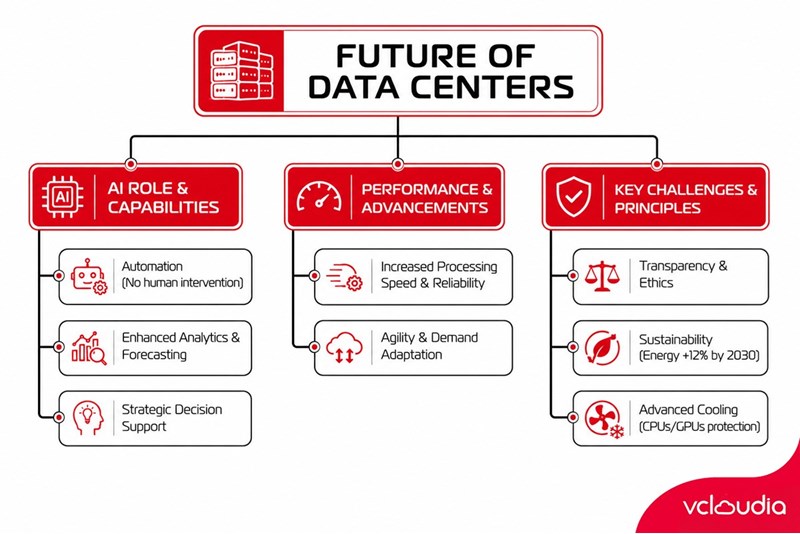
Artificial intelligence (AI) is not only contributing to enhancing the operational performance of current data centers but also opening the door to a highly potential future, where automated technologies and intelligent analytics will reshape how data infrastructure is managed and developed. These advancements promise to deliver outstanding improvements in processing speed, reliability, and the ability to adapt to the ever-increasing demands of the digitized market.
As artificial intelligence (AI) becomes a core element in data center operations, issues related to transparency will become increasingly important. Furthermore, sustainability will be a key factor in decisions regarding the use of AI in data centers. Moreover, workloads demanding massive resources, utilizing powerful CPUs and GPUs, will require advanced cooling systems to protect hardware from damage. According to the Electricity 2025 report data from the International Energy Agency (IEA), data center energy consumption is projected to increase by approximately 12% by 2030.
The adoption of AI will support data center providers in becoming more agile in responding to changes in demand, while concurrently building a large-scale and sustainable digital infrastructure platform for the future, based on principles of responsibility and ethics.
- Automated data centers: With the development of AI, future data centers may fully automate management and operational processes without the need for human intervention. This helps minimize risks caused by human factors and enhances work efficiency.
- Enhanced analytical and predictive capabilities: AI will continue to help data centers analyze and forecast future resource needs, thereby supporting infrastructure expansion and cost optimization.
- AI supporting strategic decisions: AI will not only support operations but also assist data center managers in making strategic decisions regarding investment, expansion, or operational process improvements. This helps data centers develop in a smarter and more sustainable manner.
Opportunities and Challenges of Data Centers
The application of AI in data centers brings many opportunities but is also not without challenges that need to be overcome:
Opportunities
"The advancement of artificial intelligence (AI) is a catalyst for solving the problems necessary to increase power grid efficiency," stated Liz Henderson, Global Head of Climate Risk Consulting at Aon. Additionally, AI acts as a powerful tool in supporting the early detection of security threats, minimizing risks from cyberattacks.
Below are some examples of advancements in the development of data centers focused on sustainability:
- Researchers are currently designing specialized hardware, such as new accelerators and advanced technologies like 3D chips, to improve performance. Concurrently, modern cooling technologies and locations capable of executing more computations when cheaper and more sustainable power sources are available are also being researched to optimize energy utilization at data centers.
- Data center developers and operators are investing in new technologies, such as carbon removal technology, which helps extract CO2 from the air and store it safely, contributing to minimizing environmental impact.
Although these developments are promising, the current data center landscape may encounter many challenges when considering the pressures of AI's rapid pace of development and potential human replacement in the future if not managed and controlled properly.
Challenges
- Technology and skills requirements: To deploy AI effectively, data center managers need to have solid knowledge of AI technology and big data.
- Initial investment costs: Applying AI requires a substantial investment in technology infrastructure and human resource training, which can be a challenge for many enterprises.
Effective Data Center Risk Management Strategy
Deploying AI in a data center is inseparable from an effective risk management strategy, which is highly significant for ensuring smooth and sustainable operations. Enterprises need to build a strategy to protect and respond to emergency situations, including:
- Security and system risk analysis: Assess vulnerabilities in the system and develop appropriate security measures to protect data and resources.
- Start risk management as early as possible: Engage risk consultants or specialized cloud service providers right from the early stages of project development for support in identifying risks, building mitigation strategies, leveraging existing data, and planning cost contingencies.
- Utilize a comprehensive approach: Collaborating with a reputable cloud service provider, possessing the right team of experts and technology, will help implement a comprehensive approach to data center risk management. Instead of dividing the project into three distinct phases: From construction, and operation, to decommissioning; this provider will ensure a seamless and efficient process throughout the project's lifecycle.
- Training and workforce preparation: Ensure employees understand and possess adequate skills to operate and manage AI systems, as well as emergency procedures when incidents occur.
- Continuous monitoring and rapid response: AI needs to be continuously monitored to ensure the system operates stably and responds promptly to security threats.
Artificial intelligence has been and is bringing profound changes to how data centers are operated and built. AI applications help optimize resources, enhance security, and support crucial strategic decisions. Despite many opportunities, enterprises also need to be mindful of the challenges in deploying and managing AI, especially the requirements for investment and human resource training.
Conclusion
Thus, the impact of AI on data centers is becoming increasingly profound and important; however, it is not yet truly widespread and effectively utilized in Cambodia. Overall, the application of AI not only brings technological benefits but also makes a significant contribution to the long-term development of modern data centers.
Vcloudia Cloud Server – The Cloud You Can Count On
If you're concerned about the potential limitations of Cloud Servers, Cloud Server by Vcloudia is a reliable solution for businesses of all sizes. With a modern infrastructure and comprehensive customer support, Vcloudia delivers a cloud experience with:
- Powerful connectivity to ensure stable 24/7 access
- Advanced security standards, compliant with international certifications such as ISO 27001:2013, ISO 20000:2018, ISO 9001:2015
- Flexible pricing packages tailored to your specific business needs
- Expert technical support, making migration and system deployment fast, safe, and compatible
Contact information:
- Hotline: +855 888 55 66 08 (free of charge)
- Fanpage: https://www.facebook.com/vcloudia/
- Website: https://vcloudia.com
Featured news
Related news
What is a Snapshot? The Difference Between Snapshot and Backup
Snapshot is a familiar concept in data management and protection. In the context of the information technology boom, where data is a major asset for businesses, understanding Snapshots as well as their application is a key factor for enterprises to maximize technological efficiency.
What is a Firewall? The Role and Importance of Firewalls for Users
In the context of ever-increasing cyberattacks, system security has become a top priority for many enterprises. Alongside deploying antivirus software and controlling connection ports, firewalls are also considered a key solution to effectively enhance cybersecurity.
What is DDoS? Signs, Mitigation Strategies, and Effective Prevention
DDoS is a highly dangerous cyberattack that leaves severe consequences for enterprises. Therefore, gaining a clear understanding of DDoS attacks, as well as how to detect and prevent them, is a topic of significant interest to many.
What is a Trojan? How to Detect, Avoid, and Prevent It
A Trojan is a type of malicious code or software that can cause severe consequences to computer operations. So, what is a Trojan? How can you prevent a Trojan from infiltrating your computer? In the following article, Vcloudia will provide detailed information on these issues.
What is Cloud Backup? Classification, benefits, and limitations
Cloud Backup is a solution that plays an important role in backing up and recovering data when an incident occurs. So what exactly is Cloud Backup? Let's find out the details with Vcloudia in the following article.
What is Cloud Storage? Features and Benefits of Using It
Cloud Storage is the perfect storage solution alternative to bulky, space-consuming physical hard drives. So, what is Cloud Storage? Let's explore the details with Vcloudia through the following article.
What is an API? Characteristics and applications in website design
API, short for Application Programming Interface, is a concept no longer unfamiliar in the information technology field. So what exactly is an API and why is it so important? Let's find out with Vcloudia.
What is Node.js? Instructions on how to install Node.js on cPanel
Currently, it is easy to see that Node.js is being used by quite a lot of people. This is because Node.js can support users in running on multiple platforms and multiple devices.
What is Vultr VPS? Should you use Vultr VPS?
Vultr VPS is one of the best cloud storage solutions in the world. In this article, you will learn the concept: "What is Vultr VPS?", as well as understand its advantages and disadvantages.
Zoom Cloud Meeting: What is it? Basic Things You Should Know About Zoom Cloud Meeting
In 2020, Zoom Cloud Meeting became one of the leading video conferencing software applications. It allows you to virtually interact with colleagues when in-person meetings aren't possible, and it has also been very successful for social events.