



.png)















.png)





The Energy Demand of Today's Data Centers
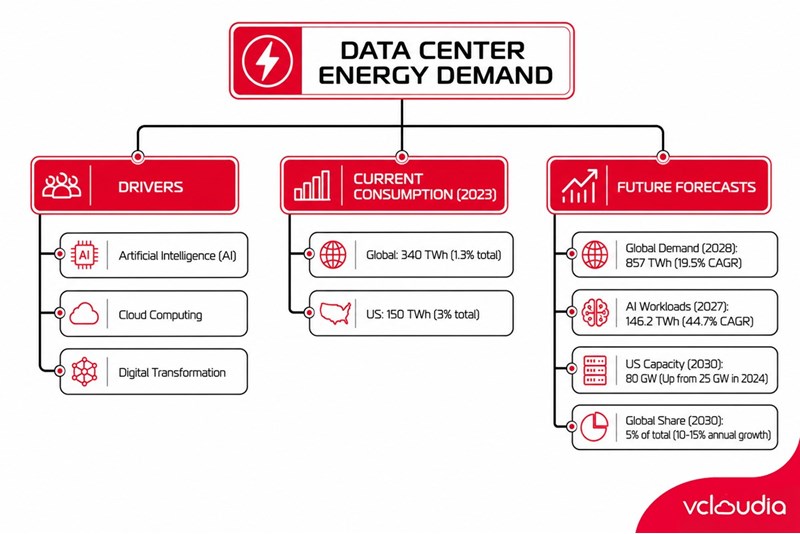
Aug 20, 2026The energy needs of data centers are rapidly expanding, driven by the swift advancements in AI, cloud computing, and digital transformation. In 2023, global data centers consumed an estimated 340 TWh of electricity, which represented 1.3% of the world's total electricity use. This figure is projected to continue its upward trajectory, presenting substantial challenges related to supply and environmental sustainability. This article will join Vcloudia in examining the energy demands of data centers globally and in Cambodia, while also exploring effective solutions to this problem.
The Energy Demand of Today's Data Centers
Recent years have seen a surge in artificial intelligence (AI), cloud computing, and digital transformation, fueling a global increase in data center demand. This trend brings with it a considerable rise in electricity requirements, straining existing energy infrastructures.
According to the International Energy Agency (IEA), worldwide data centers used approximately 340 TWh of electricity in 2023, making up 1.3% of the total global electricity demand. In the United States alone, data center electricity consumption reached 150 TWh, accounting for roughly 3% of the nation's total electricity demand. Projections indicate a significant escalation of this trend over the coming decade.
A report from International Data Corporation (IDC) in September 2024 forecasts that total global data center electricity consumption will more than double, reaching 857 TWh by 2028, with a compound annual growth rate (CAGR) of 19.5%. Notably, electricity consumption for AI-related workloads is expected to grow even faster, achieving a CAGR of 44.7% and reaching up to 146.2 TWh by 2027.
The impact of AI and cloud computing on data center energy demand
AI is considered a primary contributor to the rising energy demand from data centers. McKinsey's analysis indicates that the U.S. data center market could expand from 25 GW in 2024 to over 80 GW by 2030, largely due to digitization, the move to cloud computing, and the expansion of technologies such as AI.
According to Forbes, the growth in data centers coupled with AI development could significantly alter the path of global energy demand in the latter half of this decade. The research organization S&P Global estimates that between now and 2030, data center electricity demand will increase by 10-15% annually and could account for up to 5% of total global electricity demand by the decade's end.
The energy demand of data centers in Cambodia
Cambodia is also experiencing this growth trend, with an increasingly high demand for electricity for data centers. While precise figures for domestic data center electricity consumption are currently unavailable, it is evident that the expansion of AI, cloud computing, and digital services is putting substantial strain on Cambodia's electricity infrastructure.
Many large data centers belonging to local telecommunications companies, banks, and technology corporations are expanding their operations, resulting in a sharp increase in electricity consumption. Companies like Vcloudia, in particular, are making significant investments in international-standard data centers, while simultaneously seeking sustainable energy solutions to minimize their environmental footprint.
Challenges regarding data center energy demand
Meeting the continuously increasing electricity demand from data centers presents several challenges:
- Pressure on the power grid infrastructure: Data centers require a consistent and stable power supply, but the power grid systems in many countries, including Cambodia, face risks of overload.
- Environmental impact: Relying on electricity generated from fossil fuels makes data centers significant emitters of CO₂, positioning them as one of the major CO₂-producing industries.
- Operating costs: Electricity prices are constantly rising, particularly the costs associated with data center cooling systems, compelling businesses to seek out energy optimization strategies.
How can data centers meet the energy demand of AI?
The rapid evolution of artificial intelligence (AI) poses a considerable challenge concerning the energy requirements of data centers. To address this need, data centers can implement the following strategies:
Utilize renewable energy sources
Many large data centers globally have formed partnerships with wind and solar energy suppliers to lessen their reliance on traditional power grids. For instance, Google's and Microsoft's data centers have both invested heavily in solar and wind farms to provide power for their operations. Some data centers even proactively construct on-site renewable energy systems, which helps ensure a consistent supply and reduces long-term operational expenses.
In Cambodia, the potential for developing solar and wind power is immense. This could offer a valuable solution for domestic data centers to both satisfy their growing electricity demand and work towards sustainable development objectives.
Apply advanced cooling technologies
Cooling represents one of the most electricity-intensive components in a data center, especially when processing high-intensity AI workloads. To decrease electricity consumption from cooling systems, many data centers are transitioning to more advanced technologies, such as liquid cooling.
Compared to traditional air cooling systems, liquid cooling possesses greater efficiency in absorbing and dispersing heat, leading to a significant reduction in electricity consumption. Some data centers also leverage natural climatic conditions to cool their systems. Regions with cool climates, such as Northern Europe or high-altitude areas, can help lower cooling costs due to consistently low ambient temperatures throughout the year.
Choose reasonable data center locations
Geographical placement significantly influences a data center's ability to secure a stable power supply. Locating data centers near major energy sources like solar power plants, hydroelectric facilities, or industrial zones with robust power grids will help alleviate transmission pressure and optimize operating expenses.
Collaborate with the energy sector and invest in power storage
In addition to internal solutions, partnerships with power companies are crucial for ensuring a stable electricity supply for data centers. Data centers can collaborate with power providers to upgrade the power grid, expand generation capacity, and improve transmission capabilities.
Furthermore, investing in energy storage technology is another vital strategy for better managing electrical loads. Battery energy storage systems can enable data centers to continue operations even during power outages from the main grid. Many large enterprises are adopting this technology to guarantee system continuity and stability, especially given the escalating electricity demands from AI.
Optimize the energy efficiency of data centers
Employing modern hardware, such as new-generation processors (CPUs) and AI accelerator chips (GPUs, TPUs), can substantially enhance computational performance while consuming less electricity compared to older generations. Current AI algorithms can also be redesigned to utilize fewer resources while maintaining high accuracy, thereby reducing stress on the electrical system.
Moreover, smart energy management systems are being implemented worldwide to monitor and adjust electricity consumption in real-time. These technologies allow data centers to allocate resources flexibly, automatically adapt capacity based on usage levels, and minimize wasted electrical energy.
Conclusion
The energy demand of data centers is continuously expanding due to the robust growth of AI, creating numerous significant challenges in ensuring a stable power supply. To address this issue, data centers must implement advanced solutions, including utilizing renewable energy, optimizing operational efficiency, and deploying smart cooling technology.
Vcloudia Cloud Server – The Cloud You Can Count On
If you're concerned about the potential limitations of Cloud Servers, Cloud Server by Vcloudia is a reliable solution for businesses of all sizes. With a modern infrastructure and comprehensive customer support, Vcloudia delivers a cloud experience with:
- Powerful connectivity to ensure stable 24/7 access
- Advanced security standards, compliant with international certifications such as ISO 27001:2013, ISO 20000:2018, ISO 9001:2015
- Flexible pricing packages tailored to your specific business needs
- Expert technical support, making migration and system deployment fast, safe, and compatible
Contact information:
- Hotline: +855 888 55 66 08 (free of charge)
- Fanpage: https://www.facebook.com/vcloudia/
- Website: https://vcloudia.com
Featured news
Related news
What is a Snapshot? The Difference Between Snapshot and Backup
Snapshot is a familiar concept in data management and protection. In the context of the information technology boom, where data is a major asset for businesses, understanding Snapshots as well as their application is a key factor for enterprises to maximize technological efficiency.
What is a Firewall? The Role and Importance of Firewalls for Users
In the context of ever-increasing cyberattacks, system security has become a top priority for many enterprises. Alongside deploying antivirus software and controlling connection ports, firewalls are also considered a key solution to effectively enhance cybersecurity.
What is DDoS? Signs, Mitigation Strategies, and Effective Prevention
DDoS is a highly dangerous cyberattack that leaves severe consequences for enterprises. Therefore, gaining a clear understanding of DDoS attacks, as well as how to detect and prevent them, is a topic of significant interest to many.
What is a Trojan? How to Detect, Avoid, and Prevent It
A Trojan is a type of malicious code or software that can cause severe consequences to computer operations. So, what is a Trojan? How can you prevent a Trojan from infiltrating your computer? In the following article, Vcloudia will provide detailed information on these issues.
What is Cloud Backup? Classification, benefits, and limitations
Cloud Backup is a solution that plays an important role in backing up and recovering data when an incident occurs. So what exactly is Cloud Backup? Let's find out the details with Vcloudia in the following article.
What is Cloud Storage? Features and Benefits of Using It
Cloud Storage is the perfect storage solution alternative to bulky, space-consuming physical hard drives. So, what is Cloud Storage? Let's explore the details with Vcloudia through the following article.
What is an API? Characteristics and applications in website design
API, short for Application Programming Interface, is a concept no longer unfamiliar in the information technology field. So what exactly is an API and why is it so important? Let's find out with Vcloudia.
What is Node.js? Instructions on how to install Node.js on cPanel
Currently, it is easy to see that Node.js is being used by quite a lot of people. This is because Node.js can support users in running on multiple platforms and multiple devices.
What is Vultr VPS? Should you use Vultr VPS?
Vultr VPS is one of the best cloud storage solutions in the world. In this article, you will learn the concept: "What is Vultr VPS?", as well as understand its advantages and disadvantages.
Zoom Cloud Meeting: What is it? Basic Things You Should Know About Zoom Cloud Meeting
In 2020, Zoom Cloud Meeting became one of the leading video conferencing software applications. It allows you to virtually interact with colleagues when in-person meetings aren't possible, and it has also been very successful for social events.