



.png)


















.png)





Liquid Cooling Trends in Data Centers
Aug 20, 2026Liquid Cooling involves using water or a specialized solution to cool electronic components and equipment. What are the advantages of Liquid Cooling? What factors are driving the adoption of liquid cooling technology in data centers? Let's consult the article below with Vcloudia for precise answers.
Understanding the Liquid Cooling Method
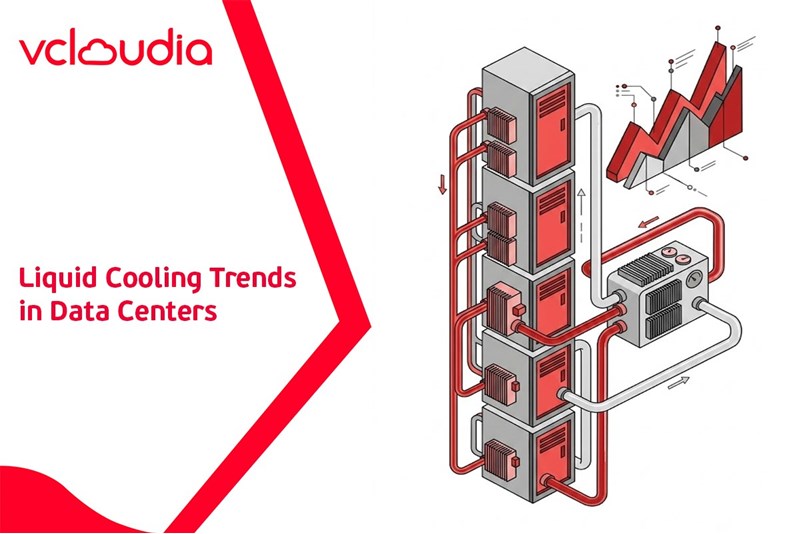
Liquid Cooling is a method that employs liquid (such as water or a special cooling solution) to absorb and dissipate heat from electronic components. Unlike traditional methods that use fans and air conditioning to maintain low temperatures, Liquid Cooling leverages the superior thermal conductivity of liquids to transfer heat rapidly and effectively.
Liquid Cooling solutions include:
- Water Cooling: This method utilizes water to dissipate heat from equipment and electronic components. Water circulates through cooling blocks attached to processors and other heat-generating components within the system. The heated water then flows to a heat exchanger where it is cooled down.
- Immersion Cooling: With Immersion Cooling, servers are submerged in a non-conductive dielectric liquid. This liquid directly absorbs heat from the components, offering exceptionally efficient cooling. Immersion Cooling serves as an alternative to fan and air conditioning heat dissipation, contributing to reduced noise and less time spent on equipment maintenance.
- Direct Liquid Cooling (DLC): In DLC, electronic components are cooled by a specialized solution. This solution is delivered directly through internal ducts within the server. The DLC method provides precise and rapid cooling, typically employed for components operating at high power densities.
Benefits of the Liquid Cooling Method
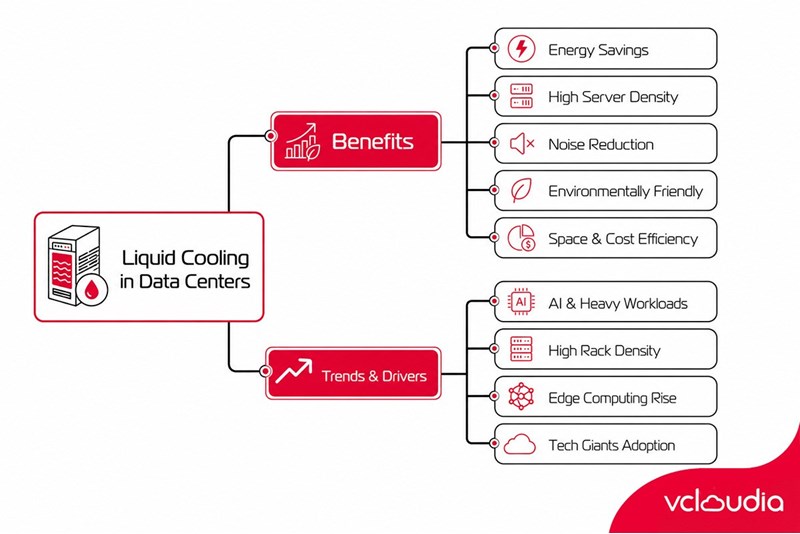
Integrating liquid cooling technology into Data Center monitoring and operations helps optimize system performance and prevent incidents. Liquid Cooling enables businesses to decrease their reliance on power and air conditioning systems, expedites heat absorption and transfer, and thereby achieves significant energy savings.
Using this method, businesses can house multiple servers within the same footprint without encountering heat dissipation problems. Liquid Cooling also supports the accommodation of high-performance equipment that demands intensive cooling. Moreover, since liquid, rather than fans and air conditioning, cools components, Liquid Cooling can substantially minimize noise while making equipment maintenance much quicker and simpler.
Beyond performance advantages, Liquid Cooling is also regarded as a safe and eco-friendly solution. By curbing energy consumption in data centers and avoiding the use of high-capacity equipment, Liquid Cooling helps reduce carbon emissions and prevent noise pollution. Specifically, cooling liquids do not contain toxic gases or chemicals, thereby limiting negative impacts on the ozone layer.
Furthermore, when adopting liquid cooling technology, businesses do not need to invest excessively in installation space or system operation. Optimizing the area and deployment scale will allow businesses to reduce the need for construction materials and resource exploitation, contributing to environmental protection.
Liquid Cooling Trends in Data Centers
Liquid Cooling is increasingly finding widespread application across many organizations and businesses. Three key factors are contributing to the rising trend of using liquid cooling systems: the necessity to handle large workloads, the density of servers and network equipment distribution in data centers, and the emergence of edge computing.
Given the rapid advancement of artificial intelligence (AI), many businesses have integrated Machine Learning models to enhance business operations and accelerate task processing. However, managing massive data volumes and operating high-performance hardware and equipment for extended periods also significantly increases power consumption. Concurrently, the dense arrangement of servers on Server Racks often leads to inefficient heat dissipation.
In such scenarios, air cooling methods are no longer the optimal choice for managing heat from electronic components. Instead, businesses require liquid cooling solutions to ensure prompt heat dissipation and efficient energy savings.
Additionally, the emergence of the edge computing model has improved system performance, accelerating information processing and reducing the load on the Data Center network. As this distributed computing model gains popularity, the demand for cooling and heat dissipation solutions for on-site equipment also grows. Liquid Cooling has become an advanced solution that businesses cannot overlook.
Leading technology corporations such as Meta, Google, and Microsoft have consistently improved and deployed liquid cooling systems to reduce power consumption and mitigate environmental impacts. Among these, Water Cooling and Immersion Cooling are the most common methods. Giga Computing, a Gigabyte subsidiary, also unveiled a water-cooled server for the Nvidia HGX H200 system at the OCP Global Summit 2024. This cooling solution can help servers maintain stable operating performance and readily meet the demands of AI processing.
Vcloudia Cloud Server – The Cloud You Can Count On
If you're concerned about the potential limitations of Cloud Servers, Cloud Server by Vcloudia is a reliable solution for businesses of all sizes. With a modern infrastructure and comprehensive customer support, Vcloudia delivers a cloud experience with:
- Powerful connectivity to ensure stable 24/7 access
- Advanced security standards, compliant with international certifications such as ISO 27001:2013, ISO 20000:2018, ISO 9001:2015
- Flexible pricing packages tailored to your specific business needs
- Expert technical support, making migration and system deployment fast, safe, and compatible
Contact information:
- Hotline: +855 888 55 66 08 (free of charge)
- Fanpage: https://www.facebook.com/vcloudia/
- Website: https://vcloudia.com
Featured news
Related news
What is a Snapshot? The Difference Between Snapshot and Backup
Snapshot is a familiar concept in data management and protection. In the context of the information technology boom, where data is a major asset for businesses, understanding Snapshots as well as their application is a key factor for enterprises to maximize technological efficiency.
What is a Firewall? The Role and Importance of Firewalls for Users
In the context of ever-increasing cyberattacks, system security has become a top priority for many enterprises. Alongside deploying antivirus software and controlling connection ports, firewalls are also considered a key solution to effectively enhance cybersecurity.
What is DDoS? Signs, Mitigation Strategies, and Effective Prevention
DDoS is a highly dangerous cyberattack that leaves severe consequences for enterprises. Therefore, gaining a clear understanding of DDoS attacks, as well as how to detect and prevent them, is a topic of significant interest to many.
What is a Trojan? How to Detect, Avoid, and Prevent It
A Trojan is a type of malicious code or software that can cause severe consequences to computer operations. So, what is a Trojan? How can you prevent a Trojan from infiltrating your computer? In the following article, Vcloudia will provide detailed information on these issues.
What is Cloud Backup? Classification, benefits, and limitations
Cloud Backup is a solution that plays an important role in backing up and recovering data when an incident occurs. So what exactly is Cloud Backup? Let's find out the details with Vcloudia in the following article.
What is Cloud Storage? Features and Benefits of Using It
Cloud Storage is the perfect storage solution alternative to bulky, space-consuming physical hard drives. So, what is Cloud Storage? Let's explore the details with Vcloudia through the following article.
What is an API? Characteristics and applications in website design
API, short for Application Programming Interface, is a concept no longer unfamiliar in the information technology field. So what exactly is an API and why is it so important? Let's find out with Vcloudia.
What is Node.js? Instructions on how to install Node.js on cPanel
Currently, it is easy to see that Node.js is being used by quite a lot of people. This is because Node.js can support users in running on multiple platforms and multiple devices.
What is Vultr VPS? Should you use Vultr VPS?
Vultr VPS is one of the best cloud storage solutions in the world. In this article, you will learn the concept: "What is Vultr VPS?", as well as understand its advantages and disadvantages.
Zoom Cloud Meeting: What is it? Basic Things You Should Know About Zoom Cloud Meeting
In 2020, Zoom Cloud Meeting became one of the leading video conferencing software applications. It allows you to virtually interact with colleagues when in-person meetings aren't possible, and it has also been very successful for social events.