



.png)















.png)





Key Considerations When Building a Data Center
Aug 20, 2026An efficiently managed data center supports IT system continuity and enables businesses to optimize costs, enhance security, and adhere to international standards. However, the construction of a Data Center necessitates thorough preparation from enterprises across various aspects, including site selection, power supply, cooling systems, operational staff, and investment budgets. This article by Vcloudia aims to clarify the crucial considerations for businesses embarking on data center construction, facilitating the most informed decisions.
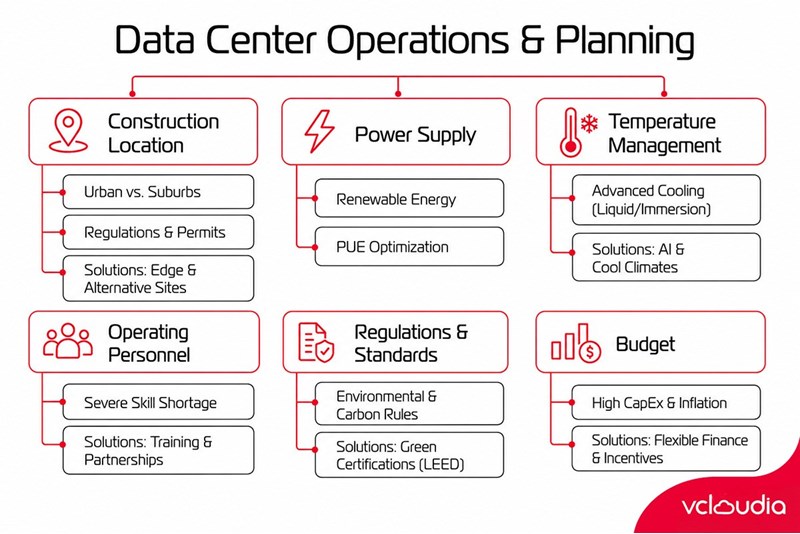
Construction Location
The chosen location for a data center significantly impacts a business's operational effectiveness and expenses. A key factor is positioning the data center near end-users to minimize data retrieval latency. Nevertheless, this presents enterprises with a choice between two options:
- Building in urban areas: Offers proximity to customers and convenient network access but entails high land lease prices and limited space.
- Moving to the suburbs: Reduces property costs and allows for easy expansion, though it might introduce challenges with access speed and network connectivity.
Moreover, zoning and environmental regulations vary by country and region, affecting data center construction feasibility. While some areas offer incentive policies, others impose stringent standards, complicating permit acquisition for businesses.
The solutions to this challenge are:
- Leveraging technology for flexible location choices: Techniques like edge computing can lessen businesses' reliance on extensive urban data centers.
- Exploring non-traditional sites: Some companies have opted for underground data centers or repurposed existing infrastructure such as power plants or mines.
Power Supply
Data centers consume substantial electricity and demand a consistent supply. Given the increasing global risk of energy shortages, businesses are compelled to find sustainable solutions for long-term operations.
Many modern data centers are transitioning to renewable energy sources, including wind and solar power, to minimize environmental impact and lower operating costs. Additionally, optimizing the Power Usage Effectiveness (PUE) index—a measure of energy efficiency—significantly reduces power waste.
For instance, Singapore has established PUE limits for new data centers to improve overall efficiency. This approach helps businesses meet environmental regulations while maintaining operational effectiveness.
Temperature Management System
Hardware within a data center generates considerable heat, making effective cooling essential for sustaining system performance and longevity.
Currently, advanced cooling technologies, such as liquid cooling and direct immersion cooling, are being implemented to boost energy efficiency. Liquid cooling methods can achieve a PUE between 1.02 and 1.20, while immersion cooling technology can bring the PUE down to nearly 1.01, leading to substantial energy savings.
However, the initial capital expenditure for these sophisticated cooling systems is quite high, and not all data centers are immediately equipped for their deployment.
The solutions to this issue include:
- Combining conventional cooling with advanced technology for optimized costs and efficiency.
- Utilizing artificial intelligence (AI) to manage and adjust temperatures in real-time.
- Constructing data centers in cool climates to capitalize on natural benefits, thereby reducing the need for artificial cooling.
Operating Personnel
The data center sector is experiencing a severe labor shortage. Specifically, 78% of businesses report difficulty in finding personnel with the necessary skills for system design, installation, and operation (According to Business Forum Magazine). Furthermore, the rapid pace of technological advancements requires experts to continuously update their skills, yet the labor market struggles to meet this demand.
Solutions include:
- Offering competitive salaries and compensation packages to attract skilled individuals.
- Investing in internal training and skill development programs.
- Collaborating with universities and training organizations to expand the talent pool.
Regulations and Standards
Data centers must comply with numerous requirements concerning environmental standards, energy consumption, and information security. Governments globally are intensifying controls on electricity usage and carbon emissions, necessitating appropriate strategies from enterprises to ensure sustainable operations.
Solutions involve:
- Investing in green technologies and obtaining certifications like LEED and ENERGY STAR.
- Closely monitoring legislative changes to develop timely adaptation plans.
Budget
Building a data center demands a significant capital investment, covering costs from land acquisition and infrastructure development to server system installation and ongoing operations. Amid rising interest rates and raw material prices, businesses may face challenges in fundraising and budget management. Additionally, the risk of economic recession compels many enterprises to carefully deliberate before committing to long-term investment decisions. Several strategies exist for budgeting:
- Optimizing construction costs: Employing advanced materials, such as high-performance concrete, to reduce expenses and construction time.
- Creating a flexible financial model: Combining equity, borrowed capital, and pay-as-you-go models to alleviate initial financial strain.
- Partnering with investors or leveraging support policies: Seeking investment funds, forming joint ventures with strategic partners, or utilizing government incentives to lower initial investment costs.
Conclusion
The construction of a data center requires enterprises to evaluate numerous critical factors, ranging from site selection, ensuring power supply, and temperature control, to operational staffing and adherence to safety standards. This process not only entails substantial costs but also presents various technical and operational hurdles.
Vcloudia Cloud Server – The Cloud You Can Count On
If you're concerned about the potential limitations of Cloud Servers, Cloud Server by Vcloudia is a reliable solution for businesses of all sizes. With a modern infrastructure and comprehensive customer support, Vcloudia delivers a cloud experience with:
- Powerful connectivity to ensure stable 24/7 access
- Advanced security standards, compliant with international certifications such as ISO 27001:2013, ISO 20000:2018, ISO 9001:2015
- Flexible pricing packages tailored to your specific business needs
- Expert technical support, making migration and system deployment fast, safe, and compatible
Contact information:
- Hotline: +855 888 55 66 08 (free of charge)
- Fanpage: https://www.facebook.com/vcloudia/
- Website: https://vcloudia.com
Featured news
Related news
What is a Snapshot? The Difference Between Snapshot and Backup
Snapshot is a familiar concept in data management and protection. In the context of the information technology boom, where data is a major asset for businesses, understanding Snapshots as well as their application is a key factor for enterprises to maximize technological efficiency.
What is a Firewall? The Role and Importance of Firewalls for Users
In the context of ever-increasing cyberattacks, system security has become a top priority for many enterprises. Alongside deploying antivirus software and controlling connection ports, firewalls are also considered a key solution to effectively enhance cybersecurity.
What is DDoS? Signs, Mitigation Strategies, and Effective Prevention
DDoS is a highly dangerous cyberattack that leaves severe consequences for enterprises. Therefore, gaining a clear understanding of DDoS attacks, as well as how to detect and prevent them, is a topic of significant interest to many.
What is a Trojan? How to Detect, Avoid, and Prevent It
A Trojan is a type of malicious code or software that can cause severe consequences to computer operations. So, what is a Trojan? How can you prevent a Trojan from infiltrating your computer? In the following article, Vcloudia will provide detailed information on these issues.
What is Cloud Backup? Classification, benefits, and limitations
Cloud Backup is a solution that plays an important role in backing up and recovering data when an incident occurs. So what exactly is Cloud Backup? Let's find out the details with Vcloudia in the following article.
What is Cloud Storage? Features and Benefits of Using It
Cloud Storage is the perfect storage solution alternative to bulky, space-consuming physical hard drives. So, what is Cloud Storage? Let's explore the details with Vcloudia through the following article.
What is an API? Characteristics and applications in website design
API, short for Application Programming Interface, is a concept no longer unfamiliar in the information technology field. So what exactly is an API and why is it so important? Let's find out with Vcloudia.
What is Node.js? Instructions on how to install Node.js on cPanel
Currently, it is easy to see that Node.js is being used by quite a lot of people. This is because Node.js can support users in running on multiple platforms and multiple devices.
What is Vultr VPS? Should you use Vultr VPS?
Vultr VPS is one of the best cloud storage solutions in the world. In this article, you will learn the concept: "What is Vultr VPS?", as well as understand its advantages and disadvantages.
Zoom Cloud Meeting: What is it? Basic Things You Should Know About Zoom Cloud Meeting
In 2020, Zoom Cloud Meeting became one of the leading video conferencing software applications. It allows you to virtually interact with colleagues when in-person meetings aren't possible, and it has also been very successful for social events.