



.png)


















.png)





Interconnection: The Core Foundation of the AI Data Center
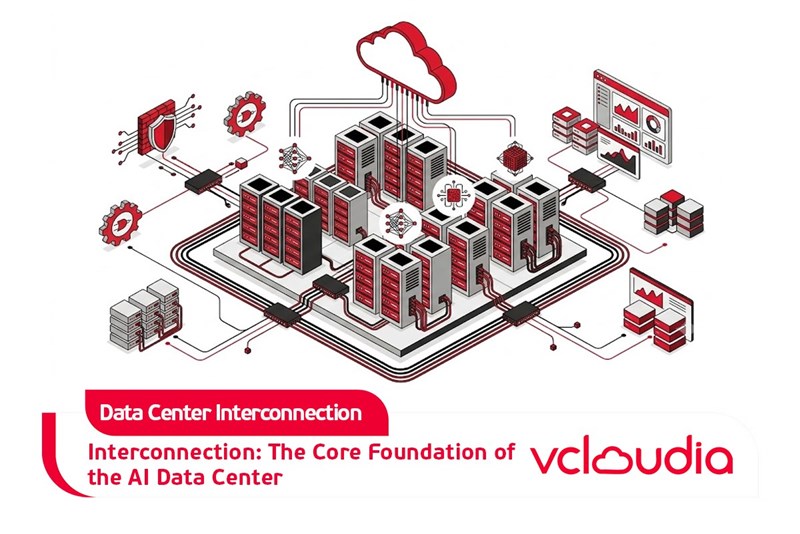
Aug 19, 2026Artificial Intelligence (AI) is changing the landscape across multiple industries, including healthcare, finance, manufacturing, and customer service. Behind these impressive AI breakthroughs is a strong Information Technology (IT) infrastructure, with Interconnection playing a crucial role. This article examines why interconnection is fundamental to the AI data center and highlights the significant advantages it offers enterprises in the AI era.
AI and the Role of Interconnection
Artificial Intelligence (AI) is transforming various sectors such as fraud detection, customer service enhancement, and advanced medical research. In healthcare, AI is revolutionizing diagnosis and treatment, especially for cancer, by enabling better disease detection, drug discovery, and personalized therapies.
For AI to reach its full potential, it requires a powerful IT infrastructure. AI needs substantial computational resources to handle vast amounts of data from numerous hospital systems and healthcare providers. At the same time, maintaining secure connectivity and complying with regulations around sensitive medical data are critical.
Worldwide, organizations face similar challenges when implementing AI. As AI evolves, businesses realize the necessity of a flexible and strong AI infrastructure that can adapt to future demands. Traditional on-premises data centers were not built with AI in mind and thus fall short for complex data processing tasks. This pushes many enterprises and service providers to seek advanced data centers capable of supporting their AI strategies.
However, interconnection is often an underestimated aspect of AI solutions. AI requires rapid transfer of large datasets between applications. No matter how advanced the AI hardware is, without the ability to transmit data quickly and securely between environments, overall efficiency will suffer. Hence, interconnection plays a vital role in AI success.
Differences in the Infrastructure Architecture of the AI Data Center
To establish a solid AI foundation, companies must choose data center types suitable for AI workloads, covering AI model training, deployment at the network edge, and throughout the AI lifecycle data management. Models like hyperscale, colocation, and edge data centers are all essential in this context.
An AI-ready data center must offer infrastructure capable of supporting high-density and energy-demanding AI workloads. This includes high-performance networking equipment that connects cloud services, AI providers, and the entire AI ecosystem.
Why is Interconnection the Core Foundation of the AI Data Center?
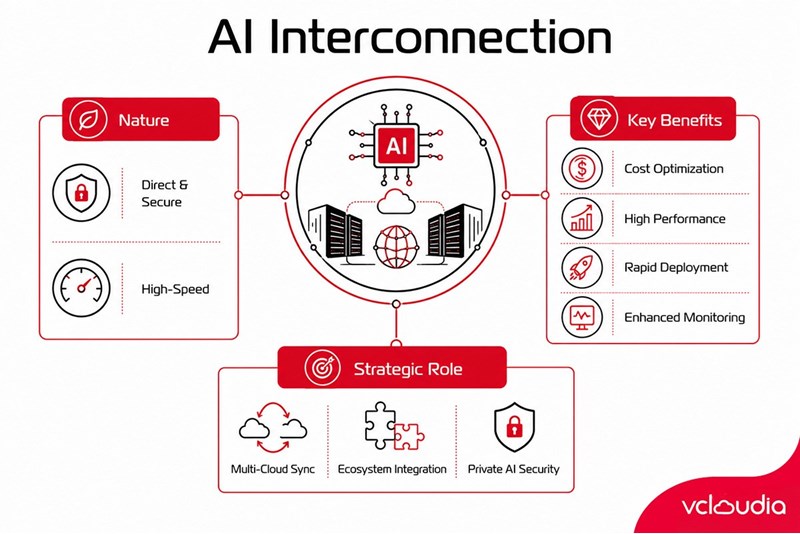
Interconnection refers to the direct, secure links between AI ecosystems and is a crucial but often undervalued piece of AI infrastructure. AI requires constant, high-speed, and secure data transfer, whereas traditional networks may introduce bottlenecks or latency issues.
Key benefits of interconnection for AI include:
- Optimizing infrastructure costs by reducing dependence on expensive traditional network connections.
- Lowering cloud data transmission expenses and offloading resources from systems.
- Enhancing AI computational performance, speeding up data transfers, and improving scalability.
- Enabling rapid AI deployments without restrictions from legacy network designs.
- Improving AI network observability and monitoring, which helps in early detection of data connection problems.
Most organizations today adopt hybrid multi-cloud strategies; interconnection synchronizes distributed systems and guarantees uninterrupted real-time access to AI data.
As AI tools and ecosystems expand, connectivity partners are becoming increasingly critical. Interconnection enables secure data exchange across different partners, providers, and AI platforms.
Because AI data is often sensitive and proprietary, many organizations favor private AI architectures. Although public internet networks can transmit AI data, they do not offer the same level of security, control, and consistent performance as private interconnected networks. Private interconnection, on the other hand, ensures secure data exchange and reliability, both necessary for successful AI projects.
Conclusion
With AI initiatives growing rapidly, the connectivity infrastructure in AI-specialized data centers becomes ever more important. Networks offering high bandwidth, low latency, and secure connections form the foundation that maximizes AI ecosystem performance. This foundation ensures organizations achieve the flexibility and scalability necessary to thrive in the digital era.
Vcloudia Cloud Server – The Cloud You Can Count On
If you're concerned about the potential limitations of Cloud Servers, Cloud Server by Vcloudia is a reliable solution for businesses of all sizes. With a modern infrastructure and comprehensive customer support, Vcloudia delivers a cloud experience with:
- Powerful connectivity to ensure stable 24/7 access
- Advanced security standards, compliant with international certifications such as ISO 27001:2013, ISO 20000:2018, ISO 9001:2015
- Flexible pricing packages tailored to your specific business needs
- Expert technical support, making migration and system deployment fast, safe, and compatible
Contact information:
- Hotline: +855 888 55 66 08 (free of charge)
- Fanpage: https://www.facebook.com/vcloudia/
- Website: https://vcloudia.com
Featured news
Related news
What is a Snapshot? The Difference Between Snapshot and Backup
Snapshot is a familiar concept in data management and protection. In the context of the information technology boom, where data is a major asset for businesses, understanding Snapshots as well as their application is a key factor for enterprises to maximize technological efficiency.
What is a Firewall? The Role and Importance of Firewalls for Users
In the context of ever-increasing cyberattacks, system security has become a top priority for many enterprises. Alongside deploying antivirus software and controlling connection ports, firewalls are also considered a key solution to effectively enhance cybersecurity.
What is DDoS? Signs, Mitigation Strategies, and Effective Prevention
DDoS is a highly dangerous cyberattack that leaves severe consequences for enterprises. Therefore, gaining a clear understanding of DDoS attacks, as well as how to detect and prevent them, is a topic of significant interest to many.
What is a Trojan? How to Detect, Avoid, and Prevent It
A Trojan is a type of malicious code or software that can cause severe consequences to computer operations. So, what is a Trojan? How can you prevent a Trojan from infiltrating your computer? In the following article, Vcloudia will provide detailed information on these issues.
What is Cloud Backup? Classification, benefits, and limitations
Cloud Backup is a solution that plays an important role in backing up and recovering data when an incident occurs. So what exactly is Cloud Backup? Let's find out the details with Vcloudia in the following article.
What is Cloud Storage? Features and Benefits of Using It
Cloud Storage is the perfect storage solution alternative to bulky, space-consuming physical hard drives. So, what is Cloud Storage? Let's explore the details with Vcloudia through the following article.
What is an API? Characteristics and applications in website design
API, short for Application Programming Interface, is a concept no longer unfamiliar in the information technology field. So what exactly is an API and why is it so important? Let's find out with Vcloudia.
What is Node.js? Instructions on how to install Node.js on cPanel
Currently, it is easy to see that Node.js is being used by quite a lot of people. This is because Node.js can support users in running on multiple platforms and multiple devices.
What is Vultr VPS? Should you use Vultr VPS?
Vultr VPS is one of the best cloud storage solutions in the world. In this article, you will learn the concept: "What is Vultr VPS?", as well as understand its advantages and disadvantages.
Zoom Cloud Meeting: What is it? Basic Things You Should Know About Zoom Cloud Meeting
In 2020, Zoom Cloud Meeting became one of the leading video conferencing software applications. It allows you to virtually interact with colleagues when in-person meetings aren't possible, and it has also been very successful for social events.