



.png)















.png)





Green Transformation: A Pressure or an Opportunity for Traditional Data Centers?
Aug 20, 2026Green transformation has become an urgent imperative for organizations and businesses operating within the Data Center sector. This shift brings not only technological innovation and improvement but is also closely linked to optimizing energy efficiency and adhering to ESG standards.
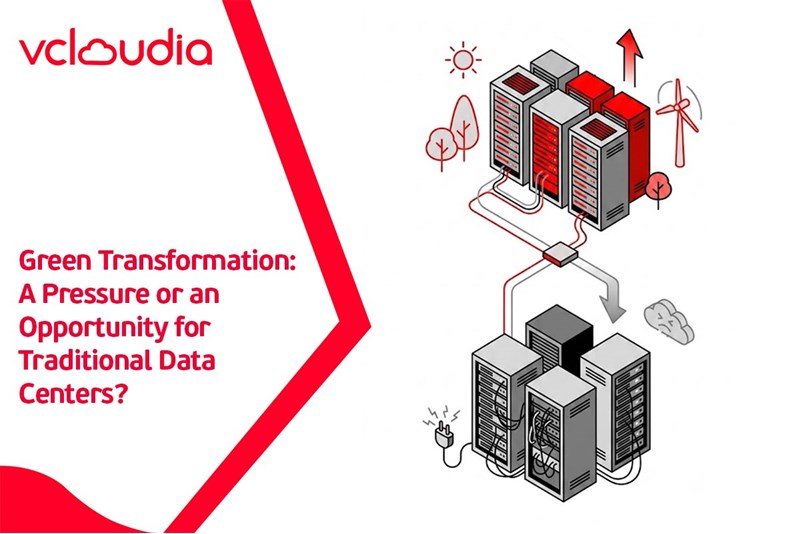
What is green transformation? Why is it impacting the Data Center industry?
Green transformation involves moving from conventional production and business models to more sustainable approaches, with the goal of conserving resources and minimizing adverse environmental impacts. This process is defined by specific standards and objectives, including:
- ESG: This framework assesses a company's sustainability based on three pillars: Environmental, Social, and Corporate Governance.
- Net Zero: This signifies an enterprise's commitment to reducing its net greenhouse gas emissions to zero.
- CBAM: The Carbon Border Adjustment Mechanism imposes a carbon price on imported goods, intending to foster "green" production and decrease global emissions.
Green transformation significantly influences all aspects of life, including the Data Center market. Data centers consume vast amounts of power and resources, thereby contributing substantially to greenhouse gas emissions. An IEA report indicates that data center electricity consumption reached 415 TWh in 2024, representing approximately 1.5% of total global electricity consumption. This situation has created an urgent need for enterprises to accelerate the adoption of energy-saving solutions and to "green" their data center infrastructure.
Simultaneously, the strong emergence of the "Green IT" trend further drives the adoption of green technology and sustainable supply chain management practices. A growing number of enterprises are proactively implementing solutions to utilize renewable energy, optimize energy efficiency, and reduce their carbon footprints in IT operations. This initiative not only helps businesses cut operational expenses but also satisfies stringent market and international partner requirements regarding green standards.
The main pressures facing traditional data centers
Pressure from increasingly high energy consumption and electricity costs
Many data centers continue to rely on air conditioning-based cooling systems and use inefficient equipment. This results in a persistently high PUE (Power Usage Effectiveness) index, leading to wasted electricity and increased operational costs for businesses.
Furthermore, electricity prices are on an upward trend in many countries due to energy supply and demand pressures, compounded by the potential widespread implementation of carbon taxation policies globally. This has created considerable pressure on traditional data centers, which operate continuously, 24/7.
Pressure to comply with environmental policies and international standards
International investors and partners are increasingly imposing strict requirements, mandating that data center infrastructure adheres rigorously to ESG criteria. According to EY's 2022 global report, as many as 99% of investors base their capital injection decisions into organizations and businesses on an evaluation of ESG factors.
Moreover, multinational corporations and companies prioritize selecting partners who use renewable energy and possess Green Data Center certifications. This implies that a data center failing to meet green standards may cause the enterprise to miss out on cooperation and market expansion opportunities.
Additionally, the tightening of carbon emission regulation policies presents a significant challenge for many businesses. Entities without a clear emission reduction plan, or those lacking transparency in their ESG reporting, risk being excluded from the global supply chain, which could impact their business operations.
Difficulties in rapidly upgrading existing systems
Establishing a Data Center system requires enterprises to commit a substantial amount of investment capital. Furthermore, traditional data centers often run on outdated technological platforms, have limited scalability, and face challenges in synchronizing and achieving compatibility with new technologies. This poses considerable difficulties for businesses attempting to upgrade their infrastructure to meet current demands.
The process of upgrading legacy systems demands significant time and cost. Without the support of a highly specialized workforce, businesses may find it challenging to ensure that the transformation process is comprehensive and thorough.
New opportunities if traditional data centers dare to undergo a green transformation
Increasing competitive capacity and attracting large customers
International organizations and major enterprises frequently seek partnerships with entities that demonstrate clear commitments to building and operating green infrastructure. Therefore, adopting a Green Data Center model not only helps businesses comply with ESG regulations but also enhances their reputation and strengthens their competitive advantage in the international market. This is a crucial element, laying the groundwork for the enterprise's sustainable development.
Optimizing operations and saving costs in the long term
By utilizing renewable energy and advanced cooling technologies, businesses can substantially reduce electricity costs while simultaneously enhancing the operational efficiency of the Data Center. Furthermore, deploying temperature and humidity monitoring systems helps enterprises maintain an optimal operating environment for equipment, thereby mitigating the risk of thermal overload, ensuring stability, and extending the lifespan of servers and network equipment.
Google stands as a pioneer in implementing smart energy management solutions. Through the integration of Artificial Intelligence (AI) into its data center monitoring processes, Google has achieved up to a 40% reduction in electricity consumption for cooling, contributing to real-time system optimization.
Enjoying green investment incentives, accessing credit and ESG funds
Transitioning to a green Data Center model not only facilitates businesses' access to preferential loans from financial institutions but also provides opportunities to benefit from green transition support funds and green bond issuance. AirTrunk serves as a prime example, having raised over AU$6 billion through ESG financing, thus solidifying its position as a leading issuer of sustainable capital in the Data Center sector.
Currently, many international investment funds exclusively prioritize injecting capital into businesses that fully satisfy ESG criteria. Consequently, building a green data center model will serve as a testament to the enterprise's commitment to adhering to ESG principles, simultaneously boosting its ability to attract foreign direct investment capital.
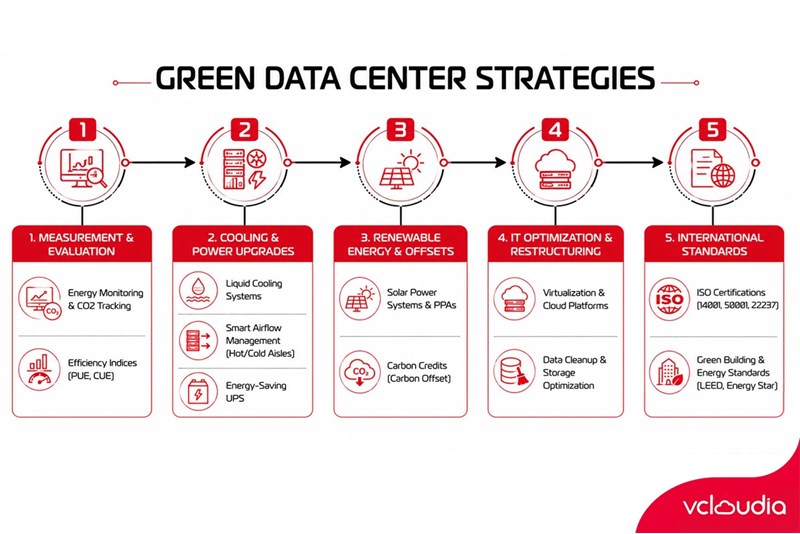
Steps for traditional data centers to successfully "go green"
Measuring and evaluating energy efficiency (PUE, CUE)
Before embarking on the implementation of "greening" solutions for the data center, enterprises must monitor and assess system performance. This process involves: tracking power consumption in each area, monitoring and calculating CO2 emissions, and evaluating equipment efficiency (servers, cooling systems, UPS, etc.). From the collected data, businesses can calculate the CUE and PUE indices, which are indicators that assess energy usage efficiency and directly reflect a data center's "green" level.
Upgrading cooling and backup power systems more efficiently
To upgrade cooling systems and backup power sources, organizations and enterprises can implement the following methods:
- Applying liquid cooling systems: Rather than installing traditional air conditioning, businesses should switch to liquid cooling solutions (using water or special fluids) to accelerate heat dissipation from electronic components.
- Smart airflow management: By separating hot and cold air streams (through hot aisle/cold aisle containment) and utilizing sensor systems, businesses can monitor and adjust temperatures in real-time, thereby significantly reducing electricity consumption.
- Upgrading to energy-saving UPS: New generation UPS systems incorporate the ability to automatically adjust capacity to match the consumption load, helping to limit energy depletion.
Utilizing renewable energy and purchasing carbon credits
Installing a solar power system not only helps businesses decrease reliance on the traditional power grid but also optimizes long-term operating costs. Additionally, enterprises should consider Power Purchase Agreement (PPA) partnerships to ensure a stable power supply for the data center.
Should a complete transition to renewable energy not be feasible, Data Center operators can purchase carbon credits from green projects to offset their greenhouse gas emissions (carbon offset).
Virtualization, IT resource optimization, and storage system restructuring
Instead of investing in physical servers, leveraging cloud platforms and resource virtualization will help businesses minimize electronic waste to the greatest extent. Moreover, enterprises need to conduct reviews and eliminate unused data to conserve resources and optimize storage space.
Applying international certificates and standards
Adhering to international standards and certificates not only guarantees the energy efficiency and sustainability of the Data Center but also enhances competitive advantage and creates cooperation opportunities for businesses. Important certificates and standards that enterprises should pay particular attention to include: ISO 14001, ISO 50001, ISO/IEC 22237, LEED, Energy Star, EU Code of Conduct for Data Centres...
Vcloudia Cloud Server – The Cloud You Can Count On
If you're concerned about the potential limitations of Cloud Servers, Cloud Server by Vcloudia is a reliable solution for businesses of all sizes. With a modern infrastructure and comprehensive customer support, Vcloudia delivers a cloud experience with:
- Powerful connectivity to ensure stable 24/7 access
- Advanced security standards, compliant with international certifications such as ISO 27001:2013, ISO 20000:2018, ISO 9001:2015
- Flexible pricing packages tailored to your specific business needs
- Expert technical support, making migration and system deployment fast, safe, and compatible
Contact information:
- Hotline: +855 888 55 66 08 (free of charge)
- Fanpage: https://www.facebook.com/vcloudia/
- Website: https://vcloudia.com
Featured news
Related news
What is a Snapshot? The Difference Between Snapshot and Backup
Snapshot is a familiar concept in data management and protection. In the context of the information technology boom, where data is a major asset for businesses, understanding Snapshots as well as their application is a key factor for enterprises to maximize technological efficiency.
What is a Firewall? The Role and Importance of Firewalls for Users
In the context of ever-increasing cyberattacks, system security has become a top priority for many enterprises. Alongside deploying antivirus software and controlling connection ports, firewalls are also considered a key solution to effectively enhance cybersecurity.
What is DDoS? Signs, Mitigation Strategies, and Effective Prevention
DDoS is a highly dangerous cyberattack that leaves severe consequences for enterprises. Therefore, gaining a clear understanding of DDoS attacks, as well as how to detect and prevent them, is a topic of significant interest to many.
What is a Trojan? How to Detect, Avoid, and Prevent It
A Trojan is a type of malicious code or software that can cause severe consequences to computer operations. So, what is a Trojan? How can you prevent a Trojan from infiltrating your computer? In the following article, Vcloudia will provide detailed information on these issues.
What is Cloud Backup? Classification, benefits, and limitations
Cloud Backup is a solution that plays an important role in backing up and recovering data when an incident occurs. So what exactly is Cloud Backup? Let's find out the details with Vcloudia in the following article.
What is Cloud Storage? Features and Benefits of Using It
Cloud Storage is the perfect storage solution alternative to bulky, space-consuming physical hard drives. So, what is Cloud Storage? Let's explore the details with Vcloudia through the following article.
What is an API? Characteristics and applications in website design
API, short for Application Programming Interface, is a concept no longer unfamiliar in the information technology field. So what exactly is an API and why is it so important? Let's find out with Vcloudia.
What is Node.js? Instructions on how to install Node.js on cPanel
Currently, it is easy to see that Node.js is being used by quite a lot of people. This is because Node.js can support users in running on multiple platforms and multiple devices.
What is Vultr VPS? Should you use Vultr VPS?
Vultr VPS is one of the best cloud storage solutions in the world. In this article, you will learn the concept: "What is Vultr VPS?", as well as understand its advantages and disadvantages.
Zoom Cloud Meeting: What is it? Basic Things You Should Know About Zoom Cloud Meeting
In 2020, Zoom Cloud Meeting became one of the leading video conferencing software applications. It allows you to virtually interact with colleagues when in-person meetings aren't possible, and it has also been very successful for social events.