



.png)


















.png)





Challenges and Opportunities Gen AI Brings to Data Centers
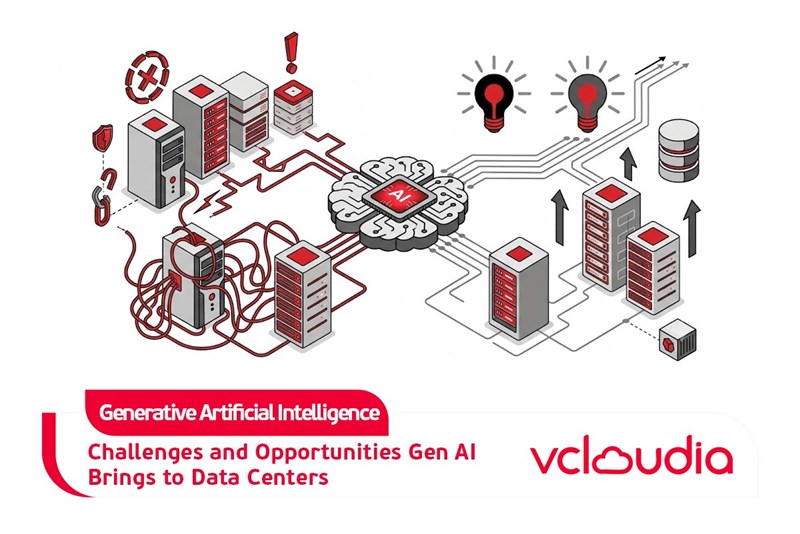
Aug 19, 2026In recent years, data centers were already evolving for cloud scale, virtualization, and high-performance computing. Now GenAI adds a different pressure: not just more compute, but more bursty, more memory-hungry, more network-sensitive, and often more operationally unpredictable than traditional enterprise workloads. The result is a new era where infrastructure teams must balance reliability, power, cooling, security, and cost—while also unlocking major opportunities for smarter operations and more flexible designs.
How Is Generative AI Changing Data Centers?
Generative AI is changing data centers the way the smartphone changed mobile networks: it doesn’t merely increase demand—it changes the shape of demand. Instead of steady CPU utilization and predictable batch windows, GenAI brings workloads that can spike dramatically during training, inference, and fine-tuning. Even within inference, traffic can be highly variable: one customer might generate short responses all day, while another might run long-form generation during specific periods. From my perspective, the most important shift is that data center infrastructure is being asked to behave less like a static utility and more like a responsive system—one that can flex quickly and safely under changing compute patterns.
At the same time, GenAI increases “system-level complexity.” Traditional server-centric thinking—optimize CPU cycles, pack more servers into racks—doesn’t fully capture the reality. Modern GenAI stacks rely heavily on accelerators (GPUs/TPUs), high-speed memory hierarchies, distributed training across many nodes, and software that benefits from low-latency networking. This means data centers must coordinate compute, networking, storage, power delivery, and cooling as a single organism. If that coordination fails, performance drops, costs rise, and reliability becomes harder to guarantee. In other words, the challenges aren’t only technical; they’re also architectural and organizational.
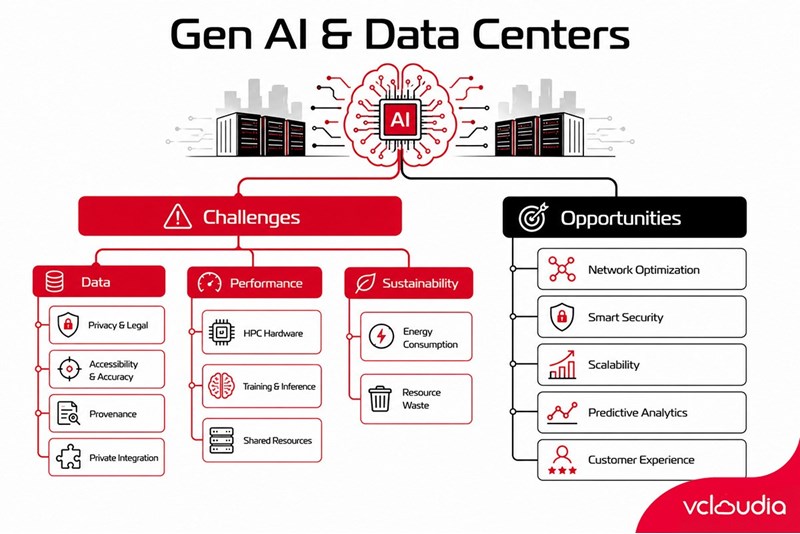
What Are the Biggest Challenges Gen AI Brings to Data Centers?
The first big challenge is that GenAI stresses multiple parts of the infrastructure at once. Power is one issue, but it’s rarely the only one. You can have enough wattage on paper and still face bottlenecks in cooling, cabling density, thermal hotspots, or network oversubscription. I’ve seen this pattern in many capacity planning discussions: teams estimate “GPU availability” without fully modeling the rest of the system’s constraints. When those constraints show up late—especially after deployment—it can force expensive retrofits or underutilization.
The second challenge is the pace of change. GenAI models evolve rapidly, and so do the hardware and software ecosystems that support them. You might deploy a cluster today for a specific model size and framework, only to find tomorrow that performance requirements, memory bandwidth needs, interconnect patterns, or software kernel optimizations have changed. This creates a “moving target” problem for infrastructure teams: procurement cycles are long, infrastructure changes are disruptive, and talent gaps remain real. The keyword Challenges and Opportunities Gen AI Brings to Data Centers often feels like a balanced trade, but in practice, the “challenge” side appears first because risk and uncertainty arrive before benefits can be realized.
Security and governance are also part of the challenge set. GenAI workloads often involve sensitive data (customer requests, proprietary documents, or internal knowledge bases). Data centers must ensure isolation between tenants and enforce robust logging, encryption, and access controls. Additionally, the operational surface area increases: more services, more endpoints, more automation, and more integrations can widen the security perimeter if not tightly managed.
How Does Gen AI Affect Data Center Power Consumption?
GenAI can increase power consumption in two distinct ways: by raising the average energy use and by increasing the volatility of power demand. Training workloads can drive sustained high power draw across many racks. Inference can be less intense on average, but it can still cause frequent bursts. That volatility matters because power systems—UPS, switchgear, PDU capacity, distribution topology—are designed for reliability under specific operating ranges, not for constant fluctuations.
From an operations standpoint, power efficiency becomes more than a metric—it becomes a budgeting tool. Data center operators often talk about PUE (Power Usage Effectiveness), but GenAI complicates the interpretation. If you keep the same facility but replace older workloads with new accelerator-heavy systems, the “facility overhead” might improve or worsen depending on airflow management, fan curves, and utilization strategies. Meanwhile, some workloads may require higher compute throughput that forces more cooling and higher fan speeds, increasing overhead even if the compute itself is more efficient per operation.
There’s also the question of power delivery architecture. Accelerator clusters frequently require dense rack power configurations, which can stress existing electrical infrastructure. If the facility was originally built for mixed workloads, GenAI might require a redesign of how power is routed, segmented, and monitored. The result is that “available power” becomes a critical strategic asset—and the Challenges and Opportunities Gen AI Brings to Data Centers shows up in the form of procurement delays, interconnection queues, and escalating electricity costs.
How Does Gen AI Change Data Center Cooling?
Cooling is where many GenAI deployments face “physics before policy.” High-performance accelerators generate intense heat over smaller areas. Even when total facility power seems within targets, localized hotspots can still throttle performance or trigger protective shutdowns. In practice, cooling challenges often show up as reduced reliability, increased error rates, and “mysterious” performance variability that makes troubleshooting harder than it should be.
GenAI workloads also tend to be sensitive to thermal conditions. Many AI kernels assume certain performance characteristics; when temperatures increase, throttling can reduce throughput and prolong job completion times. That prolongation then increases energy usage—turning a thermal problem into an energy and scheduling problem. I’ve found it useful to think of cooling as part of the compute performance envelope rather than a background service. When cooling is inadequate, the compute environment quietly stops delivering what the software expects.
This drives cooling strategy changes: more liquid cooling, improved airflow containment, and better thermal instrumentation. Traditional “cold aisle/hot aisle” might not be enough when you pack accelerator systems tightly. Data centers are also investing in finer-grained sensor networks to detect and respond to temperature anomalies faster. The opportunity side is that these improvements can benefit non-GenAI workloads too, raising overall reliability. But the challenge side is that retrofitting cooling systems can be disruptive, expensive, and time-consuming—especially if you’re constrained by ceiling height, piping routes, or existing build-outs.
How Does Gen AI Affect Data Center Networking?
GenAI changes networking from “bandwidth matters” to “latency and topology matter.” Training large models often involves communication between many nodes—synchronizing gradients, exchanging activations, and coordinating distributed computation. If the interconnect is too slow or the network fabric is poorly designed, scaling efficiency collapses. This is why many teams move from generic networking to more specialized, performance-tuned architectures.
There’s also the shift in traffic patterns. Traditional data center traffic can be somewhat predictable: east-west traffic exists, but often at lower intensity than north-south. In GenAI clusters, east-west traffic can become dominant because distributed training requires frequent node-to-node communication. That stresses switch capacity, fabric oversubscription assumptions, and even the physical cabling design.
Another networking challenge is protocol and congestion management. GenAI communication frequently involves large messages and sensitive timing requirements. Congestion can cause increased retransmissions, queue buildup, and performance jitter that the training job interprets as “slower progress,” which can extend wall-clock time and inflate costs. To address this, operators often invest in quality of service policies, improved buffer management, and careful placement strategies for compute and storage.
Yet the opportunity is significant: GenAI encourages better observability and more intelligent network control. AI-aware telemetry can help operators detect hotspots earlier, predict congestion, and optimize routing. In a sense, GenAI gives data centers an incentive to upgrade networking maturity—from reactive troubleshooting toward proactive optimization—which aligns directly with the overarching Challenges and Opportunities Gen AI Brings to Data Centers theme.
How Does Gen AI Affect Data Center Space and Rack Design?
Space becomes more constrained because GenAI clusters are not only power-dense; they are also rack-dense. You might fit more compute into the same footprint, but you also need room for cabling, cooling infrastructure, service access, and airflow management. Some modern accelerator racks are almost like self-contained “thermal systems,” where the rack itself becomes the unit of design rather than the server.
Rack design therefore becomes a critical operational and engineering challenge. Dense deployments can strain top-of-rack switching, increase cable complexity, and make maintenance more difficult. A single failed component might have larger blast radius because everything is tightly coupled—high-speed links, specialized PDUs, and shared cooling paths. If you’ve ever tried to service a densely packed high-performance rack, you know how quickly “normal maintenance” becomes a high-risk exercise.
I also think about rack design from an architectural perspective: the goal is to ensure that the data center can scale without constantly creating exceptions. For GenAI, consistency helps. Standardized rack layouts with predictable airflow paths, cable routing, and power connections reduce operational risk. But standardization can conflict with rapid hardware evolution: today’s accelerator might be replaced by a slightly different model next year, requiring changes in clearance, cooling fittings, or cabling.
The opportunity side is that rack design innovation can make data centers more efficient and more maintainable overall. Better modularity, faster hot-swap strategies, and improved serviceability can reduce downtime. Still, getting there requires upfront planning and a willingness to redesign assumptions about what “a rack” means in a modern GenAI facility.
How Does Gen AI Affect Data Center Infrastructure Costs?
GenAI introduces both capital expenditure (CapEx) pressure and operational expenditure (OpEx) pressure. CapEx increases because accelerator-ready infrastructure—power distribution upgrades, advanced cooling, high-performance networking—often requires new build-outs or significant retrofit work. Additionally, procurement costs can rise when demand for GPUs, switches, and liquid cooling components spikes globally. The supply chain has its own constraints, and AI accelerators are not commodities in the same way that general servers are.
OpEx rises when energy consumption grows and when facility utilization patterns change. Even if the facility maintains similar overall PUE, the intensity of workloads might increase total electricity usage. Labor costs can also increase because GenAI clusters require more specialized skills, more careful monitoring, and more frequent performance tuning.
In my view, the cost challenge is not only about spending more—it’s about spending in the right places and timing those investments correctly. Many data centers face uncertainty around how quickly GenAI demand will grow and what types of models or workloads will dominate. If you overbuild power and cooling for one scenario that doesn’t materialize, you risk stranded costs. If you underbuild, you risk lost revenue because the facility can’t accept jobs. This is where the phrase Challenges and Opportunities Gen AI Brings to Data Centers becomes especially relevant: the “opportunity” is not just technology; it’s also financial planning agility.
There’s also an emerging cost dimension: the cost of orchestration and platform maturity. GenAI workloads need robust scheduling, data pipelines, security tooling, and monitoring. These platform components may not dominate the initial CapEx, but they significantly affect ongoing operational costs and the ability to scale reliably. In other words, GenAI shifts spending from pure hardware toward a more integrated stack.
What Are the Infrastructure Opportunities Created by Gen AI?
The most exciting opportunity is that GenAI can push data centers toward better systems thinking. When you treat compute, networking, storage, and power/cooling as one integrated platform, you create the conditions for operational excellence. Modern telemetry, automated control loops, and predictive maintenance become more valuable because the facility’s performance is tightly coupled to many subsystems.
GenAI also creates opportunities for modular infrastructure. Some operators are exploring prefabricated pods—complete, self-contained units with power, cooling, and networking designed for fast deployment. This modularity can reduce time-to-capacity, enabling operators to respond faster to demand swings. It’s not just about speed; it’s about reducing risk. When infrastructure arrives in modular “chunks,” it becomes easier to validate performance and reliability before scaling further.
Another opportunity is improved resource utilization through smarter orchestration. GenAI workloads can be scheduled dynamically based on predicted demand, queue lengths, and job urgency. That means infrastructure can potentially achieve higher utilization without sacrificing reliability. In some cases, the same monitoring and control systems used for GenAI can improve performance for traditional workloads too—making the investment more broadly valuable.
Finally, GenAI encourages innovation in design standards: better cable management, higher-density electrical design, more advanced airflow containment, and more accurate thermal modeling. These improvements can lower downtime and increase serviceability across the entire facility. When I think about infrastructure opportunities, I don’t just see “new hardware.” I see a chance to evolve data center operations into a more intelligent, more resilient capability—directly aligning with Challenges and Opportunities Gen AI Brings to Data Centers.
How Can Gen AI Improve Data Center Operations?
GenAI can improve data center operations in practical, measurable ways—especially when it’s used as an “assistant” to humans and as an automation layer for workflows. For example, AI-driven monitoring can correlate performance drops with subtle thermal or network events that humans might miss. Instead of reading charts for hours, operators can receive prioritized insights: “This pattern suggests a cooling anomaly in rack group B,” or “This congestion trend is likely due to a misconfiguration in flow hashing.”
Predictive maintenance is another operational opportunity. Data centers generate enormous telemetry: sensor data, logs, performance metrics, and incident histories. Traditional rule-based systems can miss unusual patterns, while GenAI-based approaches can detect anomalies and classify likely causes. This can reduce incident severity and speed up root cause analysis. In operational terms, shorter time-to-diagnosis often matters more than perfect uptime—because faster recovery protects business continuity.
I also see potential for AI-assisted capacity planning. Instead of relying solely on static spreadsheets, GenAI can ingest historical utilization patterns, energy pricing, model growth forecasts, and hardware supply timelines to propose more adaptive scenarios. That doesn’t replace engineering judgment, but it can make planning cycles more responsive and less dependent on simplistic assumptions.
Finally, GenAI can improve ticket handling and operational processes. Natural language interfaces can let staff query the system: “What changed last night before the latency spike?” or “Which racks are closest to power limits during peak inference?” When implemented carefully with proper access controls and auditability, these capabilities reduce friction and improve staff productivity. The bigger theme is that Challenges and Opportunities Gen AI Brings to Data Centers can be interpreted as a shift from reactive operations to proactive, AI-enabled operations.
How Can Gen AI Improve Data Center Energy Efficiency?
Energy efficiency is a board-level concern, and GenAI can help—if it’s deployed with discipline. First, AI workloads themselves can be optimized. More efficient models, better batching strategies for inference, and improved scheduling can reduce wasted compute cycles. For instance, adaptive batching can increase throughput while keeping latency within acceptable bounds. That turns energy into useful work rather than idle waiting.
Second, GenAI can optimize facility operations. AI can analyze airflow measurements, thermal gradients, and equipment status to adjust cooling setpoints more intelligently. Instead of using conservative static thresholds, the system can respond dynamically to workload changes, potentially lowering unnecessary cooling overhead. This is especially relevant for facilities with variable demand where “always-on maximum cooling” becomes a hidden energy drain.
Third, AI can help with power management. If you can predict which racks will approach power limits, you can schedule workloads proactively to avoid triggering protective throttling or expensive emergency measures. That improves both performance and energy usage. Importantly, efficiency isn’t just lower PUE—efficiency is also reducing time under suboptimal conditions that increase rework or job retrials.
In my opinion, the key to realizing energy efficiency opportunities is avoiding “AI sprawl.” If you add AI components without governance, you can raise energy use and operational complexity. The best outcomes come when GenAI is integrated into a broader control strategy: observability, scheduling, and automated resource management working together. Done well, Challenges and Opportunities Gen AI Brings to Data Centers becomes visible in practical terms—better efficiency, less waste, and more predictable operations.
How Does Gen AI Create New Opportunities for Data Center Design?
GenAI creates opportunities not only for incremental upgrades, but for rethinking the entire design philosophy. One opportunity is greater adoption of liquid cooling and hybrid cooling architectures. Liquid cooling can be more thermally efficient for high-density workloads, and it can reduce the need for extremely high fan speeds. This has downstream benefits: less vibration noise, improved air management, and potentially more consistent thermal performance.
Another design opportunity is improved thermal modeling and simulation. GenAI training and inference clusters often require precise placement to avoid hotspots and ensure consistent cooling. Operators can use advanced modeling to predict thermal behavior under different utilization scenarios. When combined with high-frequency sensor telemetry, these models can be refined after deployment, improving design accuracy for future builds.
Data center design is also becoming more modular and “stackable” conceptually. You can imagine a facility as layers: power delivery, cooling distribution, network fabric, compute pods, and orchestration systems. GenAI encourages clearer interfaces between these layers, which makes upgrades less disruptive. For example, it may be easier to refresh the compute layer (new accelerators) without redesigning the entire facility infrastructure.
Finally, GenAI accelerates innovation in resilience engineering. Because GenAI workloads can be business-critical and time-sensitive, design teams prioritize rapid failover, redundancy strategies that are validated with realistic workload simulations, and better monitoring coverage. The design goal becomes not just “uptime,” but “predictable performance under stress.”
If I had to summarize the design opportunity: GenAI pushes data centers toward disciplined, measurable engineering rather than broad assumptions. That’s the essence of Challenges and Opportunities Gen AI Brings to Data Centers—the future belongs to facilities that treat design as a living, data-driven system.
What Are the Sustainability Challenges of GenAI Data Centers?
Sustainability challenges are real, and they deserve more than marketing language. GenAI can increase energy demand significantly. Even if a data center uses renewable energy, the overall pace of infrastructure growth can strain local grids and increase construction-related emissions. The question becomes: can we match demand growth with clean energy expansion and efficient building practices?
Another sustainability challenge is water usage, especially for cooling. Some cooling architectures rely on evaporative cooling or other water-intensive methods. In water-stressed regions, that can create environmental constraints. Operators may therefore need to choose cooling strategies that minimize water use, such as closed-loop liquid cooling with optimized heat reuse. But these strategies can be more complex to deploy and maintain, introducing operational overhead and reliability considerations.
Embodied carbon from construction is also part of sustainability. New data center builds involve concrete, steel, electrical equipment, and logistics emissions. If GenAI demand grows faster than anticipated, the risk increases that facilities will be built more urgently, potentially with less optimization. Conversely, retrofits can also have embodied carbon impacts. Sustainability therefore becomes a long-term planning problem, not just a “right now” optimization.
Finally, sustainability requires transparency and governance. Companies must be able to report energy sourcing, carbon intensity, and operational efficiency. With GenAI workloads, measurement can be challenging due to rapid workload changes and complex distributed architectures. Without accurate measurement and reporting frameworks, it becomes difficult to validate sustainability claims.
Personally, I think the sustainability discussion should include a cultural shift: treating energy and carbon as design inputs from day one, not as an afterthought. That’s where the “challenge” and “opportunity” halves can align: the same systems thinking needed to manage power and cooling can also support credible sustainability outcomes—again reflecting Challenges and Opportunities Gen AI Brings to Data Centers.
How Can Data Centers Prepare for the Growth of Gen AI?
Preparation starts with disciplined capacity planning that acknowledges GenAI’s burstiness and density. Many data centers plan for average load and forget peak realities. For GenAI, peak power, peak cooling demand, and peak network usage can be tightly coupled. So preparation means modeling not just total energy, but the concurrency of workloads and how they interact across racks and pods.
Another preparation step is investing in monitoring and data infrastructure early. To optimize power and cooling with confidence, you need high-quality telemetry: temperature sensors, power meters, network counters, and workload-level metrics. Without good data, “optimization” becomes guesswork. And without telemetry, incident response slows down. From my experience, data centers that built strong monitoring foundations earlier adapt faster to new workload types.
Operators should also focus on standardizing deployment. GenAI platforms often evolve, but the underlying infrastructure can be made more consistent: standardized rack designs, pre-engineered cabling pathways, consistent thermal profiles, and repeatable commissioning procedures. Standardization reduces risk when adding capacity and accelerates the learning curve for operations teams.
Finally, data centers should build partnerships across the ecosystem. GenAI growth impacts energy utilities, equipment vendors, cooling specialists, and software integrators. Preparation therefore means aligning procurement lead times, power availability timelines, and engineering design cycles. In a world where infrastructure decisions may take years, coordination becomes a competitive advantage.
In essence, preparation is about making the facility flexible and observable. That way, the Challenges and Opportunities Gen AI Brings to Data Centers can be met with structured adaptation rather than frantic firefighting.
Should Businesses Build, Retrofit or Colocate AI Infrastructure?
This is one of the most practical questions—and it’s rarely answered by a simple cost comparison. Building new AI infrastructure provides the greatest control over design, power/cooling/network architecture, and long-term scalability. But the timeline can be long, and permitting and utility interconnection can become major bottlenecks. If GenAI demand arrives faster than expected, building can delay revenue or force compromises.
Retrofitting existing facilities can be faster, but it’s constrained by what’s already there: available power capacity, current cooling layout, rack density limitations, and the physical infrastructure for cabling and piping. Retrofitting is often a trade between speed and risk. In my view, retrofits can be worthwhile when the existing building shell is strong and when the organization has strong engineering discipline. However, if the facility’s base electrical and thermal design is poorly suited, retrofits may become increasingly expensive and disruptive.
Colocation offers a different kind of opportunity: speed and shared infrastructure expertise. A good colocation provider can accelerate deployment by offering pre-built power and cooling capacity tailored for high-density compute. But businesses must evaluate service quality, governance controls, and whether the provider’s roadmap aligns with future requirements. In AI, technology evolves quickly; you want to avoid being locked into a provider whose infrastructure design assumptions don’t match future needs.
There’s also a strategic consideration: control versus flexibility. Building gives control but demands internal expertise. Colocation shifts some expertise to the provider, but requires careful contract management. Retrofitting sits between the two.
Ultimately, the right decision depends on workload characteristics, time horizon, and risk tolerance. What’s consistent is that each path addresses aspects of Challenges and Opportunities Gen AI Brings to Data Centers—but none eliminates all tradeoffs. The best approach is to evaluate not only CapEx or monthly cost, but also scalability, reliability, and future upgrade pathways.
Conclusion
Generative AI is reshaping data centers by intensifying demands across power delivery, cooling, networking, rack density, and cost structures, while simultaneously unlocking new opportunities for modular design, smarter operations, predictive maintenance, and AI-driven energy efficiency. The most successful organizations will treat Challenges and Opportunities Gen AI Brings to Data Centers as a holistic agenda—combining accurate capacity planning, robust telemetry, operational automation, and sustainability-minded engineering—to prepare for workload volatility, rapid hardware evolution, and long-term scalability without compromising reliability.
Vcloudia Cloud Server – The Cloud You Can Count On
If you're concerned about the potential limitations of Cloud Servers, Cloud Server by Vcloudia is a reliable solution for businesses of all sizes. With a modern infrastructure and comprehensive customer support, Vcloudia delivers a cloud experience with:
- Powerful connectivity to ensure stable 24/7 access
- Advanced security standards, compliant with international certifications such as ISO 27001:2013, ISO 20000:2018, ISO 9001:2015
- Flexible pricing packages tailored to your specific business needs
- Expert technical support, making migration and system deployment fast, safe, and compatible
Contact information:
- Hotline: +855 888 55 66 08 (free of charge)
- Fanpage: https://www.facebook.com/vcloudia/
- Website: https://vcloudia.com
Featured news
Related news
What is a Snapshot? The Difference Between Snapshot and Backup
Snapshot is a familiar concept in data management and protection. In the context of the information technology boom, where data is a major asset for businesses, understanding Snapshots as well as their application is a key factor for enterprises to maximize technological efficiency.
What is a Firewall? The Role and Importance of Firewalls for Users
In the context of ever-increasing cyberattacks, system security has become a top priority for many enterprises. Alongside deploying antivirus software and controlling connection ports, firewalls are also considered a key solution to effectively enhance cybersecurity.
What is DDoS? Signs, Mitigation Strategies, and Effective Prevention
DDoS is a highly dangerous cyberattack that leaves severe consequences for enterprises. Therefore, gaining a clear understanding of DDoS attacks, as well as how to detect and prevent them, is a topic of significant interest to many.
What is a Trojan? How to Detect, Avoid, and Prevent It
A Trojan is a type of malicious code or software that can cause severe consequences to computer operations. So, what is a Trojan? How can you prevent a Trojan from infiltrating your computer? In the following article, Vcloudia will provide detailed information on these issues.
What is Cloud Backup? Classification, benefits, and limitations
Cloud Backup is a solution that plays an important role in backing up and recovering data when an incident occurs. So what exactly is Cloud Backup? Let's find out the details with Vcloudia in the following article.
What is Cloud Storage? Features and Benefits of Using It
Cloud Storage is the perfect storage solution alternative to bulky, space-consuming physical hard drives. So, what is Cloud Storage? Let's explore the details with Vcloudia through the following article.
What is an API? Characteristics and applications in website design
API, short for Application Programming Interface, is a concept no longer unfamiliar in the information technology field. So what exactly is an API and why is it so important? Let's find out with Vcloudia.
What is Node.js? Instructions on how to install Node.js on cPanel
Currently, it is easy to see that Node.js is being used by quite a lot of people. This is because Node.js can support users in running on multiple platforms and multiple devices.
What is Vultr VPS? Should you use Vultr VPS?
Vultr VPS is one of the best cloud storage solutions in the world. In this article, you will learn the concept: "What is Vultr VPS?", as well as understand its advantages and disadvantages.
Zoom Cloud Meeting: What is it? Basic Things You Should Know About Zoom Cloud Meeting
In 2020, Zoom Cloud Meeting became one of the leading video conferencing software applications. It allows you to virtually interact with colleagues when in-person meetings aren't possible, and it has also been very successful for social events.