



.png)
















.png)





7 Mandatory Data Center Standards for Serving AI Workloads
Aug 20, 2026Data center infrastructure is crucial for operating and managing artificial intelligence applications. In this article, Vcloudia will review the essential data center standards for supporting AI workloads, assisting you in selecting a suitable Data Center provider to ensure system performance and security.
The Difference Between AI Systems and Traditional Systems
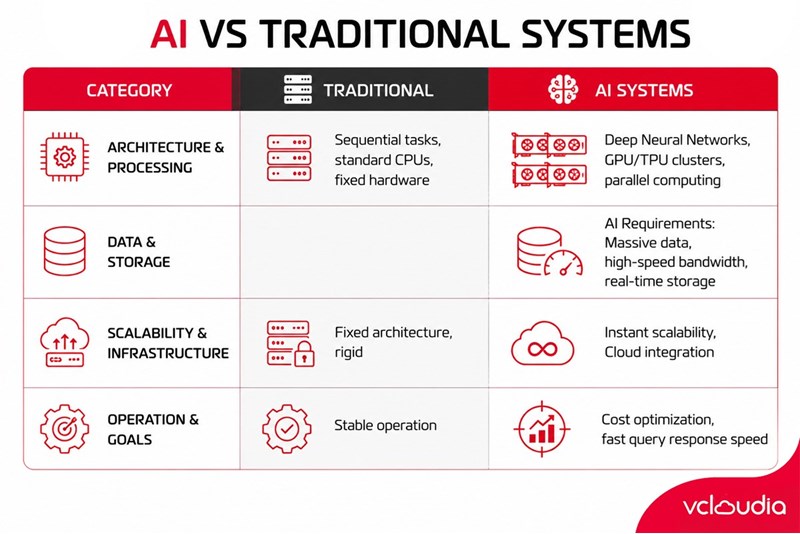
Traditional IT systems are built for sequential task processing, whereas AI systems demand a fundamentally different infrastructure architecture. Artificial intelligence models, particularly Deep Neural Networks, often require superior processing performance that standard CPUs cannot provide. Consequently, a GPU/TPU cluster is the most effective choice, allowing for the simultaneous execution of numerous complex calculations to accelerate the training and development of AI models.
Furthermore, artificial intelligence heavily depends on vast quantities of data. This necessitates enterprises to have robust bandwidth and high-speed storage systems. Overlooking this factor will significantly restrict the ability to transmit and process information in real-time, reducing performance and directly affecting the deployment of the enterprise's applications and services.
Traditional IT infrastructure typically features a fixed architecture that is difficult to adjust flexibly based on practical needs. In contrast, instant scalability is a mandatory requirement for operating an AI system. For this reason, artificial intelligence platforms are often integrated directly into the Cloud environment, allowing businesses to easily scale resources up or down as needed without significant investment in physical hardware.
While a standard IT system merely needs stable operation to be deployed, an AI system must be optimized for both operational costs and query response speed. This helps enterprises enhance application performance, conserve resources, and improve their competitive advantage in the market.
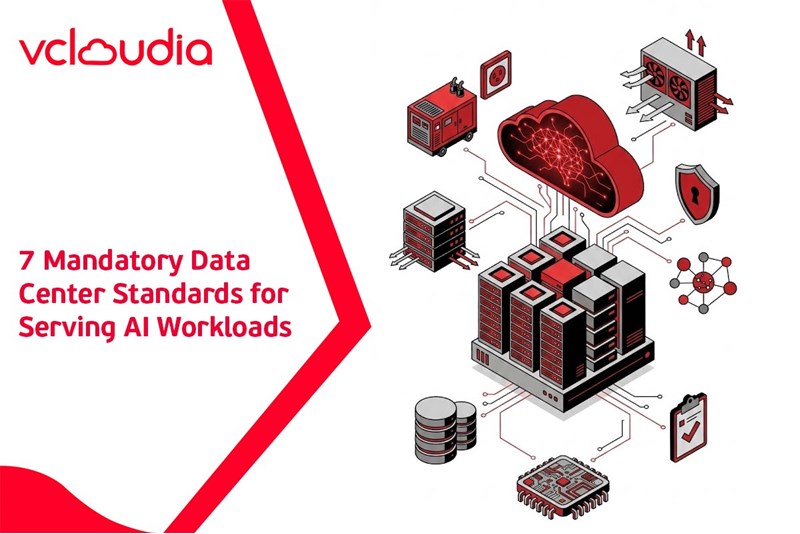
7 Mandatory Data Center Standards for Serving AI Workloads
Ultra-Stable, High-Load Power Supply
To simultaneously receive and process multiple queries, GPU nodes require an enormous amount of electricity and experience continuous peak loads for extended periods. This puts immense strain on the data center infrastructure. Any power-related incident can lead to equipment failure and disrupt all business operations.
To meet the power demand and ensure the continuity of the AI system, a Data Center must be fully equipped with dual power supplies, backup generators capable of operating for many hours, and high-capacity UPS systems. Additionally, service providers should implement smart PDUs to monitor the power consumption of each rack, effectively distribute loads, and proactively respond to potential risks.
Specialized Cooling Systems for AI Infrastructure
GPUs typically generate a massive amount of heat during operation, far exceeding the heat dissipation capabilities of conventional cooling solutions. If temperature and humidity are not maintained at optimal levels, this can shorten equipment lifespan and impact operational performance.
Therefore, data centers serving AI need to utilize intensive cooling technologies, including hotspot cooling, liquid cooling, or deep pressure cooling. These technologies are crucial for maintaining an ideal heat dissipation environment for servers and network equipment, helping to minimize component failure.
Ultra-High Bandwidth, Low-Latency Network Infrastructure
AI training and inference tasks often demand rapid data transmission capabilities. Thus, the internal network system must achieve a minimum speed of 10Gbps to 100Gbps. With stable bandwidth infrastructure, GPUs can operate at full capacity, thereby minimizing latency and shortening time to market. Additionally, AI-serving Data Centers must support specialized protocols like RDMA, InfiniBand, or high-speed Ethernet, while providing dedicated transmission lines to major Cloud platforms to accelerate the deployment of Hybrid AI workloads.
Inter-Regional Connectivity, Cross-Platform Integration
Integrating cloud platforms such as Public Cloud (AWS, GCP, Azure) or Private Cloud into a modern data center can offer flexibility and optimal security. Concurrently, Data Centers must be designed to support distributed AI models (Hybrid AI, Federated Learning, Edge AI) and establish dedicated Direct Connect/Interconnect channels, enabling enterprises to seamlessly connect with remote Data Lakes or Model Stores.
Big Data Requires Massive Storage
To ensure fast access speeds and limit I/O bottlenecks, the storage infrastructure in an AI data center needs to be equipped with NVMe systems, Object Storage, and support for hot-warm-cold tier data stratification. Furthermore, horizontal scale-out capability is an extremely important factor, helping to meet ever-increasing storage demands and minimize the risk of operational disruption.
Multi-Layer Security
AI models frequently process sensitive information, which establishes stringent requirements for data security and control. To prevent potential threats and legal risks, the data center system must comply with international standards such as ISO/IEC 27001, PCI DSS, GDPR, and others. Moreover, deploying advanced security layers like firewalls, DDoS prevention systems, Zero Trust Architecture, and AI cameras is also a mandatory condition to enhance monitoring capabilities and manage access activities.
Operations Team with AI Infrastructure Expertise
A data center cannot operate effectively without a dedicated IT team. This team should not only consist of standard DC engineers but also experts who understand AI workloads, cluster optimization mechanisms, GPU management, and ML pipeline setup. With solid knowledge and professional experience, the data center operations team can provide consultation on DataOps, MLOps, and AI Infrastructure Lifecycle solutions, while supporting customers to quickly deploy AI projects, from the Proof-of-Concept (PoC) stage to Scaling. In the context of the strong AI boom, a solid technology infrastructure is key for enterprises to accelerate and develop, thereby consolidating their competitive position in the market.
Vcloudia Cloud Server – The Cloud You Can Count On
If you're concerned about the potential limitations of Cloud Servers, Cloud Server by Vcloudia is a reliable solution for businesses of all sizes. With a modern infrastructure and comprehensive customer support, Vcloudia delivers a cloud experience with:
- Powerful connectivity to ensure stable 24/7 access
- Advanced security standards, compliant with international certifications such as ISO 27001:2013, ISO 20000:2018, ISO 9001:2015
- Flexible pricing packages tailored to your specific business needs
- Expert technical support, making migration and system deployment fast, safe, and compatible
Contact information:
- Hotline: +855 888 55 66 08 (free of charge)
- Fanpage: https://www.facebook.com/vcloudia/
- Website: https://vcloudia.com
Featured news
Related news
What is a Snapshot? The Difference Between Snapshot and Backup
Snapshot is a familiar concept in data management and protection. In the context of the information technology boom, where data is a major asset for businesses, understanding Snapshots as well as their application is a key factor for enterprises to maximize technological efficiency.
What is a Firewall? The Role and Importance of Firewalls for Users
In the context of ever-increasing cyberattacks, system security has become a top priority for many enterprises. Alongside deploying antivirus software and controlling connection ports, firewalls are also considered a key solution to effectively enhance cybersecurity.
What is DDoS? Signs, Mitigation Strategies, and Effective Prevention
DDoS is a highly dangerous cyberattack that leaves severe consequences for enterprises. Therefore, gaining a clear understanding of DDoS attacks, as well as how to detect and prevent them, is a topic of significant interest to many.
What is a Trojan? How to Detect, Avoid, and Prevent It
A Trojan is a type of malicious code or software that can cause severe consequences to computer operations. So, what is a Trojan? How can you prevent a Trojan from infiltrating your computer? In the following article, Vcloudia will provide detailed information on these issues.
What is Cloud Backup? Classification, benefits, and limitations
Cloud Backup is a solution that plays an important role in backing up and recovering data when an incident occurs. So what exactly is Cloud Backup? Let's find out the details with Vcloudia in the following article.
What is Cloud Storage? Features and Benefits of Using It
Cloud Storage is the perfect storage solution alternative to bulky, space-consuming physical hard drives. So, what is Cloud Storage? Let's explore the details with Vcloudia through the following article.
What is an API? Characteristics and applications in website design
API, short for Application Programming Interface, is a concept no longer unfamiliar in the information technology field. So what exactly is an API and why is it so important? Let's find out with Vcloudia.
What is Node.js? Instructions on how to install Node.js on cPanel
Currently, it is easy to see that Node.js is being used by quite a lot of people. This is because Node.js can support users in running on multiple platforms and multiple devices.
What is Vultr VPS? Should you use Vultr VPS?
Vultr VPS is one of the best cloud storage solutions in the world. In this article, you will learn the concept: "What is Vultr VPS?", as well as understand its advantages and disadvantages.
Zoom Cloud Meeting: What is it? Basic Things You Should Know About Zoom Cloud Meeting
In 2020, Zoom Cloud Meeting became one of the leading video conferencing software applications. It allows you to virtually interact with colleagues when in-person meetings aren't possible, and it has also been very successful for social events.