



.png)



















.png)





What is Linux Cloud? The Differences Between Linux Cloud and Windows Cloud?
16/09/2026Linux Cloud is the perfect combination of the open-source Linux operating system and the cloud computing platform (Cloud). What values will this combination bring to users? Let's explore this in more detail with Vcloudia in this article.
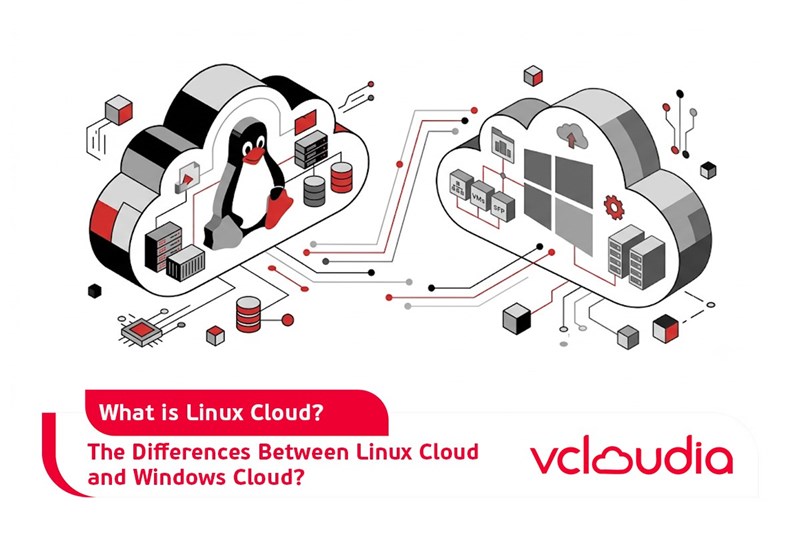
Overview of Linux Cloud
Many enterprises today are focusing on having a Cloud-based system in their IT infrastructure because they are more reliable, robust, and can be set up quickly. Although a Cloud-based system can increase the workload of monitoring and managing the architecture, enterprises are continuously optimizing these processes. This is one of the main reasons why many enterprises use Linux Cloud systems. Simply put, Linux Cloud helps save costs, is secure, scalable, open-source, and optimized for the community.
Thanks to the flexibility of Linux Cloud, IT organizations can optimize their infrastructure using other open-source tools. The integration within Linux Cloud brings outstanding advantages to users. It is interesting to note that over 75% of enterprises using the Cloud report using Linux Cloud as their primary cloud platform. Linux is perfect for running highly available, reliable, and mission-critical workloads in cloud computing environments.
The Differences Between Linux Cloud and Windows Cloud
For a clearer understanding of Linux Cloud, in this section, we will make a small comparison between Linux Cloud and Windows Cloud to identify the superior points of this model.
Similarities
Fundamentally, both Windows and Linux Cloud are systems developed on the Cloud platform and were created to meet certain user needs such as storage (Hosting,...). Both Windows and Linux are relatively popular operating systems for the majority of users at present.
Differences
In reality, there always exist fundamental differences between Windows and Linux Cloud.
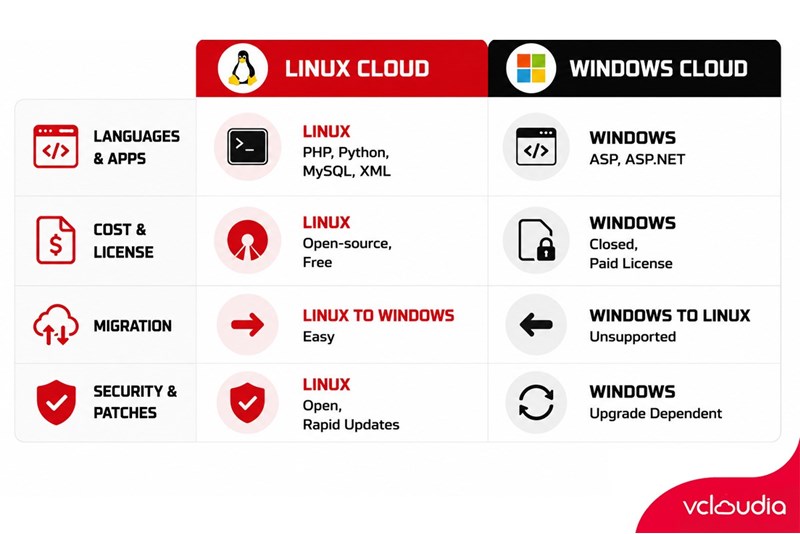
- Operating System: Linux Cloud is developed based on the Linux operating system. It is written in PHP, MySQL, Python, and XML languages. In contrast, Windows Cloud is built on the Windows operating system. It is written in languages such as ASP and ASP.net. Normally, Websites will run more smoothly on Windows Cloud Hosting instead of Linux Cloud Hosting.
- Cost: Linux Cloud uses the Linux operating system, hence they are cost-effective, secure, scalable, open-source, and optimized for the community. Conversely, Windows Cloud uses Windows, which is a closed operating system. Therefore, they are somewhat restricted and do not allow for much customization. This requires customers to purchase a License to use compared to the aforementioned Linux Cloud.
- Migration Capability: Linux Cloud users can easily migrate to Windows Cloud. Unfortunately, in the reverse direction, this is not widely supported.
- Security: Linux Cloud uses the Linux operating system, leading to higher security capabilities. The reason is that Linux is an open operating system, which allows it to be quickly updated with patches by users instead of having to wait for the next upgrade versions like Windows.
Applications of Linux Cloud
By combining cloud computing technology and the Linux operating system, one of the most popular applications of Linux Cloud is in the storage field - Linux Cloud Hosting. Linux Cloud Hosting can support programming languages such as PHP, Pear, Python, and the MySQL database management system.
Linux Cloud Hosting brings users specific advantages such as:
- Security: Linux Cloud Hosting, with the advantage of the Linux operating system, brings superiority in security capabilities. This means your Website will be able to operate stably, smoothly, and limit downtime to the maximum extent.
- Compatibility: Linux Cloud Hosting uses an open operating system, thus it brings high compatibility. It can be easily customized to help other applications run correctly on Linux servers. Thereby, it brings higher applicability and flexibility.
- Cost savings: Linux Cloud Hosting uses Linux, which is a free operating system. Thus, in theory, it helps optimize costs better for users. You will not need to pay any additional fees when using this operating system.
Conclusion
Compared to Windows Cloud, Linux Cloud brings significantly more outstanding advantages. However, that does not mean it is suitable for everyone and every need. Based on the characteristics of each type and depending on different needs, you can choose the appropriate model.
Looking for a high-performance, secure solution?
Explore the services offered by Vcloudia – a leading provider of Cloud Computing and Data Center solutions. Contact us for expert consultation and find the right model for your needs:
- Hotline: +855 888 55 66 08 (free of charge)
- Fanpage: https://www.facebook.com/vcloudia/
- Website: https://vcloudia.com/
ព័ត៌មានពិសេស
ព័ត៌មានដែលទាក់ទង
What is a Mail Server? Understanding How a Mail Server Works
With just a simple mouse click, you can quickly send an Email to anyone, anywhere in the world. At this point, the Mail Server plays a crucial role, enabling the Email to be sent and function exactly as you intend. But have you ever thought more deeply about what a Mail Server is, as well as how a Mail Server operates?
What is AWS? Everything You Need to Know About Amazon Web Services
What is AWS? Simply put, AWS (Amazon Web Services) is a comprehensive cloud computing platform provided by retail giant Amazon, serving a wide range of user needs. In this article, let's explore the details with Vcloudia to clearly understand what AWS is!
What is Cloud Computing? An Overview of Cloud Computing Models
Today, many users are no longer unfamiliar with the term Cloud Computing (Cloud Computing). If you do not yet know what Cloud Computing is, it will be a significant disadvantage when building a website or carrying out other related activities on the Internet.
What is Network security? Classification and comparison with Cybersecurity
Today's network architectures are complex and face an ever-changing threat environment and attackers constantly seeking and exploiting vulnerabilities. These vulnerabilities can exist across multiple areas, including hardware devices, data, applications, users, and locations. For this reason, numerous network security management tools and applications are used today to address individual threats and exploits as well as regulatory non-compliance.
What is a Virtual Host? How to Set Up Virtual Hosts on XAMPP
Virtual Hosts are arguably one of the most popular technologies in the storage technology field. This is a method through which a server can serve multiple different websites simultaneously. If you do not know much about Virtual Hosts, this article is for you!
What is the OpenStack platform? Everything users need to know about the OpenStack platform
Today, many people are still quite vague and do not fully understand what the OpenStack platform is. Through this article, let's explore the OpenStack platform in more detail with Vcloudia.
What is Ubuntu Server? Should You Use Ubuntu Server?
Most people today have heard the term Ubuntu Server at least once. But, do you know what Ubuntu Server is yet? Who should use this operating system, and what benefits does it bring us? Let's join Vcloudia in exploring this information through the article below!
What Is Creative Cloud Desktop? Everything Users Need to Know About the Creative Cloud Desktop Solution
Currently, with the severe outbreak of the Covid-19 pandemic, the demand for remote work has increased at an astonishing rate. For this reason, the Creative Cloud Desktop solution has been and is highly favored by many users.
What is a Tier 3 Data Center? An Overview of Tier Standards
When researching data centers, you have probably frequently come across the phrase: "International standard Tier 3 Data Center", but you do not understand what they are? And how is an international standard Tier 3 Data Center different from normal Data Centers?