



.png)


















.png)





Open Kubernetes Service
A PaaS providing Developers with a Kubernetes platform to easily build, deploy, scale and manage containerized applications
Open Kubernetes Service (vOKS) is a service at the Platform layer providing Developers with a complete OS-virtualized environment, supporting them on developing, testing and deploying applications on Kubernetes.
Inherited the advantages of Vcloudia’s highly robust and stable Public Cloud infrastructure, possesses the ability to create and provide Kubernetes clusters to Developers at a high speed, fully automated and self-configurated manner. Our service also meets many of the Cloud industry standards and achieved many related certifications, both local (Cloud for Government) and global (ISO 9001:2015 - Quality Management System, ISO 27001:2013 - Information Technology System Management, ISO 27017:2015 - Information technology-Security techniques-Code of practice for information security controls for cloud services, etc).
Activity diagram

Node Group
The Node Group feature allows developers to create, customize, and manage related worker nodes or meet various infrastructure needs within the same Kubernetes resource cluster.

Centralized Node Management
Manage Worker Nodes based on labels, taints, and autoscale configurations within the same Node Group. It allows easy addition and removal of Node Groups, and centralized cost management via the Vcloudia self-service portal.

Upgrade to New Versions
Supports the latest versions and continuous upgrades, providing performance and security enhancements to ensure customers use the most up-to-date features of the Kubernetes platform.

Persistent Volume Storage with NFS Storage Solution
Integrates an NFS Node to enable long-term data storage and automatic sharing between nodes. Customers can easily expand NFS Storage capacity when needed via the service management page.

Automated Pod Creation and Recovery
Kubernetes automatically creates new Pods, removes old Pods, and reallocates resources from old Pods to new ones without causing downtime. It also automatically reboots Pods that are malfunctioning, deletes, or replaces unresponsive Pods.

Quick Setup and Use of Monitoring Tools
Quickly set up monitoring tools such as Kubernetes Dashboard, Prometheus, and Grafana with just one click on the Vcloudia service management interface.

Cluster Change Control
Track and review all changes made to the Kubernetes resource cluster, including Node Group creation, support tool installation, and NFS Storage expansion.

CloudWatch Integration
Easily collect logs and monitor components such as Pods, Volumes, and Nodes in Kubernetes through Vcloudia’s CloudWatch tool.

Implement microservice architecture
Kubernetes and Containers play an important role in deploying applications under the microservices architecture and in standardizing how software is developed into service sets that are data-separated and operate independently.

Deploy API & backend services
Build and manage backend services on vOKS to speed up deployment and improve application performance. Development team builds the application, tests and updates the new version independently without affecting other applications, thereby improving the availability and efficiency of customers’ services.
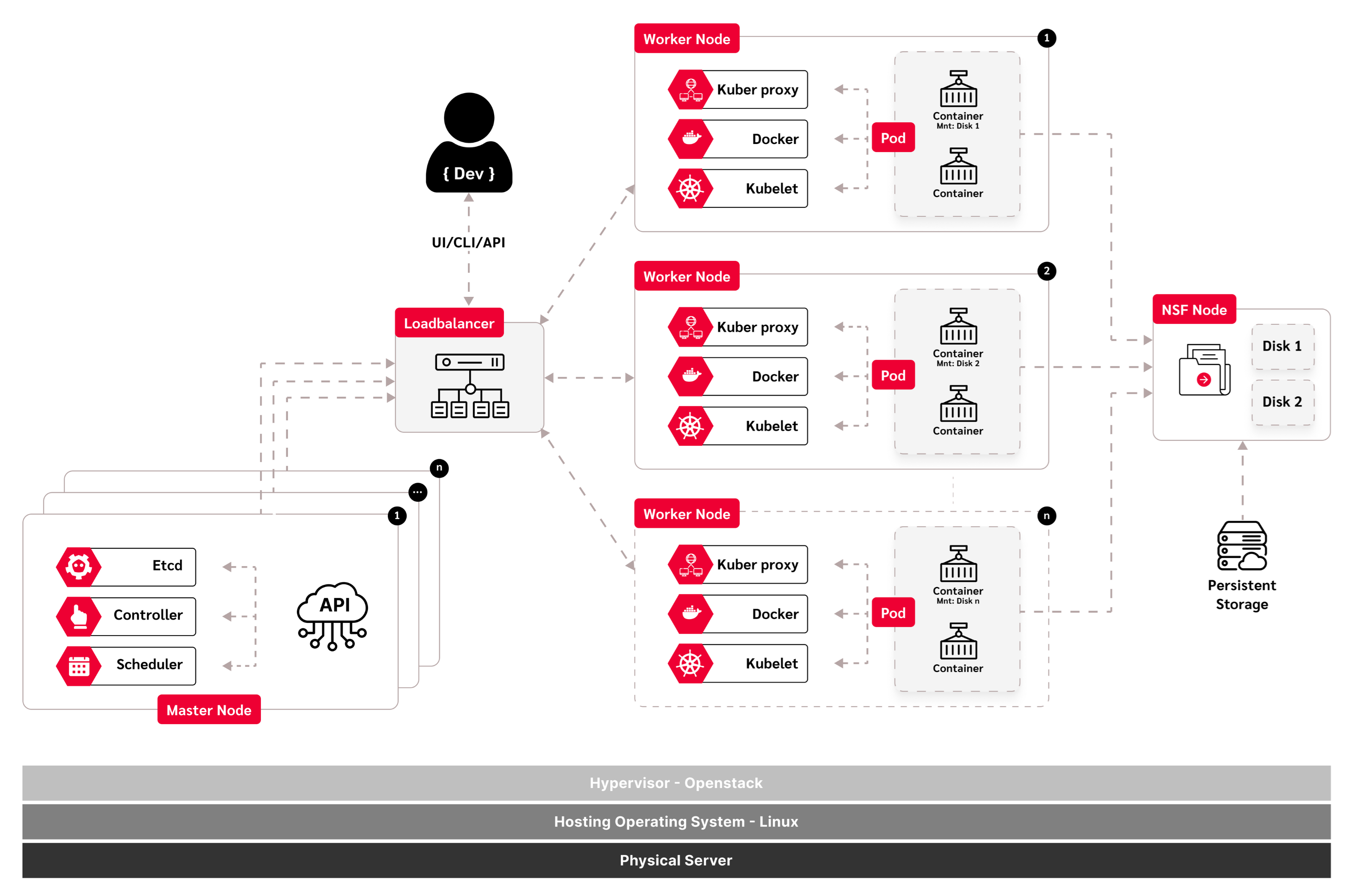
- Container is a standardized unit of software that contains the source code and dependencies needed to run an application or service.
- Docker is a platform and tool for packaging an application into a container, automating the deployment of a container application from one environment to another, ensuring that the application works stably and consistently.
- Kubernetes is not responsible for creating containers by itself; its most important purpose is orchestrating, scheduling, and managing the state of containers when scaling deployment with the requirement to coordinate multiple containers working together to distribute distribute individual services on a physical or virtualized infrastructure.
- vOKS provides customers with Kubernetes clusters with a choice of 01 Master Node or 03 Master Nodes with Loadbalancer to improve service availability; Worker Nodes can expand to an unlimited number:
* Master Node: a VM, containing all the logic components to coordinate the activities of the Worker Nodes and define, deploy, and manage the lifecycle of the containers running on the Worker Node.
* Worker Node: Containerized applications will deploy on Worker Nodes. In each vOKS service package, Vcloudia provides at least 03 Worker Nodes in order to improve fault tolerance and availability when deploying applications.
- NFS Node - Persistent Storage: a NFS Server (Network File System) used as a protocol to connect containers running in Worker Node to an independent data storage area (Persistent Storage).
- Node Storage has a fixed capacity of 50 GB (SSD), used to store data (cache form) of the container during operation. This data is only saved temporarily and will be deleted when the user restarts/reschedules the containers.
- On the other hand, the container's data during operation is stored on its own storage area (Persistent Storage) and will be retained when the containers are restarted/rescheduled; this data can be transferred between containers.
- Customers can easily use all existing plugins or tools developed and contributed by the Kubernetes community. Also, applications running on any standard Kubernetes environment on other Cloud infrastructure (AWS, Microsoft Azure, etc.) or On-Premise Data Center are compatible and easily migrated to Vcloudia's vOKS service.