



.png)


















.png)





When Should Businesses Choose a Cloud Server?
Feb 27, 2026Determining the right time for a business to adopt a Cloud Server is a critical question for managers, especially in an era of rapidly evolving technology. Choosing the right moment can help organizations optimize costs, enhance scalability, and maintain competitiveness in the market. Let’s explore this topic in more detail with Vcloudia in the following article.
Overview of Cloud Servers
1. Basic Concept
A Cloud Server is a computing service that provides data storage, processing power, and application hosting through a cloud computing platform. Instead of owning and maintaining physical servers, businesses can rent or subscribe to Cloud Server services from reputable providers such as Amazon Web Services, Microsoft Azure, Google Cloud, or local service providers.
This model offers significant advantages in terms of flexibility, scalability, and reduced upfront capital expenditure. Cloud Servers operate on the principle of distributing data and computing resources across multiple data centers, enabling organizations to easily scale resources up or down based on actual demand. As a result, businesses can focus on their core operations and growth strategies without being constrained by technological limitations.
2. Key Features
Cloud Servers are not merely data storage solutions; they integrate a wide range of advanced features such as automatic load balancing, on-demand scalability, self-healing capabilities, intuitive management interfaces, and seamless integration with value-added services including data analytics, artificial intelligence (AI), and machine learning.
One of the most notable advantages of Cloud Servers is their ability to dynamically allocate resources according to usage requirements. During traffic spikes or operational fluctuations, the system automatically adjusts to maintain stable performance. In addition, robust security mechanisms and automated data backup significantly reduce the risks of data loss and cyberattacks, enhancing overall business resilience in today’s digital environment.
The Enterprise Shift Toward Cloud Adoption
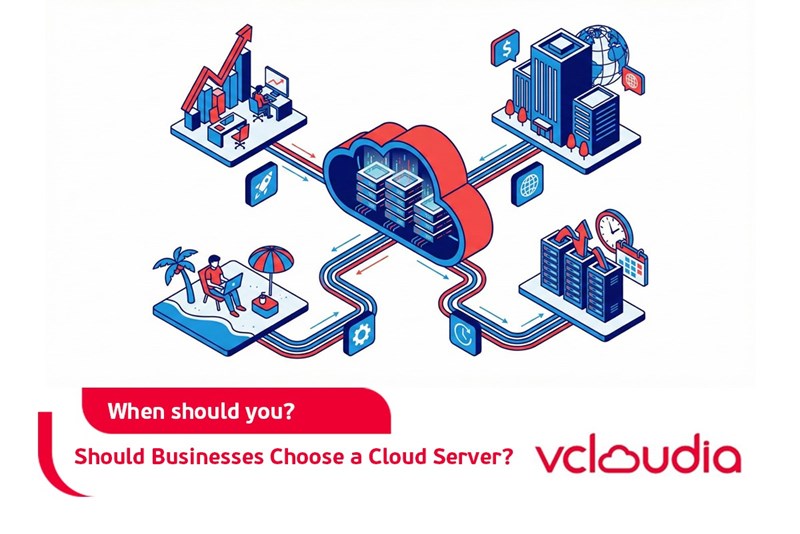
In recent years, the migration to cloud platforms has become an inevitable trend for enterprises of all sizes. This shift is driven not only by the need for greater agility, but also by increasing demands for data security, cost optimization, and global competitiveness. Cloud computing empowers businesses to capitalize on digital transformation, innovate freely, and operate more efficiently.
Moreover, modern cloud platforms offer an expanding ecosystem of integrated services, ranging from data analytics and AI to IoT solutions. This allows organizations to adapt quickly to market changes, collaborate more effectively, and scale business models with ease. From startups to multinational corporations, cloud adoption has become a strategic foundation aligned with global digitalization.
That said, cloud migration also presents technical and managerial challenges. Enterprises must develop a clear strategy, identify the right timing, and select appropriate solutions to maximize benefits while minimizing risks. Understanding when to adopt Cloud Servers is therefore a decisive factor in achieving successful digital transformation.
Why Businesses Should Consider Cloud Servers
When evaluating a transition to Cloud Servers, organizations must carefully assess the strategic benefits. Below are key reasons why Cloud Servers should be considered as part of a long-term growth strategy.
1. Optimized Investment Costs
The initial investment required for physical servers—including hardware, software, maintenance staff, and ongoing upkeep—can be substantial. Cloud Servers address this challenge by shifting from capital expenditure (CapEx) to an operational expenditure (OpEx) model, allowing businesses to pay only for the resources they actually use.
Operational costs are also significantly reduced, as enterprises no longer need to maintain specialized technical teams for infrastructure management. Cloud providers handle system updates, maintenance, and optimization as part of their service offerings, enabling more accurate forecasting of monthly or annual IT budgets.
This cost efficiency is particularly beneficial for small and newly established businesses, allowing them to leverage advanced technology while preserving financial resources. The savings can then be reinvested in strategic areas such as research, product development, and marketing.
2. Flexible Scalability
In a constantly changing market, adaptability is a key determinant of success. Cloud Servers enable businesses to scale resources up or down quickly and easily based on real-time operational needs.
For example, during peak seasons, organizations can allocate additional computing resources to handle increased traffic, while scaling down during off-peak periods to reduce costs. This flexibility prevents resource waste, ensures continuous performance, and supports expansion into larger projects or international markets without the need for new hardware investments.
Such scalability also enables businesses to experiment with new business models, integrate emerging technologies, and enter new markets efficiently—strengthening long-term competitiveness.
3. High Availability
System availability is critical to maintaining uninterrupted business operations. Cloud Servers are designed for high availability through data redundancy, automated failover, and self-recovery mechanisms.
Data is distributed across multiple data centers, minimizing the risk of loss due to natural disasters, hardware failures, or technical incidents. Automated backup and recovery solutions allow rapid system restoration, while load balancing ensures stable performance even during high traffic volumes.
These capabilities help organizations maintain service quality, build customer trust, and protect their reputation—whether managing e-commerce platforms, customer service applications, or enterprise resource planning (ERP) systems.
4. Disaster Recovery
In today’s technology landscape, risks such as cyberattacks, system failures, and natural disasters are unavoidable. Having a Cloud Server infrastructure significantly enhances an organization’s disaster recovery capabilities.
Critical data is automatically backed up and stored across multiple locations, ensuring accessibility anytime and anywhere when needed. Cloud-based disaster recovery services can automatically switch operations to backup data centers, maintaining service continuity even during unexpected disruptions.
This minimizes downtime, protects business operations, and reinforces customer confidence under all circumstances.
5. Accelerated Innovation
In the digital era, innovation is no longer optional—it is essential for survival. Cloud Servers allow businesses to rapidly develop, test, and deploy new solutions with greater agility and lower costs.
Cloud platforms offer built-in services such as AI, big data analytics, IoT, and blockchain, enabling easy integration without heavy infrastructure investment. This fosters creativity, accelerates time-to-market, and empowers organizations to stay ahead of technological trends.
Rapid access to advanced technologies also supports the creation of flexible business models and enhanced customer experiences, helping enterprises not only follow trends but also shape them.
When Is the Right Time for Businesses to Choose a Cloud Server?
Every organization faces unique growth stages and challenges. Identifying the right moment to adopt Cloud Servers is key to ensuring a smooth and effective transition. Below are clear indicators that signal when businesses should consider moving to the cloud.
1. When Existing Infrastructure Limits Growth
If on-premises servers or traditional hosting environments can no longer handle increasing traffic—causing slow performance, downtime, or limited scalability—this is a clear sign that the current infrastructure is overloaded. Migrating to Cloud Servers removes scalability constraints, reduces unnecessary costs, and supports continuous operations.
2. When Flexible Scaling Is Required
Marketing campaigns, product launches, or international expansion demand rapid scalability. Cloud Servers allow real-time resource adjustments without hardware procurement, ensuring cost efficiency and responsiveness during peak business periods.
3. When Infrastructure Costs Become a Burden
Rising maintenance, hardware upgrades, and unpredictable expenses can erode profitability. Cloud Servers provide usage-based pricing, enabling precise cost control and freeing resources for strategic initiatives.
4. When Data Security Must Be Strengthened
With increasing regulatory pressure and cyber threats, data security is mission-critical. Cloud Servers offer advanced security features such as encryption, access control, continuous monitoring, and compliance with international security standards—enhancing trust among customers and partners.
5. When Technology Innovation Is a Priority
Emerging technologies such as AI, big data, IoT, and blockchain require powerful and flexible infrastructure. Cloud Servers enable cost-effective experimentation and rapid deployment, accelerating innovation and market expansion.
Conclusion
In today’s fast-paced technological landscape, identifying the right time to adopt Cloud Servers is essential for a smooth, efficient, and sustainable digital transformation. Indicators such as outdated infrastructure, the need for scalability, rising costs, and the drive for innovation all point toward cloud adoption.
Cloud Servers offer cost optimization, seamless scalability, enhanced security, high availability, disaster recovery, and accelerated innovation. They provide a strategic foundation for businesses to overcome digital challenges, maintain competitiveness, and unlock future growth opportunities.
Explore the services offered by Vcloudia – a leading provider of cloud computing and data center solutions. Contact us for expert consultation and find the right model for your needs:
- Hotline: +855 888 55 66 08 (free of charge)
- Fanpage: https://www.facebook.com/vcloudia/
- Website: https://vcloudia.com
Featured news
Related news
What is a Snapshot? The Difference Between Snapshot and Backup
Snapshot is a familiar concept in data management and protection. In the context of the information technology boom, where data is a major asset for businesses, understanding Snapshots as well as their application is a key factor for enterprises to maximize technological efficiency.
What is a Firewall? The Role and Importance of Firewalls for Users
In the context of ever-increasing cyberattacks, system security has become a top priority for many enterprises. Alongside deploying antivirus software and controlling connection ports, firewalls are also considered a key solution to effectively enhance cybersecurity.
What is DDoS? Signs, Mitigation Strategies, and Effective Prevention
DDoS is a highly dangerous cyberattack that leaves severe consequences for enterprises. Therefore, gaining a clear understanding of DDoS attacks, as well as how to detect and prevent them, is a topic of significant interest to many.
What is a Trojan? How to Detect, Avoid, and Prevent It
A Trojan is a type of malicious code or software that can cause severe consequences to computer operations. So, what is a Trojan? How can you prevent a Trojan from infiltrating your computer? In the following article, Vcloudia will provide detailed information on these issues.
What is Cloud Backup? Classification, benefits, and limitations
Cloud Backup is a solution that plays an important role in backing up and recovering data when an incident occurs. So what exactly is Cloud Backup? Let's find out the details with Vcloudia in the following article.
What is Cloud Storage? Features and Benefits of Using It
Cloud Storage is the perfect storage solution alternative to bulky, space-consuming physical hard drives. So, what is Cloud Storage? Let's explore the details with Vcloudia through the following article.
What is an API? Characteristics and applications in website design
API, short for Application Programming Interface, is a concept no longer unfamiliar in the information technology field. So what exactly is an API and why is it so important? Let's find out with Vcloudia.
What is Node.js? Instructions on how to install Node.js on cPanel
Currently, it is easy to see that Node.js is being used by quite a lot of people. This is because Node.js can support users in running on multiple platforms and multiple devices.
What is Vultr VPS? Should you use Vultr VPS?
Vultr VPS is one of the best cloud storage solutions in the world. In this article, you will learn the concept: "What is Vultr VPS?", as well as understand its advantages and disadvantages.
Zoom Cloud Meeting: What is it? Basic Things You Should Know About Zoom Cloud Meeting
In 2020, Zoom Cloud Meeting became one of the leading video conferencing software applications. It allows you to virtually interact with colleagues when in-person meetings aren't possible, and it has also been very successful for social events.