



.png)


















.png)





What is OpenStack Cinder? Understanding Block Storage in the OpenStack Ecosystem
Jun 30, 2026When building cloud infrastructure with OpenStack, choosing the right storage solution is a key factor. Among these, Cinder is the component responsible for providing block storage, a crucial form of storage for virtual machines and high-performance applications.
So, what is OpenStack Cinder, how does it work, and what role does it play in the cloud ecosystem? The article below by Vcloudia will help you understand everything from the platform fundamentals to practical applications.
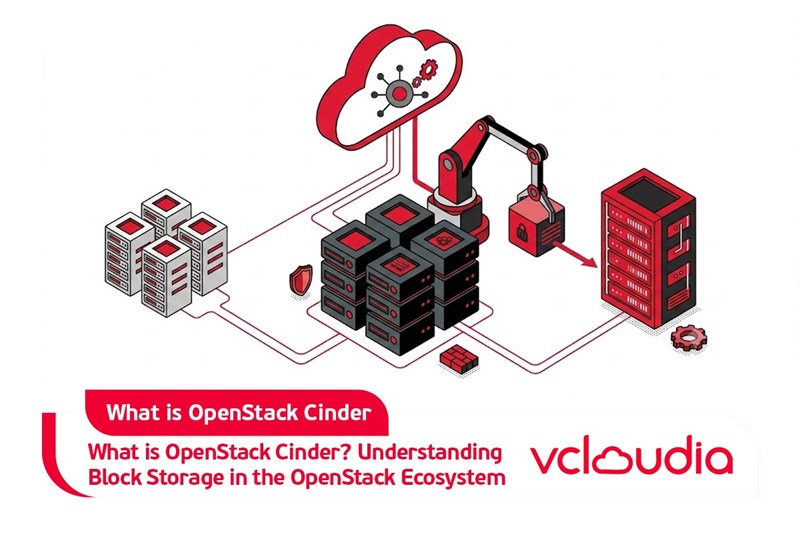
What is OpenStack Cinder?
OpenStack Cinder is a block storage service within the OpenStack ecosystem, allowing for the creation and management of volumes (virtual disks) that can be attached to virtual machines. It is the component responsible for storing block-level data, similar to a physical hard drive but implemented in a virtualized form.
Unlike object storage (like Swift) or file storage, block storage provides direct access to individual data blocks, allowing the operating system on the virtual machine to use it like a regular disk. This is especially important for applications requiring high performance, such as databases, transaction processing systems, or workloads that need fast data retrieval.
A major strength of Cinder is the complete separation between compute and storage. This helps virtual machines use volumes independently, making it easy to expand or change without affecting the compute system.
The Role of OpenStack Cinder in Cloud Architecture
Providing Block Storage for Virtual Machines
In OpenStack, Cinder acts as a virtual hard drive for virtual machines managed by the Nova service. When a virtual machine needs persistent storage, Cinder provides a volume to attach to it. Unlike ephemeral storage, Cinder volumes can exist independently even if the virtual machine is deleted. This ensures data is not lost and can be reused by other instances.
Separating Compute and Storage
One of the most important principles of cloud architecture is the separation of compute and storage resources. Cinder enables this by managing storage separately, independent of the virtual machine's lifecycle. This separation offers many benefits, such as: Easily scaling each component individually, increasing fault tolerance, and providing flexibility in resource allocation.
Supporting Flexible Cloud Scaling
Cinder allows for flexible storage capacity scaling based on demand. When the system requires more storage space, you can create additional volumes or extend existing ones without needing to change the entire infrastructure. This is particularly useful in cloud environments where resource demands frequently fluctuate.
The Architecture of OpenStack Cinder
Cinder's architecture is designed based on a distributed model, including multiple components that coordinate with each other to provide stable and flexible storage services. The first component is the Cinder API, which is responsible for receiving and processing requests from users or the system. This is the primary contact point between Cinder and other services within OpenStack.
Next is the Cinder Scheduler, tasked with determining the appropriate storage backend to store the volume. The Scheduler makes optimal decisions based on various factors such as remaining capacity, performance, or allocation policies.
Cinder Volume is the component that directly manages the creation, deletion, and connection of volumes. This is where actual data-related operations are performed. Additionally, Cinder Backup provides volume backup functionality, ensuring data protection and supporting recovery when necessary. Thanks to this architecture, Cinder can operate flexibly and scale easily in large cloud environments.
How Does OpenStack Cinder Work?
Volume Creation Process
When a user requests the creation of a volume, this request is sent to the Cinder API. Subsequently, the Cinder Scheduler selects an appropriate storage backend based on the configuration and system status. Once the backend is identified, Cinder Volume performs the creation of the volume and returns the result to the user. This entire process occurs automatically and transparently.
Attaching and Detaching Volumes to Virtual Machines
After creating a volume, users can attach it to a virtual machine. This process is carried out through coordination between Cinder and Nova. When attached, the volume appears as a new disk within the virtual machine's operating system. Users can format and use it like a regular hard drive. When no longer needed, the volume can be detached without data loss, allowing it to be attached to another machine when necessary.
Snapshots and Backup
Snapshot is a feature that allows capturing the state of a volume at a specific point in time. This enables users to revert to a previous state when errors occur. Cinder also supports backup, allowing data to be saved to other storage systems. This is a critical solution for ensuring data safety in cloud environments.
Volume Lifecycle Management
Cinder manages the entire volume lifecycle, from creation, usage, snapshot, and backup, to deletion. Users can perform these operations through the API or the management interface. Lifecycle management helps optimize resources and ensures the system always operates efficiently.
Outstanding Features of OpenStack Cinder
Flexible Volume Management
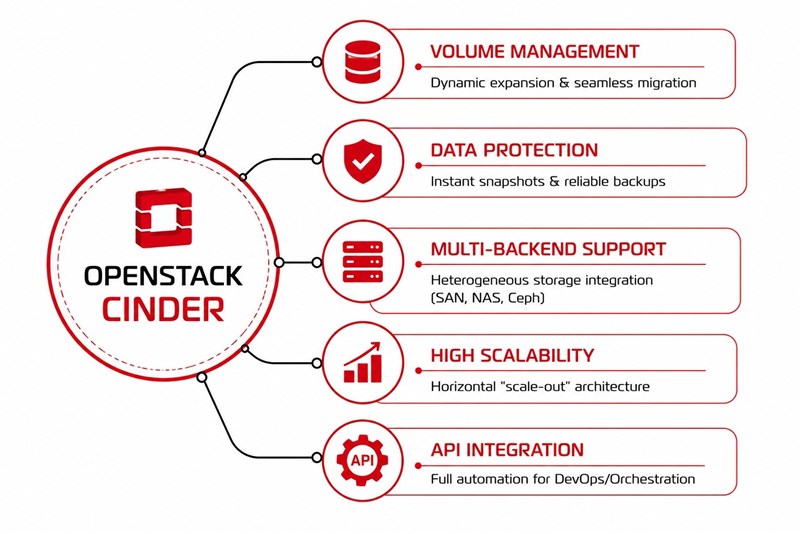
One of the core strengths of OpenStack Cinder lies in its extremely flexible volume management, well-suited to the constantly changing demands of cloud environments. Users can go beyond simply creating or deleting volumes; they can also expand capacity, change storage types, or migrate volumes between different backends without causing system disruptions.
In practice, this brings significant benefits to enterprises. For example, when an application grows and requires more storage, administrators can expand the volume immediately without shutting down the virtual machine or redeploying the infrastructure. Additionally, moving volumes between backends helps optimize costs and performance, such as moving hot data to high-speed storage and cold data to more economical storage.
Data Snapshot and Backup
Cinder provides snapshot and backup mechanisms that help protect data at a high level, which is particularly critical in production systems. Snapshots allow recording the state of a volume at a specific point in time, akin to freezing the data so that one can revert to it at any time.
A notable point is that snapshots operate almost instantaneously and do not significantly affect system performance. This is very useful in scenarios such as software updates, configuration changes, or experimental deployments, where you need a safe recovery point.
Multi-Backend Support
One of the prominent advantages that makes Cinder flexible is its ability to support multiple storage backends within the same system. Instead of being limited to a single storage type, users can integrate various technologies such as local disks, SAN, NAS, or distributed systems like Ceph.
Multi-backend support enables enterprises to build multi-tier storage strategies. For example, critical or high-performance data can be stored on SSDs or SANs, while less frequently accessed data can be moved to lower-cost storage systems.
High Scalability
OpenStack Cinder is designed to operate in a distributed environment, allowing for near-limitless scaling as demands increase. When the system requires more capacity or performance, you simply need to add more storage backends without changing the overall structure.
This scale-out capability is particularly important in large cloud systems where the number of virtual machines and data can grow rapidly over time. Instead of having to vertically upgrade hardware at high costs, Cinder allows for horizontal expansion, helping optimize investment costs.
Powerful API Integration
Cinder provides a complete and flexible API system, allowing users to easily integrate with other services in the cloud ecosystem or build automated processes. Through the API, you can perform most operations such as volume creation, attachment, snapshot, or backup without manual intervention. This is especially useful in DevOps environments, where automation is a key factor for accelerating deployment and reducing human error.
Additionally, Cinder's API supports integration with orchestration tools like Heat or CI/CD systems, helping manage storage resources in a synchronized and efficient manner throughout the entire application lifecycle.
Practical Applications of OpenStack Cinder
In practical deployment, OpenStack Cinder is widely used as a block storage platform for cloud systems, especially in enterprise environments and data centers. One of the most popular applications is providing storage for virtual machines, where Cinder volumes act as the primary drive or data drive for the operating system and applications.
For database systems or applications requiring high-frequency transaction processing, Cinder provides a distinct advantage due to its fast and stable data access capability. Using block storage helps ensure low latency and high performance, which other storage forms struggle to meet.
Furthermore, Cinder plays a vital role in backup and disaster recovery solutions. Enterprises can use snapshots and backups to build multi-layered data protection strategies, ensuring quick recovery capabilities when incidents occur. This is particularly critical for financial, e-commerce, or online service systems requiring high uptime.
When Should You Use OpenStack Cinder?
Private Cloud Systems
OpenStack Cinder is an ideal choice when enterprises build private clouds and need a flexible block storage solution. In this environment, Cinder helps provide storage resources on demand, while ensuring scalability and centralized management. Using Cinder in a private cloud also helps enterprises better control data and security, especially in industries with strict compliance requirements such as finance or healthcare.
Enterprises Requiring High-Performance Block Storage
For systems requiring high performance such as databases, ERP systems, or big data processing applications, Cinder is a suitable choice due to its ability to provide block storage with low latency and fast access speeds. Not stopping at performance, Cinder also allows customization of the storage backend to optimize according to each workload type, helping balance costs and resource efficiency.
Environments Requiring Separation of Storage and Compute
In large-scale systems, separating storage and compute is an important factor to ensure scalability and efficient management. Cinder allows this to be performed clearly, helping each component develop independently. This is particularly useful when the system needs upgrading or expansion, as you can change storage without affecting compute, and vice versa. As a result, the infrastructure becomes more flexible and easily adapts to new requirements in the future.
Conclusion
OpenStack Cinder is a vital component in the OpenStack ecosystem, providing a flexible and efficient block storage solution for cloud systems. Understanding how Cinder works and its applications will help you maximize the power of OpenStack, thereby improving the performance and reliability of your system in the long term.
FAQ
1. Is using Cinder slower than local disks of virtual machines?
It is possible, but not always. The performance of Cinder depends heavily on the storage backend (SSD, SAN, Ceph, etc.). If a high-quality backend is used and configured correctly, Cinder still meets the needs of heavy workloads such as databases. However, compared to local disks, latency may be slightly higher due to network transit, so a balance between performance and flexibility needs to be considered.
2. If the virtual machine is deleted, is the data in Cinder lost?
No, this is a core strength of Cinder. Cinder volumes exist independently of virtual machines, so when an instance is deleted, the data remains intact. You can re-attach the volume to another machine at any time. This helps avoid data loss and offers more flexibility in operating the system.
3. Is Cinder safe enough for production systems?
Yes, but it needs to be implemented correctly. Cinder supports snapshots, backups, and integrates with many highly reliable storage backends. However, to ensure data safety, enterprises still need to build appropriate backup, replication, and monitoring strategies. If used with default settings without optimization, risks may still occur.
Vcloudia Cloud Server – The Cloud You Can Count On
If you're concerned about the potential limitations of Cloud Servers, Cloud Server by Vcloudia is a reliable solution for businesses of all sizes. With a modern infrastructure and comprehensive customer support, Vcloudia delivers a cloud experience with:
- Powerful connectivity to ensure stable 24/7 access
- Advanced security standards, compliant with international certifications such as ISO 27001:2013, ISO 20000:2018, ISO 9001:2015
- Flexible pricing packages tailored to your specific business needs
- Expert technical support, making migration and system deployment fast, safe, and compatible
Contact information:
- Hotline: +855 888 55 66 08 (free of charge)
- Fanpage: https://www.facebook.com/vcloudia/
- Website: https://vcloudia.com
Featured news
Related news
What is a Snapshot? The Difference Between Snapshot and Backup
Snapshot is a familiar concept in data management and protection. In the context of the information technology boom, where data is a major asset for businesses, understanding Snapshots as well as their application is a key factor for enterprises to maximize technological efficiency.
What is a Firewall? The Role and Importance of Firewalls for Users
In the context of ever-increasing cyberattacks, system security has become a top priority for many enterprises. Alongside deploying antivirus software and controlling connection ports, firewalls are also considered a key solution to effectively enhance cybersecurity.
What is DDoS? Signs, Mitigation Strategies, and Effective Prevention
DDoS is a highly dangerous cyberattack that leaves severe consequences for enterprises. Therefore, gaining a clear understanding of DDoS attacks, as well as how to detect and prevent them, is a topic of significant interest to many.
What is a Trojan? How to Detect, Avoid, and Prevent It
A Trojan is a type of malicious code or software that can cause severe consequences to computer operations. So, what is a Trojan? How can you prevent a Trojan from infiltrating your computer? In the following article, Vcloudia will provide detailed information on these issues.
What is Cloud Backup? Classification, benefits, and limitations
Cloud Backup is a solution that plays an important role in backing up and recovering data when an incident occurs. So what exactly is Cloud Backup? Let's find out the details with Vcloudia in the following article.
What is Cloud Storage? Features and Benefits of Using It
Cloud Storage is the perfect storage solution alternative to bulky, space-consuming physical hard drives. So, what is Cloud Storage? Let's explore the details with Vcloudia through the following article.
What is an API? Characteristics and applications in website design
API, short for Application Programming Interface, is a concept no longer unfamiliar in the information technology field. So what exactly is an API and why is it so important? Let's find out with Vcloudia.
What is Node.js? Instructions on how to install Node.js on cPanel
Currently, it is easy to see that Node.js is being used by quite a lot of people. This is because Node.js can support users in running on multiple platforms and multiple devices.
What is Vultr VPS? Should you use Vultr VPS?
Vultr VPS is one of the best cloud storage solutions in the world. In this article, you will learn the concept: "What is Vultr VPS?", as well as understand its advantages and disadvantages.
Zoom Cloud Meeting: What is it? Basic Things You Should Know About Zoom Cloud Meeting
In 2020, Zoom Cloud Meeting became one of the leading video conferencing software applications. It allows you to virtually interact with colleagues when in-person meetings aren't possible, and it has also been very successful for social events.