



.png)















.png)





What is Cross Connect in Data Center? The ultimate solution to optimize latency and absolute security for servers
Jun 30, 2026In the Data Center ecosystem, placing a server is just the beginning. To operate the system at peak performance, you need a direct, dedicated, and secure connection line called a Cross Connect. So what is Cross Connect in a data center, and why is it considered the gold standard for connectivity in professional data centers like Vcloudia? Let's find out right below.
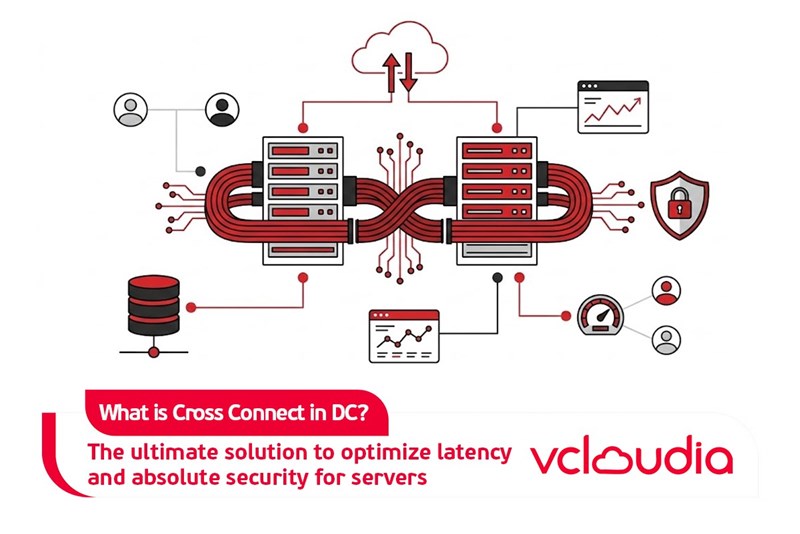
What is Cross Connect in a Data Center?
A Cross Connect in a Data Center is a method of providing direct physical connections between customer equipment and various network providers.
You can think of a Cross Connect like a "focal hub". Here, customers can access interconnected networks from multiple different service providers. The special feature of the Cross Connect environment in a Data Center is that it allows data exchange to take place completely privately and directly, without going through the public network.
Distinguishing Cross Connect and Interconnect
Although both Cross Connect and Interconnect serve the purpose of connecting network systems, their structures and operational methods are entirely different.
- Cross Connect: This is a tangible connection between two networks, usually implemented via a cable. Through this cable, networks can directly exchange traffic with each other. A Cross Connect is typically used to: connect two private networks or connect a private network to a public network.
- Interconnect: Conversely, Interconnect connects networks virtually, utilizing virtual circuits or Software-Defined Networking (SDN) technology. Interconnect is most commonly used to: connect public networks together or connect a private network to a Cloud Network.
The benefits of using a Cross Connect in a Data Center
There are many reasons why deploying a Cross connect in a data center brings a significant competitive advantage to server colocation customers. Not only does it help businesses escape the worry of network congestion, but this solution is also a much more cost-effective alternative compared to traditional telecommunications networks.
1. Minimizing latency
In the digital era, speed is everything. The time it takes for data to travel from one point to another can severely impact business performance.
The issue is that regular Internet connections, even fiber optics, are still affected by physical distance and cable management factors, leading to unwanted latency.
Therefore, Cross Connect was born to solve that problem. By establishing a direct connection within the same Data Center environment, the travel distance of data is minimized to just a few meters of cable. This helps accelerate transmission speeds, improves traffic management capabilities, and delivers a significantly smoother, more consistent experience compared to Internet-based connections.
2. Enhancing security
Cross Connect is a solid shield for sensitive data and a crucial part of a disaster recovery strategy.
- Absolute privacy: Data never "steps" outside the public Internet network. This completely eliminates the risk of being stolen, eavesdropped on, or subjected to Cyberattacks during transmission.
- Safety for Hybrid/Multi-Cloud: When connecting a private server to Cloud providers through a Cross Connect, the attack surface is significantly narrowed. Your data remains safe behind the protective layer of the private network until you personally grant access.
3. High reliability and availability
For businesses operating 24/7/365, downtime of even a few seconds can cause massive financial losses.
The public Internet network has too many risk variables beyond control. In contrast, a Cross connect in a data center eliminates these variables by creating a straight, simple, and solid path.
Furthermore, by connecting directly to Cloud service providers or partners, you eliminate intermediate complications, ensuring the system always operates stably at peak performance exactly as committed by the SLA.
Practical applications of Cross Connect in a Data Center
Not just stopping at connecting Internet service providers or cloud networks, Cross Connect in a Data Center is becoming a secret weapon for industries with the most demanding requirements for processing speed and data security. Below are the 3 sectors that benefit the most from this solution.
1. Financial services
In the financial market, time is literally money. A millisecond of latency can also make a huge difference between a profitable trade and a missed opportunity.
Therefore, financial institutions use Cross Connect to establish direct transmission lines from their systems to market data sources and trading gateways right inside the Data Center.
This solution ensures pricing data and trading orders are updated in real-time as fast as possible. Consequently, high-frequency trading algorithms can operate precisely and yield optimal investment returns.
2. Manufacturing and Supply Chain
For modern manufacturing, optimizing connection latency equates to a smoother operating supply chain. Businesses in this field use Cross Connect to create a closed and secure connected ecosystem.
Specifically, they connect their servers directly to the infrastructure of key partners in the supply chain such as: maintenance units, Enterprise Resource Planning (ERP) solution providers, and logistics partners.
The instant exchange of production and inventory data helps managers make quick decisions. This contributes to significantly minimizing downtime in the operational line and enhancing overall system productivity.
3. Healthcare and Medical
Medical data is an extremely sensitive type of asset and demands the highest level of security. Additionally, medical imaging data files like MRI and CT Scanners usually have very large capacities, requiring broad bandwidth for transmission.
Modern healthcare systems utilize Cross Connect to securely link between laboratories, imaging diagnostic centers, and hospitals. Patients' medical records are thereby transmitted within a private network, staying entirely clear of information leakage risks on the public Internet.
More importantly, high transmission speeds enable doctors to access imaging data immediately. In emergency situations, the stability and swiftness of this connection directly contribute to improving treatment outcomes and saving patients' lives.
How does Cross Connect optimize connectivity capabilities?
In the digital infrastructure era, multidimensional connectivity capability is the key for businesses to scale and elevate their competitive position. Cross connect in a data center is the exact technical tool that helps actualize this through two core mechanisms: Neutrality and Centralized physical infrastructure.
1. Leveraging the power of a neutral data center
Modern data centers like Viettel IDC often operate on a "carrier-neutral" model. Here, Cross Connect acts as an open communication gateway, allowing businesses to freely choose and connect directly with any Internet Service Provider (ISP) without being limited by monopolistic barriers.
Instead of being "locked-in" to a single carrier, businesses can flexibly establish Cross Connect lines to multiple different partners. This not only helps optimize operational costs but also creates a multi-layered redundancy mechanism, ensuring the network system always operates continuously even if one provider encounters an incident.
2. Inter-regional connection architecture and Meet-Me-Room (MMR)
To meet massive data exchange needs, Cross Connect systems are often centrally planned in a specialized interconnection area called a Meet-Me-Room (MMR). This is considered the physical "heart" of the Data Center, where the Points of Presence (PoP) of numerous carriers and major tech partners converge.
Through this MMR infrastructure, Cross Connect allows for establishing private connection circuits between different data centers or directly connecting businesses with Cloud Providers platforms.
As a result, businesses possess a network system with high availability, absolute security, and the ability to scale instantly according to development needs, creating momentum for a strong breakthrough in the digital business environment.
Conclusion
In summary, a Cross Connect in a Data Center is not merely a physical cable, but a strategic solution that helps businesses optimize performance, secure data, and ensure absolute stability for the network system. To fully exploit this connectivity power, choosing an international standard data center infrastructure is a prerequisite.
Vcloudia Cloud Server – The Cloud You Can Count On
If you're concerned about the potential limitations of Cloud Servers, Cloud Server by Vcloudia is a reliable solution for businesses of all sizes. With a modern infrastructure and comprehensive customer support, Vcloudia delivers a cloud experience with:
- Powerful connectivity to ensure stable 24/7 access
- Advanced security standards, compliant with international certifications such as ISO 27001:2013, ISO 20000:2018, ISO 9001:2015
- Flexible pricing packages tailored to your specific business needs
- Expert technical support, making migration and system deployment fast, safe, and compatible
Contact information:
- Hotline: +855 888 55 66 08 (free of charge)
- Fanpage: https://www.facebook.com/vcloudia/
- Website: https://vcloudia.com
Featured news
Related news
What is a Snapshot? The Difference Between Snapshot and Backup
Snapshot is a familiar concept in data management and protection. In the context of the information technology boom, where data is a major asset for businesses, understanding Snapshots as well as their application is a key factor for enterprises to maximize technological efficiency.
What is a Firewall? The Role and Importance of Firewalls for Users
In the context of ever-increasing cyberattacks, system security has become a top priority for many enterprises. Alongside deploying antivirus software and controlling connection ports, firewalls are also considered a key solution to effectively enhance cybersecurity.
What is DDoS? Signs, Mitigation Strategies, and Effective Prevention
DDoS is a highly dangerous cyberattack that leaves severe consequences for enterprises. Therefore, gaining a clear understanding of DDoS attacks, as well as how to detect and prevent them, is a topic of significant interest to many.
What is a Trojan? How to Detect, Avoid, and Prevent It
A Trojan is a type of malicious code or software that can cause severe consequences to computer operations. So, what is a Trojan? How can you prevent a Trojan from infiltrating your computer? In the following article, Vcloudia will provide detailed information on these issues.
What is Cloud Backup? Classification, benefits, and limitations
Cloud Backup is a solution that plays an important role in backing up and recovering data when an incident occurs. So what exactly is Cloud Backup? Let's find out the details with Vcloudia in the following article.
What is Cloud Storage? Features and Benefits of Using It
Cloud Storage is the perfect storage solution alternative to bulky, space-consuming physical hard drives. So, what is Cloud Storage? Let's explore the details with Vcloudia through the following article.
What is an API? Characteristics and applications in website design
API, short for Application Programming Interface, is a concept no longer unfamiliar in the information technology field. So what exactly is an API and why is it so important? Let's find out with Vcloudia.
What is Node.js? Instructions on how to install Node.js on cPanel
Currently, it is easy to see that Node.js is being used by quite a lot of people. This is because Node.js can support users in running on multiple platforms and multiple devices.
What is Vultr VPS? Should you use Vultr VPS?
Vultr VPS is one of the best cloud storage solutions in the world. In this article, you will learn the concept: "What is Vultr VPS?", as well as understand its advantages and disadvantages.
Zoom Cloud Meeting: What is it? Basic Things You Should Know About Zoom Cloud Meeting
In 2020, Zoom Cloud Meeting became one of the leading video conferencing software applications. It allows you to virtually interact with colleagues when in-person meetings aren't possible, and it has also been very successful for social events.