



.png)


















.png)





What is Container as a Service (CaaS)? Advantages of CaaS?
Aug 21, 2026Container technology has become a vital solution for ensuring software runs consistently and reliably when moved between different computing environments. With the rise of "as-a-Service" delivery models in the tech industry, Container as a Service (CaaS) has emerged, offering numerous benefits to businesses in terms of operational efficiency and cost savings. So, what exactly is Container as a Service? How does CaaS function? In this article, Vcloudia will provide detailed insights into Container as a Service.
Container technology is an advanced virtualization method that packages an application and its dependencies into a specialized, isolated environment called a container. This containerization ensures that a single version of an application or software can operate across various computing environments, maintaining consistency and reliability when software is transferred between them.
What is Container as a Service?
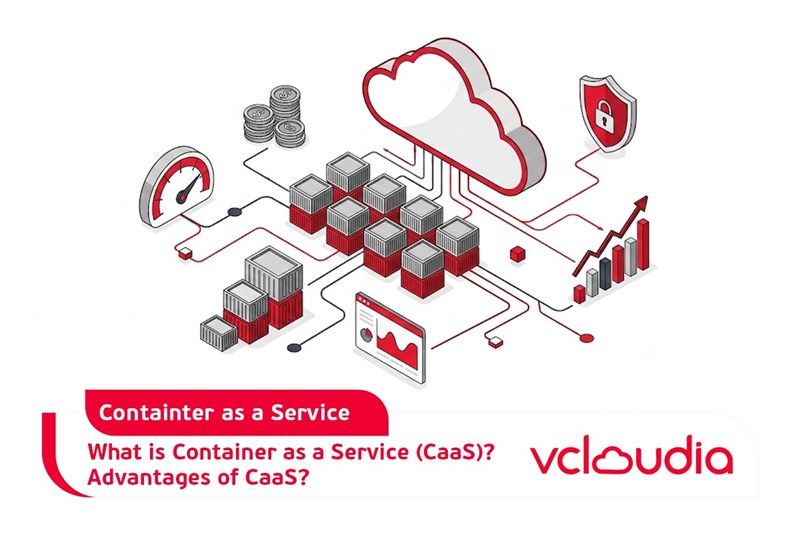
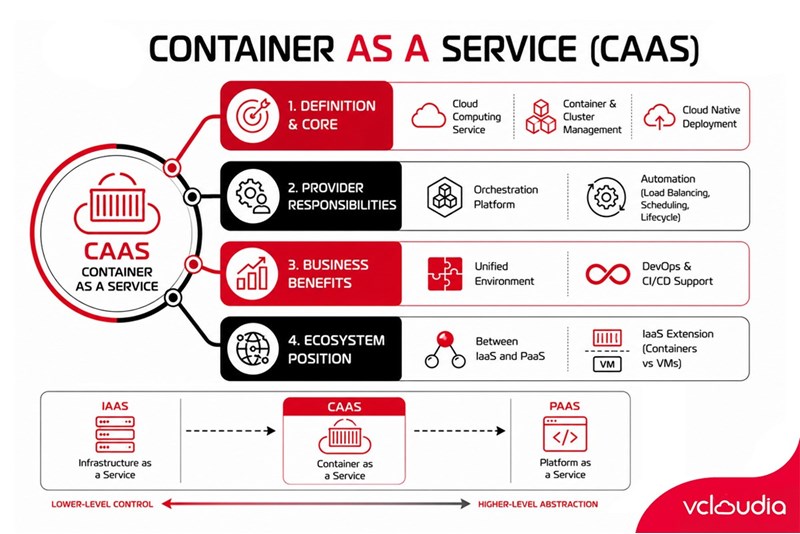
Container-as-a-Service (CaaS) is a cloud computing offering that enables customers to manage and deploy applications using container technology. With CaaS, users can easily upload, organize, launch, and scale applications by leveraging containers, clusters, and tools such as APIs or web portal interfaces. This provides a stable and flexible operational environment, facilitating the rapid development of Cloud Native applications that can run across multiple environments, from on-premises systems to cloud services.
In the CaaS model, the service provider is responsible for delivering the container orchestration platform. This platform is where containers are deployed and managed, and it also automates critical IT functions like load balancing, scheduling, and container lifecycle management. This not only reduces the workload for enterprise technology teams but also boosts operational efficiency.
Moreover, CaaS creates a unified operational environment, ensuring applications deploy and run smoothly across all platforms. This is a crucial factor in supporting businesses to adopt modern development strategies such as DevOps and CI/CD, thereby accelerating product development speed and market competitiveness.
Within the cloud ecosystem, CaaS is positioned between Infrastructure as a Service (IaaS) and Platform as a Service (PaaS). However, CaaS is often seen as an extension of IaaS, with the key distinction being its use of containers as the core resource instead of virtual machines or bare-metal systems, which are typical of traditional IaaS environments.
Features of Container as a Service (CaaS)
CaaS offers many remarkable features that help businesses enhance the operational efficiency of their IT infrastructure. The specific features are as follows:
Containerization
Containerization is a fundamental feature of CaaS. Operating a large number of containers typically involves a complex process. CaaS allows businesses to automate the containerization process, leveraging the flexibility and portability of containers.
Container Orchestration
The CaaS system facilitates the automated deployment, load balancing, scheduling, scaling, and lifecycle management of containers across the entire IT ecosystem.
Networking Connectivity
Providers use network overlays and Software-Defined Networking (SDN) to optimize connectivity, ensuring efficient communication among containers.
Platform Configuration
CaaS is designed to enable users to interact easily with the container platform through customizable Application Programming Interfaces (APIs) or web interfaces. Users can define resource requirements, network configurations, and environment variables to optimize container performance.
Security and Access Control
CaaS provides tools such as Role-Based Access Control (RBAC), container isolation, container image scanning, and network policies. These features help monitor and control traffic between containers in real-time, ensuring data security within the containers.
Integration with Other Services
With CaaS, businesses can integrate with CI/CD, DevOps, databases, or caching systems to accelerate development speed and improve the products packaged within containers.
Benefits of CaaS for Enterprises
Container-as-a-Service (CaaS) offers numerous significant benefits, allowing enterprises to concentrate on building and deploying applications without concerns about the underlying infrastructure or storage needs.
Flexible Scalability
CaaS services enable businesses to flexibly add or remove containers on demand, helping to optimize resources as workloads fluctuate. Today, CaaS platforms typically include autoscaling features, allowing enterprises to automatically adjust container scaling.
Effective Portability
The portability of CaaS services is demonstrated by the automation of the containerization process and support for seamless application migration across on-premises and cloud environments, eliminating the need for servers. This helps enterprises easily transition applications between traditional on-premises environments and the cloud, aligning with today's cloud migration trend. Additionally, CaaS services allow businesses to build applications once and deploy them across multiple environments without rewriting code, ensuring stable operation across various operating systems and hardware.
High Speed and Performance
In CaaS, containers are lighter and demand fewer computing resources compared to traditional virtual machines or software running directly on hardware. Consequently, containers take only a few seconds to create, start, and replicate applications, which helps to accelerate the application development process.
Troubleshooting Capabilities
CaaS services ensure that containerized applications operate consistently across diverse environments, significantly reducing compatibility issues and simplifying troubleshooting. Each container functions independently and in isolation; thus, an issue in one container does not affect others, ensuring applications run in the most stable and secure manner.
Integration Capabilities in DevOps Environments
With CaaS, development and operations teams can work simultaneously, yet independently, on different components of an application. For instance, if a developer needs to resolve an issue on a new e-commerce platform, the development team can manage the container content, while the operations team focuses on troubleshooting the orchestration system. This accelerates development speed and testing cycles.
Cost Optimization
CaaS services are typically offered through flexible pricing models based on usage demand, helping to optimize operational costs. Furthermore, businesses do not need to invest in infrastructure systems, leading to significant savings on initial investment costs.
Is CaaS Similar to or Different from Kubernetes?
Fundamentally, Kubernetes is a container platform, while CaaS is a service that provisions and manages containers. Kubernetes and CaaS are interconnected. Specifically, Kubernetes is one of the core platforms used for deploying and managing CaaS.
Below is a comparison table highlighting the differences between CaaS and Kubernetes:
Applications of Container as a Service (CaaS)
According to reports, the global CaaS market was valued at nearly $2 billion in 2022 and is projected to surpass $7 billion by 2027, with a Compound Annual Growth Rate (CAGR) of 30.2%. This growth indicates that CaaS is playing an increasingly vital role in driving technological innovation and modern application development.
Supporting the Building of Microservices Architecture
CaaS services can be applied to support the building of Microservices Architecture by packaging microservices for easy deployment across various platforms. Accordingly, microservices architecture breaks down large applications into smaller, independent services, enhancing flexibility and development speed. For example, e-commerce companies like Amazon have leveraged microservices to improve scalability and optimize website performance, thereby delivering a better shopping experience for users.
Supporting DevOps
CaaS creates a consistent environment for development and operations teams to work in parallel throughout the application development lifecycle. This not only improves coordination among DevOps teams but also helps minimize deployment time and elevate the quality of the final product.
Application Modernization
CaaS enables enterprises to package legacy applications into containers and migrate them to the cloud without rewriting code from scratch, saving time and costs. Currently, many banks have transitioned their legacy financial transaction systems to cloud environments via CaaS to improve performance and optimize costs.
Conclusion
Container as a Service, with its outstanding features and advantages, is being widely adopted in Cambodia. A clear understanding of CaaS helps businesses select appropriate container services, assisting in application building, resource utilization, and the creation of effective customer experiences. Especially in the context of the strong ongoing cloud migration, adopting cloud solutions like CaaS is inevitable to keep pace with modern developments.
Vcloudia Cloud Server – The Cloud You Can Count On
If you're concerned about the potential limitations of Cloud Servers, Cloud Server by Vcloudia is a reliable solution for businesses of all sizes. With a modern infrastructure and comprehensive customer support, Vcloudia delivers a cloud experience with:
- Powerful connectivity to ensure stable 24/7 access
- Advanced security standards, compliant with international certifications such as ISO 27001:2013, ISO 20000:2018, ISO 9001:2015
- Flexible pricing packages tailored to your specific business needs
- Expert technical support, making migration and system deployment fast, safe, and compatible
Contact information:
- Hotline: +855 888 55 66 08 (free of charge)
- Fanpage: https://www.facebook.com/vcloudia/
- Website: https://vcloudia.com
Featured news
Related news
What is a Snapshot? The Difference Between Snapshot and Backup
Snapshot is a familiar concept in data management and protection. In the context of the information technology boom, where data is a major asset for businesses, understanding Snapshots as well as their application is a key factor for enterprises to maximize technological efficiency.
What is a Firewall? The Role and Importance of Firewalls for Users
In the context of ever-increasing cyberattacks, system security has become a top priority for many enterprises. Alongside deploying antivirus software and controlling connection ports, firewalls are also considered a key solution to effectively enhance cybersecurity.
What is DDoS? Signs, Mitigation Strategies, and Effective Prevention
DDoS is a highly dangerous cyberattack that leaves severe consequences for enterprises. Therefore, gaining a clear understanding of DDoS attacks, as well as how to detect and prevent them, is a topic of significant interest to many.
What is a Trojan? How to Detect, Avoid, and Prevent It
A Trojan is a type of malicious code or software that can cause severe consequences to computer operations. So, what is a Trojan? How can you prevent a Trojan from infiltrating your computer? In the following article, Vcloudia will provide detailed information on these issues.
What is Cloud Backup? Classification, benefits, and limitations
Cloud Backup is a solution that plays an important role in backing up and recovering data when an incident occurs. So what exactly is Cloud Backup? Let's find out the details with Vcloudia in the following article.
What is Cloud Storage? Features and Benefits of Using It
Cloud Storage is the perfect storage solution alternative to bulky, space-consuming physical hard drives. So, what is Cloud Storage? Let's explore the details with Vcloudia through the following article.
What is an API? Characteristics and applications in website design
API, short for Application Programming Interface, is a concept no longer unfamiliar in the information technology field. So what exactly is an API and why is it so important? Let's find out with Vcloudia.
What is Node.js? Instructions on how to install Node.js on cPanel
Currently, it is easy to see that Node.js is being used by quite a lot of people. This is because Node.js can support users in running on multiple platforms and multiple devices.
What is Vultr VPS? Should you use Vultr VPS?
Vultr VPS is one of the best cloud storage solutions in the world. In this article, you will learn the concept: "What is Vultr VPS?", as well as understand its advantages and disadvantages.
Zoom Cloud Meeting: What is it? Basic Things You Should Know About Zoom Cloud Meeting
In 2020, Zoom Cloud Meeting became one of the leading video conferencing software applications. It allows you to virtually interact with colleagues when in-person meetings aren't possible, and it has also been very successful for social events.