



.png)



















.png)





What is Cloud Sprawl? Causes, Risks, and How to Control It
Jun 30, 2026In the process of digital transformation, cloud helps enterprises deploy infrastructure rapidly and scale more easily than traditional models. However, when the number of virtual machines or cloud services increases without a clear management strategy, the system can easily fall into a state of chaos. This is precisely the Cloud Sprawl phenomenon, a problem that many enterprises are facing but have not fully recognized.
So what is Cloud Sprawl, why does it occur, and how can it be controlled effectively? Let's join Vcloudia to explore in detail!
What is Cloud Sprawl?
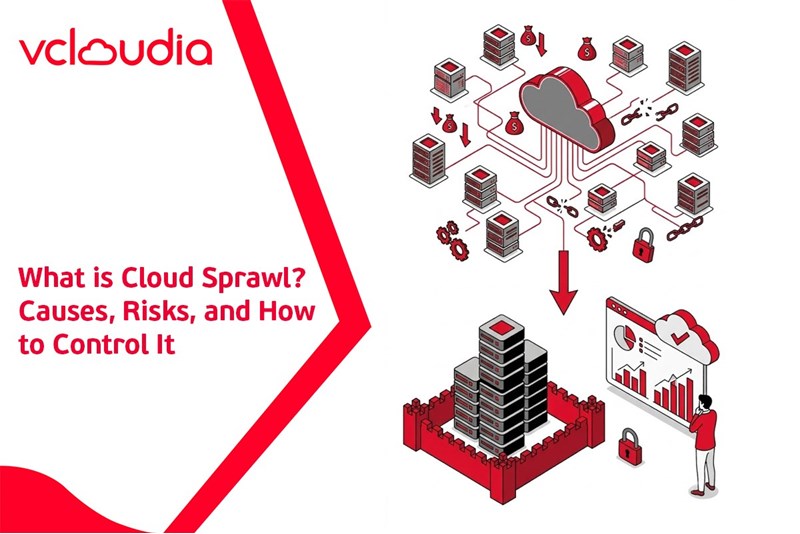
Cloud Sprawl is a state in which resources in a cloud environment are created excessively, scattered, and lacking control, leading to management difficulties, resource wastage, and increased operational costs. These resources can include virtual machines, storage, databases, containers, load balancers, or other cloud services deployed by multiple teams within an organization without centralized supervision.
Cloud Sprawl does not happen overnight but typically accumulates over time. Initially, development teams create resources to serve testing, staging, or deploying new features. After completion, many resources are not deleted or reused but continue to exist in the system. When this is repeated multiple times, the number of resources increases rapidly and becomes a chaotic mess that is difficult to control.
The problem lies not only in the number of resources, but also in the lack of transparency. Enterprises may not know exactly how many resources are active, who created them, and what purpose they serve. This is precisely what makes Cloud Sprawl a major risk in modern infrastructure management.
Causes of Cloud Sprawl
Cloud Sprawl is not the fault of any single individual or department, but rather the consequence of many factors combined during the operation of a cloud system. One of the main causes is the ease of resource creation. In a cloud environment, initiating a virtual machine or database takes only a few clicks or a piece of script. This helps speed up development, but it also causes resources to be created without much thought about their lifecycle or long-term costs.
In addition, many organizations lack clear resource management processes. When there are no regulations on who is allowed to create resources, under what circumstances, and when they must be deleted, teams will freely deploy them based on their own needs. This leads to scattered resources, a lack of common standards, and difficulty in control.
The DevOps model also contributes to the increase in Cloud Sprawl if it is not accompanied by appropriate governance. DevOps encourages automation and rapid deployment, but without control mechanisms, pipelines can create many temporary resources that are not cleaned up after completion.
How Does Cloud Sprawl Affect the System?
Cloud Sprawl is not just a management issue but also directly impacts the performance, security, and costs of the system. First of all, cloud cost is the most easily recognizable factor. When many unused resources are still active, enterprises have to pay for resources that bring no value. These expenses may be small for each individual resource, but when accumulated, they become a significant figure over time.
Operationally, Cloud Sprawl makes the system harder to manage. When the number of resources is too large and lacks a clear structure, searching for, updating, or troubleshooting issues becomes complex. The operations team will spend a lot of time identifying which resource is related to which system, thereby slowing down the troubleshooting process.
Furthermore, Cloud Sprawl also affects overall performance. When resources are not optimized, the system may utilize them inefficiently, leading to over-provisioning or under-provisioning at different times. This reduces the system's responsiveness and affects the user experience.
Signs of Cloud Sprawl
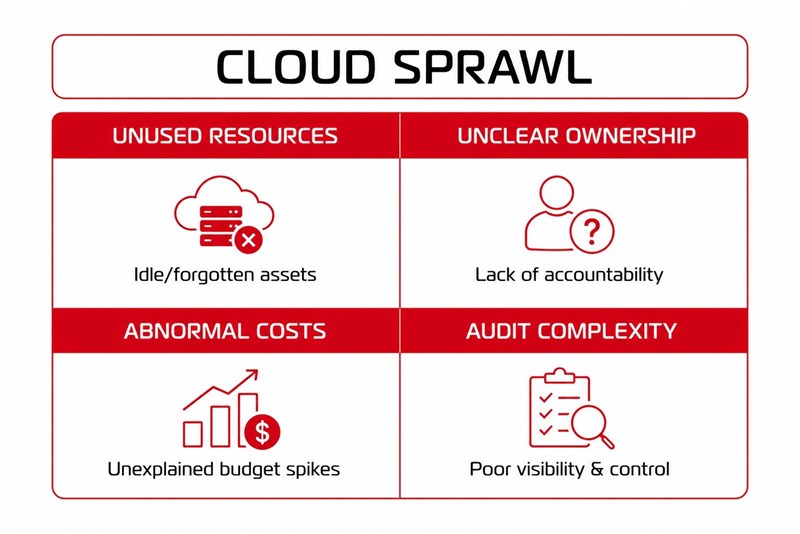
Unused Resources Still Exist
One of the clearest signs of Cloud Sprawl is the existence of resources that no longer serve a specific purpose but are still active. These resources may be created for testing or experimentation purposes, but are not deleted afterward. They still consume costs and resources without bringing practical value.
Unclear Resource Ownership
As the system grows without a clear management mechanism, a point will come when no one knows exactly who is responsible for a specific resource. This causes difficulties in maintenance, updates, or troubleshooting, as there is no clear point of contact for coordination.
Abnormal Cost Increase
Cloud Sprawl is often discovered when cloud costs spike suddenly without a clear reason. This is a sign that many resources are running out of control. Without a detailed monitoring system, identifying the cause will be very difficult.
Difficulty in Controlling and Auditing the System
When the number of resources is too large and not properly organized, auditing the system becomes complicated. Enterprises may face difficulties in determining which resources are being used, which resources can be eliminated, and which resources need to be secured.
How to Control Cloud Sprawl
Establishing Resource Management Policies
To mitigate Cloud Sprawl, enterprises need to start by building a clear system of regulations on how resources are created, used, and retired at the end of their lifecycle. Each resource in the cloud environment should not exist indefinitely, but needs to be tied to a specific purpose and have a designated time for reassessment or removal.
Establishing governance from the very beginning helps ensure that all resources are controlled according to a common standard, rather than relying on the individual working methods of each team. For example, it can be clearly regulated which resources are allowed to be created in the production environment, which resources are only used for testing and must be automatically deleted after a certain period of time.
Utilizing Resource Tagging
Tagging is one of the most important methods to control resources in a cloud environment, especially as the number of resources grows. Tagging each resource helps enterprises clearly understand who owns the resource, what purpose it serves, and which environment it operates in.
Instead of looking at a long, unstructured list of virtual machines or services, tagging allows for clear classification by project, department, environment, or priority level. This not only supports management but also assists in rapid tracing when incidents occur.
Monitoring and Optimizing Costs
One of the most effective ways to detect Cloud Sprawl is to monitor cloud costs continuously and systematically. When redundant or unused resources are created, costs will typically increase without being accompanied by actual value. Establishing a real-time cost monitoring system helps enterprises quickly recognize abnormal signs. Instead of waiting until the end of the month to receive the invoice, the operations team can detect and handle issues as soon as there are signs of unexpected cost generation.
Management Automation
In modern cloud environments, manual management is no longer appropriate when the number of resources grows rapidly. Automation becomes the key factor to control Cloud Sprawl effectively and sustainably.
Through tools or scripts, enterprises can set up automated processes such as deleting unused resources after a period of time, shutting down virtual machines outside of working hours, or periodically checking system status. If done manually, these tasks would consume a lot of time and are easy to miss, but automation ensures consistency and accuracy.
Access Control Permissions
Controlling access permissions is one of the important measures to prevent Cloud Sprawl right from the root. When everyone has the permission to create resources, the risk of generating unnecessary resources increases significantly.
Applying the principle of appropriate delegation of authority helps limit the permission to create, edit, or delete resources only to those who truly need it. Each team or individual will have their own access scope, matching their role in the system. This approach not only helps control the number of resources but also enhances security, reducing the risk of unintended configuration changes. When combined with periodic inspection and audit mechanisms, enterprises can maintain a clean, transparent, and more manageable cloud environment.
When Does Cloud Sprawl Need to Be Solved?
Cloud Sprawl is not always easy to recognize from the beginning, but when the system starts to show abnormal signs, that is the moment enterprises need to take action. One of the clearest signals is when cloud costs increase rapidly without corresponding to the growth of the system or users. This indicates that many redundant or unused resources may exist that do not serve a specific purpose but still consume budget.
In addition to the cost factor, the system becoming difficult to manage is also an important sign. When the operations team cannot clearly determine which resource belongs to which project, who is responsible, or how that resource is being used, Cloud Sprawl has begun to affect control capabilities. This not only slows down the troubleshooting process but also makes infrastructure optimization much more complex.
In reality, many enterprises only start to pay attention to Cloud Sprawl when their systems have grown to a large scale. However, handling it at this stage often takes more time and effort because of the need to review all resources. Therefore, the best time to control Cloud Sprawl is right when the system begins to expand, when the number of resources is still within control. Proactively deploying monitoring tools, establishing management processes, and optimizing resources early will help enterprises avoid losing control in the future.
Conclusion
Cloud Sprawl is a common problem in modern cloud environments. Although it is not a critical error immediately, if left uncontrolled, it can lead to high costs, security risks, and operational difficulties. Clearly understanding Cloud Sprawl, identifying signs early, and applying appropriate control measures will help enterprises optimize resources, reduce costs, and maintain system stability in the long term.
FAQ
1. Is Cloud Sprawl a sign that the system is growing well?
Not necessarily. The rapid growth of resources may reflect that the system is expanding, but without control, it is a sign of Cloud Sprawl. Sustainable growth must be accompanied by clear resource management, otherwise it will lead to wasted costs and operational risks.
2. Why is Cloud Sprawl often difficult to detect in the early stages?
In the early stages, the number of resources is still small, so redundancy does not cause noticeable impacts. However, over time, uncleaned resources will gradually accumulate, causing costs and complexity to increase. Therefore, Cloud Sprawl is usually only recognized when the system has become difficult to control.
3. Is it possible to completely eliminate Cloud Sprawl in a cloud system?
It is almost impossible to completely eliminate, because the cloud environment is constantly changing and new resources are generated continuously. However, enterprises can control it effectively by applying governance, automation, and regular cost monitoring to keep the system in an optimal state.
Vcloudia Cloud Server – The Cloud You Can Count On
If you're concerned about the potential limitations of Cloud Servers, Cloud Server by Vcloudia is a reliable solution for businesses of all sizes. With a modern infrastructure and comprehensive customer support, Vcloudia delivers a cloud experience with:
- Powerful connectivity to ensure stable 24/7 access
- Advanced security standards, compliant with international certifications such as ISO 27001:2013, ISO 20000:2018, ISO 9001:2015
- Flexible pricing packages tailored to your specific business needs
- Expert technical support, making migration and system deployment fast, safe, and compatible
Contact information:
- Hotline: +855 888 55 66 08 (free of charge)
- Fanpage: https://www.facebook.com/vcloudia/
- Website: https://vcloudia.com
Featured news
Related news
What is a Snapshot? The Difference Between Snapshot and Backup
Snapshot is a familiar concept in data management and protection. In the context of the information technology boom, where data is a major asset for businesses, understanding Snapshots as well as their application is a key factor for enterprises to maximize technological efficiency.
What is a Firewall? The Role and Importance of Firewalls for Users
In the context of ever-increasing cyberattacks, system security has become a top priority for many enterprises. Alongside deploying antivirus software and controlling connection ports, firewalls are also considered a key solution to effectively enhance cybersecurity.
What is DDoS? Signs, Mitigation Strategies, and Effective Prevention
DDoS is a highly dangerous cyberattack that leaves severe consequences for enterprises. Therefore, gaining a clear understanding of DDoS attacks, as well as how to detect and prevent them, is a topic of significant interest to many.
What is a Trojan? How to Detect, Avoid, and Prevent It
A Trojan is a type of malicious code or software that can cause severe consequences to computer operations. So, what is a Trojan? How can you prevent a Trojan from infiltrating your computer? In the following article, Vcloudia will provide detailed information on these issues.
What is Cloud Backup? Classification, benefits, and limitations
Cloud Backup is a solution that plays an important role in backing up and recovering data when an incident occurs. So what exactly is Cloud Backup? Let's find out the details with Vcloudia in the following article.
What is Cloud Storage? Features and Benefits of Using It
Cloud Storage is the perfect storage solution alternative to bulky, space-consuming physical hard drives. So, what is Cloud Storage? Let's explore the details with Vcloudia through the following article.
What is an API? Characteristics and applications in website design
API, short for Application Programming Interface, is a concept no longer unfamiliar in the information technology field. So what exactly is an API and why is it so important? Let's find out with Vcloudia.
What is Node.js? Instructions on how to install Node.js on cPanel
Currently, it is easy to see that Node.js is being used by quite a lot of people. This is because Node.js can support users in running on multiple platforms and multiple devices.
What is Vultr VPS? Should you use Vultr VPS?
Vultr VPS is one of the best cloud storage solutions in the world. In this article, you will learn the concept: "What is Vultr VPS?", as well as understand its advantages and disadvantages.
Zoom Cloud Meeting: What is it? Basic Things You Should Know About Zoom Cloud Meeting
In 2020, Zoom Cloud Meeting became one of the leading video conferencing software applications. It allows you to virtually interact with colleagues when in-person meetings aren't possible, and it has also been very successful for social events.