



.png)



















.png)





What is Cloud Hosting? Where to Buy Good Cloud Hosting?
Aug 24, 2026In today's rapidly developing digital technology landscape, data storage has become more critical than ever. As a result, Cloud Hosting has quickly emerged as an efficient, convenient, and secure storage option for both businesses and individuals. In the following article, Vcloudia will provide a clearer understanding of Cloud Hosting's concept, along with its advantages and disadvantages.
What is Cloud Hosting?
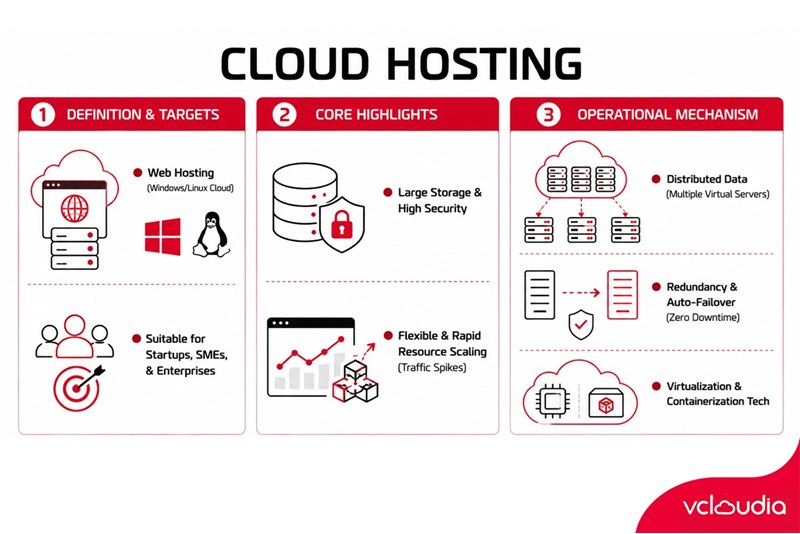
Cloud Hosting refers to a website hosting service that operates on Windows or Linux servers through a cloud computing platform. Beyond its capacity for storing large amounts of information, Cloud Hosting also helps improve website security.
A key feature of Cloud Hosting is its ability to quickly and flexibly fulfill users' resource demands. For instance, if a website experiences a sudden increase in traffic, Cloud Hosting can automatically allocate additional resources to ensure uninterrupted and smooth website operation.
Notably, Cloud Hosting is not only suitable for large enterprises but also highly appropriate for startups and small to medium-sized enterprises (SMEs) due to its flexibility and potential for cost optimization.
How Cloud Hosting Works
Cloud Hosting functions by leveraging cloud technology (Cloud computing) to manage and distribute resources from extensive servers. It combines this with cloud storage to deliver a secure, flexible, and efficient data storage service.
Furthermore, Cloud Hosting operates on the principle of distributed data across Linux and Windows operating systems. Instead of relying on a single physical server, a business's data and applications are stored and managed across multiple virtual servers. These servers can be located in various geographical areas but always work in synchronization to provide a stable and secure storage environment.
A primary benefit of this operational model is its capacity for redundancy and recovery. Should one server experience an issue, other servers within the network will automatically take over, maintaining services without interruption for users. This approach minimizes downtime risks, safeguards your data, and ensures your website or application remains consistently available to users.
Moreover, with the support of modern technologies such as virtualization and containerization, Cloud Hosting can establish independent virtualized environments, simplifying the efficient management and deployment of applications.
Essential Parameters for Cloud Hosting
When selecting a Cloud Hosting service, a clear understanding of technical parameters is vital to ensure you choose a solution that aligns with your needs. Below are some important parameters to consider:
- Disk Space: This represents the storage capacity available for your data, including files, images, videos, databases, and all other website content. Ample disk space allows for storing more data, which is particularly beneficial if you manage a significant amount of multimedia content or information.
- Bandwidth: Bandwidth dictates the volume of data that can be transferred from the server to end-users within a specified timeframe. High bandwidth is crucial for ensuring that a website can handle substantial traffic without experiencing slowdowns or interruptions. Additionally, bandwidth is typically capped monthly, requiring careful consideration and calculation for scaling to prevent encountering 502 errors.
- Parked Domain: These are extra domains that you can add to your hosting account without needing to create a new website for each domain. A Parked Domain is frequently used to protect your brand by ensuring that alternative versions of your primary domain are not used by others.
- Addon Domain: An Addon Domain enables you to host multiple independent websites on the same hosting account. Each Addon Domain can have its own distinct content and structure, yet they all share the primary website's storage resources and bandwidth.
- Subdomain: A Subdomain is an extension of the primary domain, allowing for the creation of different sections of the website with unique functions or content. For example, "blog.viettelidc.com.vn" could be a Subdomain of "viettelidc.com.vn" specifically dedicated to the blog section.
- Email: The number of email accounts an organization can create and manage on its domain will vary based on the service package purchased. Email hosting is a significant component of Cloud Hosting services, especially for businesses requiring professional communication management through domain-specific email addresses.
Advantages and Limitations of Cloud Hosting
Advantages
- Good Uptime & High Availability: Cloud Hosting is renowned for its ability to maintain high uptime, typically at 99.9% or higher. This is achieved by distributing data across multiple virtual servers. If one server experiences an issue, others immediately take over, ensuring your website remains operational and easily accessible from anywhere.
- High Performance: Cloud Hosting frequently employs modern technologies like SSDs and advanced networking systems, which optimize processing and data transmission speeds, guaranteeing the best user experience.
- Rapid Deployment: With Cloud Hosting, deploying a new website or application can be accomplished quickly, sometimes in just a few minutes. This offers businesses greater flexibility in expanding operations or launching new projects without the long waiting periods associated with traditional hosting methods.
- Backup & Disaster Recovery: Cloud Hosting typically includes automated backup solutions and rapid data recovery capabilities. This ensures your data is consistently protected and can be quickly restored in case of an incident, minimizing the risk of data loss and business disruptions.
- Flexible Scalability: One of Cloud Hosting's most significant benefits is its ability to flexibly scale resources. You can easily increase or decrease resources such as CPU, RAM, or storage capacity based on your actual needs without migrating to a new server.
- Cost Savings: Utilizing a pay-as-you-go payment model, Cloud Hosting helps businesses save money by only charging for the resources they actually consume. This is especially advantageous for small and medium-sized enterprises focused on optimizing operational costs.
- Post-incident Recovery Capability: Cloud Hosting is generally equipped with an automated data recovery system, ensuring that websites or applications can be quickly restored after any incident. This provides businesses with peace of mind, guaranteeing that services will not be interrupted while using Cloud Hosting.
These advantages position Cloud Hosting as an ideal choice for many businesses, from small startups to large enterprises, seeking a robust, flexible, and secure storage solution.
Some limitations
- Initial Costs May Be High: While costs are optimized based on usage, the initial setup and management of Cloud Hosting might require a greater investment compared to traditional hosting types.
- Complexity in Management: Managing Cloud Hosting demands a higher level of technical expertise, particularly when handling extensive systems with numerous distributed resources.
- Security and Privacy Concerns: If an organization does not choose a reputable cloud storage service provider, there is a very high risk of cyberattacks and privacy breaches. Especially for businesses new to cloud storage services, a lack of familiarity with the interface, features, and technology may lead to an inability to implement appropriate security measures.
Types of Cloud Hosting
Cloud Hosting is divided into various categories, designed to meet users' specific needs and security requirements. Below are the 4 most common types of Cloud Hosting:
- Private Cloud: A private cloud is a Cloud Hosting system specifically developed for a single organization or individual, enhancing security and privacy. Despite higher costs, a private cloud ensures complete control and absolute data security.
- Public Cloud: A Public Cloud is a cloud service offered publicly over the internet and accessible to any individual or organization. The security of a Public Cloud differs significantly from a Private Cloud because services such as applications, storage, and resources are publicly provided. When users utilize Public Cloud services, they must establish a dedicated connection provided by the cloud service provider to ensure data storage safety.
- Hybrid Cloud: A hybrid cloud combines public and private clouds, allowing businesses to leverage the benefits of both storage models. You can store sensitive data on a private cloud while using a public cloud for less critical tasks to optimize costs and resources.
- Community Cloud: Community Cloud is a form of Cloud Hosting shared among multiple organizations with similar objectives or requirements. This model allows organizations to share infrastructure and maintenance costs while still maintaining privacy and security.
Additionally, there are a few lesser-known types of Cloud Hosting:
- Multi-Cloud: Multi-cloud is a solution that uses several different cloud services from various providers to maximize the benefits of each service. This helps improve redundancy capabilities and flexibility in resource management.
- Distributed Cloud: Distributed Cloud is an expanded version of Cloud Hosting where cloud resources are spread across different geographic locations but are still centrally managed. This helps optimize performance, reduce latency, and meet local regulatory requirements.
- Big Data Cloud: Big Data Cloud is specifically designed for processing and storing massive volumes of data, commonly used in big data analytics applications. This cloud type offers robust computing power and vast storage capacity, making it suitable for businesses that need to analyze complex data.
- HPC Cloud (High-Performance Computing Cloud): HPC Cloud is a type of Cloud Hosting optimized for applications requiring significant computational power, such as scientific simulations, 3D graphics rendering, or complex research computations. HPC Cloud provides powerful computing resources, helping to accelerate data processing workflows.
When Should You Use Cloud Hosting Services?
Cloud Hosting is an incredibly flexible storage solution, ideal for companies and individuals demanding high performance, substantial bandwidth, and continuous 24/7 operation. Moreover, Cloud Hosting is an excellent choice for organizations that need to rapidly scale servers without encountering any interruptions. Additionally, Cloud Hosting is highly suitable for bloggers with high-traffic websites to ensure stable performance for their users.
Conclusion
Cloud Hosting offers a flexible and powerful cloud storage solution, providing numerous benefits to businesses such as rapid scalability, high reliability, cost optimization, and data security. Depending on specific business needs, types of Cloud Hosting including public, private, hybrid, and multi-cloud can address various requirements regarding performance, security, and management.
Looking for a high-performance, secure solution?
Explore the services offered by Vcloudia – a leading provider of Cloud Computing and Data Center solutions. Contact us for expert consultation and find the right model for your needs:
- Hotline: +855 888 55 66 08 (free of charge)
- Fanpage: https://www.facebook.com/vcloudia/
- Website: https://vcloudia.com
Featured news
Related news
What is a Snapshot? The Difference Between Snapshot and Backup
Snapshot is a familiar concept in data management and protection. In the context of the information technology boom, where data is a major asset for businesses, understanding Snapshots as well as their application is a key factor for enterprises to maximize technological efficiency.
What is a Firewall? The Role and Importance of Firewalls for Users
In the context of ever-increasing cyberattacks, system security has become a top priority for many enterprises. Alongside deploying antivirus software and controlling connection ports, firewalls are also considered a key solution to effectively enhance cybersecurity.
What is DDoS? Signs, Mitigation Strategies, and Effective Prevention
DDoS is a highly dangerous cyberattack that leaves severe consequences for enterprises. Therefore, gaining a clear understanding of DDoS attacks, as well as how to detect and prevent them, is a topic of significant interest to many.
What is a Trojan? How to Detect, Avoid, and Prevent It
A Trojan is a type of malicious code or software that can cause severe consequences to computer operations. So, what is a Trojan? How can you prevent a Trojan from infiltrating your computer? In the following article, Vcloudia will provide detailed information on these issues.
What is Cloud Backup? Classification, benefits, and limitations
Cloud Backup is a solution that plays an important role in backing up and recovering data when an incident occurs. So what exactly is Cloud Backup? Let's find out the details with Vcloudia in the following article.
What is Cloud Storage? Features and Benefits of Using It
Cloud Storage is the perfect storage solution alternative to bulky, space-consuming physical hard drives. So, what is Cloud Storage? Let's explore the details with Vcloudia through the following article.
What is an API? Characteristics and applications in website design
API, short for Application Programming Interface, is a concept no longer unfamiliar in the information technology field. So what exactly is an API and why is it so important? Let's find out with Vcloudia.
What is Node.js? Instructions on how to install Node.js on cPanel
Currently, it is easy to see that Node.js is being used by quite a lot of people. This is because Node.js can support users in running on multiple platforms and multiple devices.
What is Vultr VPS? Should you use Vultr VPS?
Vultr VPS is one of the best cloud storage solutions in the world. In this article, you will learn the concept: "What is Vultr VPS?", as well as understand its advantages and disadvantages.
Zoom Cloud Meeting: What is it? Basic Things You Should Know About Zoom Cloud Meeting
In 2020, Zoom Cloud Meeting became one of the leading video conferencing software applications. It allows you to virtually interact with colleagues when in-person meetings aren't possible, and it has also been very successful for social events.